“Five hundred years of volcanic frost kept three children so perfectly preserved that you can still see the faint imprint of a sleep-heavy sigh on their lips.”
About Museum of High Altitude Archaeology
The saga began in 1999 when archaeologists Johan Reinhard and Constanza Ceruti scaled the Llullaillaco volcano, the world’s highest active peak, to investigate reports of Incan ruins. At the summit, they unearthed a six-year-old girl, a seven-year-old boy, and a fifteen-year-old girl, known now as the Children of Llullaillaco. These young people were selected for their perfection to participate in the Capacocha, a state-sanctioned ritual of sacrifice that followed a grueling journey from Cusco. Their discovery sent shockwaves through the scientific world, as they were not mummies in the traditional sense, but bodies that had simply never begun to decompose. The museum opened its doors in 2004, utilizing specialized capsules designed by aerospace engineers to maintain the exact atmospheric pressure and temperature of the Andean summit.

Deep in the heart of Salta, a colonial city framed by the jagged silhouettes of the Andes, lies a sanctuary that challenges our modern understanding of time and mortality. The Museum of High Altitude Archaeology, or MAAM, is built around a discovery that felt more like a resurrection than an excavation. Inside its temperature-controlled chambers rest three Inca children who were left as offerings on the summit of the Llullaillaco volcano over five centuries ago. Their preservation is so flawless that they appear to be merely napping, their skin supple and their woven tunics still vibrant with the dyes of the sun and the earth. This institution serves as a bridge between the high-altitude peaks of the Puna and the urban bustle of the plaza, offering a quiet, heavy space for reflection on the spiritual mechanics of an empire long vanished.
Deep in the heart of Salta, a colonial city framed by the jagged silhouettes of the Andes, lies a sanctuary that challenges our modern understanding of time and mortality.

A multidisciplinary team led by Johan Reinhard and Constanza Ceruti climbed to a dizzying 6,739 meters in 1999, battling thin air and freezing gales to reach the summit of Llullaillaco. They uncovered what would become the highest archaeological site on the planet, finding three children buried in small stone chambers beneath the volcanic ash. These children were part of the Capacocha ritual, a sacred Incan ceremony intended to bring balance to the cosmos and secure the favor of the gods. For five hundred years, the extreme cold and lack of moisture at the peak acted as a natural cryogenic freezer, halting the process of decay. When the children were brought down to Salta, the museum was specifically designed to replicate those sub-zero conditions using advanced cryopreservation technology, ensuring that these messengers from the past remain perfectly intact for future generations to study and honor.
Passing through the heavy doors of the museum, you leave the bright, citrus-scented air of Salta behind for a world of soft shadows and velvet silence. The lighting is kept low to protect the fragile textiles, creating an atmosphere that feels less like a gallery and more like a tomb. You feel a sudden, involuntary shiver as you approach the central display, where a single child is shown on a rotating basis. The sight of the 'Lightning Girl' or the 'Maiden' is profoundly moving; you notice the fine hairs on their arms and the intricate braiding of their hair, details that make the five-century gap disappear instantly. A hush usually falls over the visitors, as the sheer humanity of the children commands a respect that transcends simple curiosity. You find yourself walking slower, your footsteps muffled by the carpeted floors, as you absorb the gravity of the ritual items—tiny gold llamas and delicate pottery—that accompanied them on their journey to the sky.
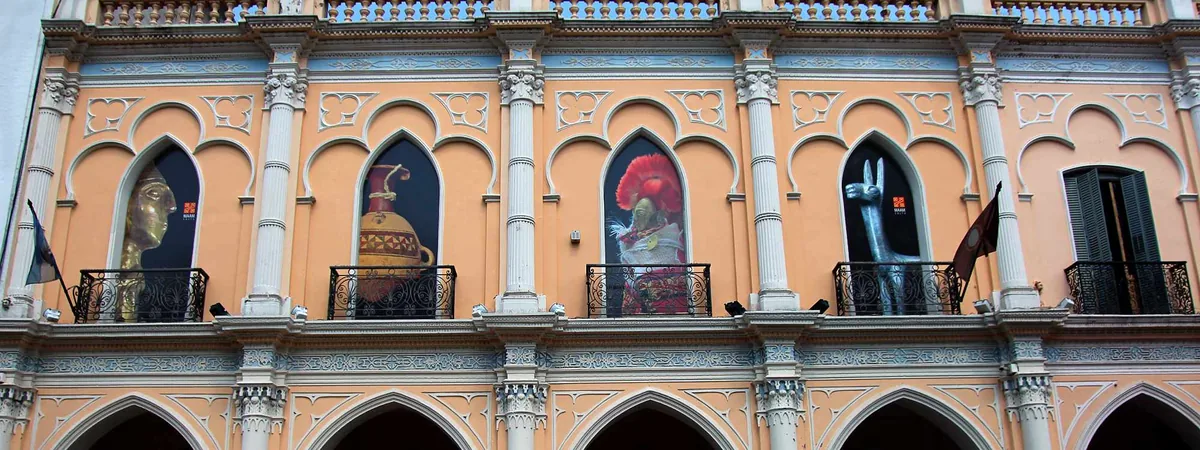
Salta’s main square, the Plaza 9 de Julio, provides the grand setting for the museum, which occupies a restored neo-Gothic building that blends seamlessly with the surrounding colonial architecture. Most travelers reach the city via a flight from Buenos Aires or a long, winding bus journey through the red canyons of the north. Once in the center, the museum is impossible to miss, its entrance marked by elegant ironwork and a steady stream of locals and scholars alike. Tickets are timed to manage the flow of people and maintain the delicate internal environment, so securing a spot in the early morning is wise. After the emotional weight of the exhibits, sitting under the arches of the nearby cafes with a local empanada helps ground you back in the vibrant, living energy of modern-day Salta.
Salta’s main square, the Plaza 9 de Julio, provides the grand setting for the museum, which occupies a restored neo-Gothic building that blends seamlessly with the surrounding colonial architecture.
The Experience
The air inside the MAAM is chilled and still, a deliberate echo of the thin, freezing atmosphere at 22,000 feet. You notice that people rarely speak above a whisper; there is an overwhelming sense that you are in the presence of someone who has just drifted off to sleep. The most jarring moment comes when you spot the small, everyday objects buried with them—a bag of coca leaves or a pair of leather sandals—which humanize the monumental history of the Inca Empire. You feel the weight of the mountain in the darkness of the rooms, a stark contrast to the lively accordions playing in the plaza just outside. It is a haunting, intimate encounter that forces you to confront the visceral reality of ancient faith.
Why It Matters
MAAM is the global epicenter for high-altitude archaeology, housing the best-preserved human remains from the pre-Columbian era. It represents a critical intersection of indigenous heritage and cutting-edge science, where the ethics of displaying ancestors are balanced with the educational value of their story. The museum honors the cultural continuity of the Andean peoples, acknowledging that for many, these children are not specimens, but sacred protectors of the mountain.
Why Visit
Most archaeological museums show you bones and shards, but the MAAM shows you a face. It offers the rarest of travel experiences: a genuine, unmediated encounter with a person from the 15th century. This isn't just about the Inca; it is a profound meditation on the lengths humanity will go to in search of the divine, located in one of Argentina's most beautiful colonial cities.
✦ Insider Tips
- 1
Arrive as soon as the doors open at 11:00 AM to ensure you have a few moments of solitude with the central exhibit before the afternoon crowds.
- 2
Pay close attention to the textile room, as the woven patterns in the children's clothing indicate their specific social status and origin within the vast Inca Empire.
- 3
Check the rotating schedule at the front desk if you have your heart set on seeing a specific child, as only one is displayed at a time to minimize light exposure.
- 4
Spend a moment in the 'Inca Road' section to grasp the sheer physical distance these children traveled on foot from Peru to the Salta volcano.
- 5
Visit the museum shop for high-quality replicas of the ritual ceramics, which are handmade by local artisans using traditional Andean techniques.