“Tens of thousands of years of human footsteps have worn a path through these mountains, where the rock faces are striped with seven colors as vivid as a fresh bruise.”
About Quebrada de Humahuaca
Prehistoric hunters first marked these canyon walls with soot and ochre, creating a high-altitude highway that would later serve as the northernmost reach of the Inca's Royal Road. When the Spanish Conquistadors arrived, they didn't just conquer; they layered their baroque sensibilities over the existing Guaraní and Omaguaca traditions, resulting in the unique 'Mestizo' architecture seen in the valley's parish churches. The 19th century brought the chaos of revolution, with the Quebrada serving as a rugged shield for the fledgling Argentine Republic against royalist forces from the north. Every adobe wall and stone terrace here holds a memory of these successive waves of migration, conflict, and eventual blending, creating a demographic fabric as complex as the mineral stripes on the hills.
What Quebrada de Humahuaca actually is
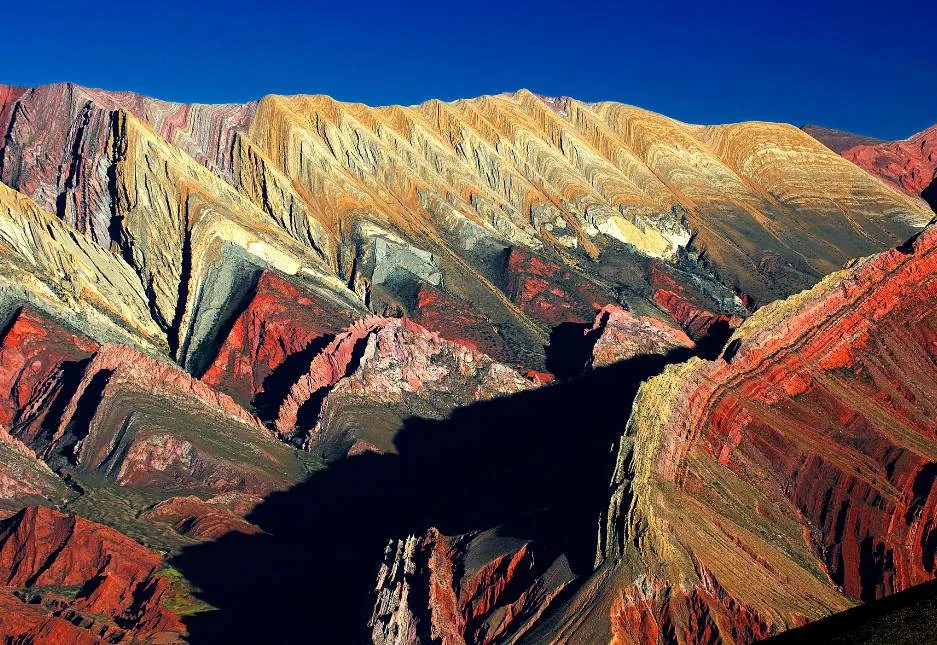
High in the arid northwest of Argentina, the earth seems to have forgotten its usual palette of browns and grays, opting instead for a violent explosion of mineral pigments. The Quebrada de Humahuaca follows the path of the Rio Grande, a narrow valley that climbs toward the high Altiplano through mountains that look like they were painted by a giant with a penchant for ochre, malachite, and deep hematite red. This is more than a geological curiosity; it is a cultural artery that has carried the weight of civilizations for over ten thousand years. The room here is thin, dry, and smells of sun-baked dust and wild sage, while the light has a crystalline sharpness that makes every jagged ridge and adobe brick stand out in high relief. Through the quiet streets of Purmamarca or Tilcara, There is a profound sense of continuity, where the pre-Hispanic past isn't just remembered but actively lived.
High in the arid northwest of Argentina, the earth seems to have forgotten its usual palette of browns and grays, opting instead for a violent explosion of mineral pigments.
Nomadic hunter-gatherers first used this canyon
Nomadic hunter-gatherers first used this canyon as a natural corridor between the high Andean plateaus and the low-lying plains ten millennia ago. By the 15th century, the Inca Empire had integrated the Quebrada into its sprawling Camino Inca, using the valley as a strategic link for trade and troop movements. The arrival of the Spanish in the 1500s added another layer of complexity, as colonial chapels rose alongside indigenous pucarás, or stone fortresses. During the Argentine War of Independence, the Quebrada became a bloody theater of guerrilla warfare, where the locals defended the northern border with a ferocity that eventually helped secure the nation's freedom. In 2003, UNESCO recognized this 155-kilometer stretch not just for its dramatic geology, but as a living cultural landscape where ancient agricultural terraces are still tilled by the descendants of those who built them.
Standing before the Hill of Seven Colors
Standing before the Hill of Seven Colors in the early morning, The silence is broken only by the dry rustle of cactus thorns in the wind. The mineral layers on the mountainside shift from deep indigo to burning orange as the sun clears the horizon, a transformation so vivid it feels optical rather than natural. A grit of the red soil under your boots climbing toward the Pucará de Tilcara, where the view opens up to show the vast, sun-bleached valley floor snaking into the distance. The markets in the town squares are sensory anchors; The earthy tang of dried peppers and the wooly warmth of hand-spun llama ponchos. Most people overlook the tiny, mud-walled chapels in villages like Uquía, where seventeenth-century paintings of angels dressed as Spanish musketeers hang in the dim, cool interiors. San Salvador de Jujuy is the route into the north, with flights arriving from Buenos Aires into an airport surrounded by lush green foothills that give no hint of the desert canyons to come. From the provincial capital, National Route 9 strikes northward, climbing steadily as the vegetation thins and the red rocks begin to dominate the horizon. Local buses, often filled with villagers carrying crates of produce, provide a slow but authentic pulse of the valley's rhythm. The most rewarding way to traverse the Quebrada is by car, allowing for spontaneous detours into the side canyons of Huacalera or up the terrifyingly beautiful switchbacks of the Cuesta de Lipán, which leads to the high-altitude salt flats beyond the valley rim.
The Experience
You feel the altitude in the back of your throat, a dry tingle that makes the scent of burning palo santo in the village squares even more pungent. The light at 3,000 meters is unapologetic, bleaching the valley floor at noon but turning the red cliffs of the Quebrada de las Señoritas into glowing embers by five in the afternoon. What registers is the locals moving with a deliberate, slow grace that matches the pace of the landscape, often chewing coca leaves to stave off the thin air's fatigue. You hear a lone charango echoing off the stone walls of a Tilcara side street provides a haunting, high-pitched soundtrack to your climb. It is a place that demands you slow your heart rate and your expectations, rewarding the patient observer with a glimpse of an older, slower world.
You feel the altitude in the back of your throat, a dry tingle that makes the scent of burning palo santo in the village squares even more pungent.
Why It Matters
The Quebrada matters because it is a rare surviving link in the Great Inka Road, representing a millennia-long dialogue between the Andean world and the lowlands. It is a site where traditional land-use systems and communal property rights have survived the onslaught of modernity. This canyon is the guardian of the Omaguaca culture, preserving linguistic fragments and agricultural techniques that have vanished elsewhere in the Andes.
Why Visit
While the Grand Canyon offers scale, the Quebrada offers a human soul. You don't just look at these mountains; you walk through the villages that have grown out of their dust, eating corn grown on ancient terraces and hearing stories that predate the Spanish language. It provides a tactile, dusty intimacy with history that the more famous, sterile canyons can never replicate.
✦ Insider Tips
- 1
Arrive in Purmamarca before 8:00 AM to see the Hill of Seven Colors before the shadow of the opposite mountain obscures the lower mineral bands.
- 2
Look for the 'Angeles Arcabuceros' in the Uquía church, rare paintings depicting angels carrying colonial firearms instead of harps.
- 3
Chew on some dried coca leaves or drink 'té de coca' immediately upon arrival to prevent the 'soroche' or altitude sickness that often hits at 3,000 meters.
- 4
Seek out the small, family-run 'peñas' in Tilcara for an evening of folk music and goat-cheese empanadas away from the primary tourist plazas.
- 5
Carry a high-SPF sunscreen even when it feels cool, as the thin atmosphere at this height offers almost no protection against the fierce Andean sun.