“A delicate glass palace from 1875 survived a journey across the oceans from Germany to hold a single species of lily that was once as famous as a movie star.”
About Adelaide Botanic Garden
The garden's early years were defined by the colonial urge to acclimatize European plants to the harsh Australian soil, a mission that eventually gave way to a deeper appreciation for native biodiversity. Under the leadership of Richard Schomburgk in the late 1800s, the site became a world-class institution, boasting the first museum of economic botany in the Southern Hemisphere. This museum, a perfectly preserved Victorian interior, still displays thousands of seeds, fibers, and timbers in ornate wooden cabinets. The mid-twentieth century brought a shift toward education and conservation, leading to the creation of the world-class First Creek Wetland. Today, the garden manages a delicate balance, preserving its historic rose gardens and promenades while spearheading global efforts to safeguard endangered seeds in the South Australian Seed Conservation Centre.
What Adelaide Botanic Garden actually is
Tucked behind the red-brick facade of North Terrace, fifty hectares of curated wilderness offer a cool, green lung to a city often scorched by the South Australian sun. Adelaide Botanic Garden functions as a living laboratory where the iron-and-glass skeletons of the Victorian era stand alongside the sharp, aggressive geometries of modern conservation. Moving through the iron gates, the urban clatter of Adelaide’s city center is replaced by the soft rustle of Moreton Bay figs and the distant, liquid call of wattlebirds. This space changes every few hundred meters, shifting from the dry, resinous scent of the Australian forest to the humid, mossy breath of the tropical conservatories. It feels like a space out of time, where the Victorian obsession with order meets the desperate contemporary need to preserve the strange and beautiful flora of our planet.
Tucked behind the red-brick facade of North Terrace, fifty hectares of curated wilderness offer a cool, green lung to a city often scorched by the South Australian sun.
opened these grounds, 1857
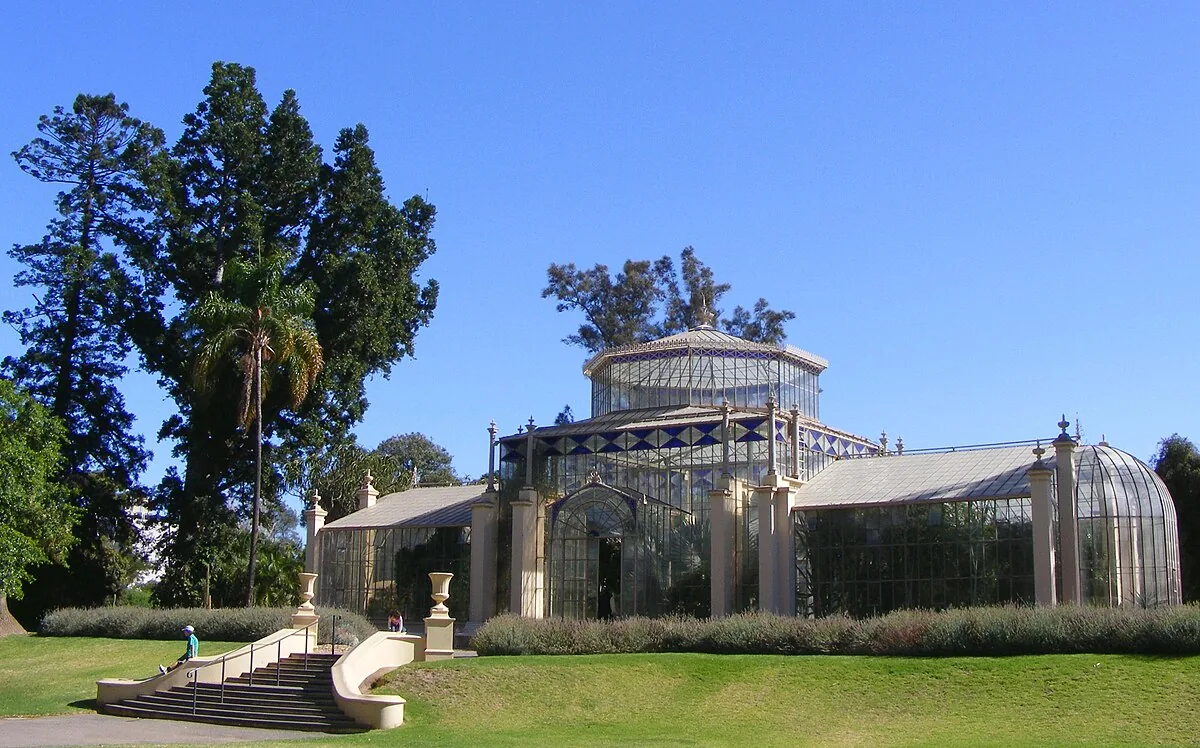
George Francis officially opened these grounds in 1857, but the garden’s soul was forged by Richard Schomburgk, a director whose botanical connections spanned the globe. He was responsible for the Palm House, an exquisite iron-and-glass structure imported from Bremen in 1875, which remains one of the last of its kind in the world. The garden survived the droughts and economic shifts of the twentieth century by evolving from a colonial pleasure ground into a hub for serious science. The 1980s saw the addition of the Bicentennial Conservatory, a massive glinting arc that mimics the shape of a tropical leaf and protects a fragile lowland rainforest within. More recently, the garden has reclaimed its heritage by restoring the Amazon Waterlily Pavilion, a jewel-box of a building designed specifically to house the giant Victoria amazonica, a plant that once caused a sensation in the drawing rooms of Europe.
Inside the Bicentennial Conservatory, The sound of the city is completely replaced by the rhythmic dripping of condensation and the heavy, earthy smell of wet fern. The light filters through the curved glass in soft, green-tinted rays, making the dense canopy above feel like an emerald cathedral. the sudden prickle of humidity on your skin, a startling contrast to the dry Mediterranean breeze waiting just outside the glass doors. Moving toward the First Creek Wetland, The subtle croak of frogs and the way the reeds bend in the wind, a quiet reminder that this garden also is a sophisticated water recycling system for the city. What stays with you is standing in the shade of the Plane Tree Drive at noon, where the dappled shadows create a flickering pattern on the path and the temperature feels ten degrees cooler than the street. A smooth, cool surface of the stone monuments and the rough, prehistoric bark of the Wollemi pines, ancient survivors that bring a sense of deep time to a morning stroll. Arriving at the garden is effortless, with multiple entrances lining the cultural precinct of North Terrace and the quiet parklands of the East End. The city’s free tram drops you just a few steps from the main gate, while those walking from the Rundle Mall area can follow the tree-lined boulevard of Frome Road. Many locals choose to enter from the Botanic Park side, wandering under the giant canopy of the century-old figs before reaching the garden’s northern boundary. This approach allows the garden to reveal itself slowly, moving from the wilder, open parkland into the more intimate and structured beauty of the botanical collections.
The Experience
Opening the visit is the way the light catches the ripples in the Amazon Waterlily pond, making the giant, dinner-plate-sized leaves appear to float in a void of black glass. You catch in the Palm House is uniquely fragile, a faint tinkle of expanding metal and glass that speaks to the building's age and delicacy. The soft, spongy texture of the mulch underfoot in the Australian Forest, a stark contrast to the hard, hot pavements of the city just a wall away. The thing most visitors overlook is the Santos Museum of Economic Botany, where the silence is so thick you can almost hear the dust settling on the 19th-century papier-mâché fruit models. What sticks with you is the walk through the wisteria arbor in late spring, when the purple blooms create a heavy, fragrant ceiling that vibrates with the hum of bees.
Opening the visit is the way the light catches the ripples in the Amazon Waterlily pond, making the giant, dinner-plate-sized leaves appear to float in a void of black glass.
Why It Matters
Adelaide Botanic Garden matters as a physical timeline of botanical science, from the era of imperial discovery to the modern age of ecological restoration. It houses some of the most significant 19th-century glasshouse architecture in the world, serving as a rare survivor of the Great Exhibition era. Culturally, it is the quiet heart of Adelaide, a place where the city’s history is literally rooted in the ground.
Why Visit
Sydney has the harbor views and Melbourne has the scale, but Adelaide has the intimacy and the architectural gems that feel like a secret shared with the past. You visit because the Palm House and the Waterlily Pavilion offer a level of craftsmanship and history that is becoming increasingly rare. It is a place where you can travel from the Amazon to the Australian outback within a twenty-minute walk.
✦ Insider Tips
- 1
Step into the Museum of Economic Botany to see the world's best collection of 19th-century German papier-mâché fungi models, it is strangely compelling.
- 2
Look for the Madagascan Baobab tree near the conservatory; its swollen trunk looks like a piece of prehistoric sculpture dropped into the garden.
- 3
Visit the Amazon Waterlily Pavilion at midday when the sun is directly overhead to see the giant leaves perfectly illuminated through the glass roof.
- 4
Check the flowering schedule for the Titan Arum; if it’s blooming, the garden stays open late so you can experience its famous, pungent scent.
- 5
Walk the quiet path along First Creek at dusk to see the local fruit bats beginning their nightly flight over the city skyline.