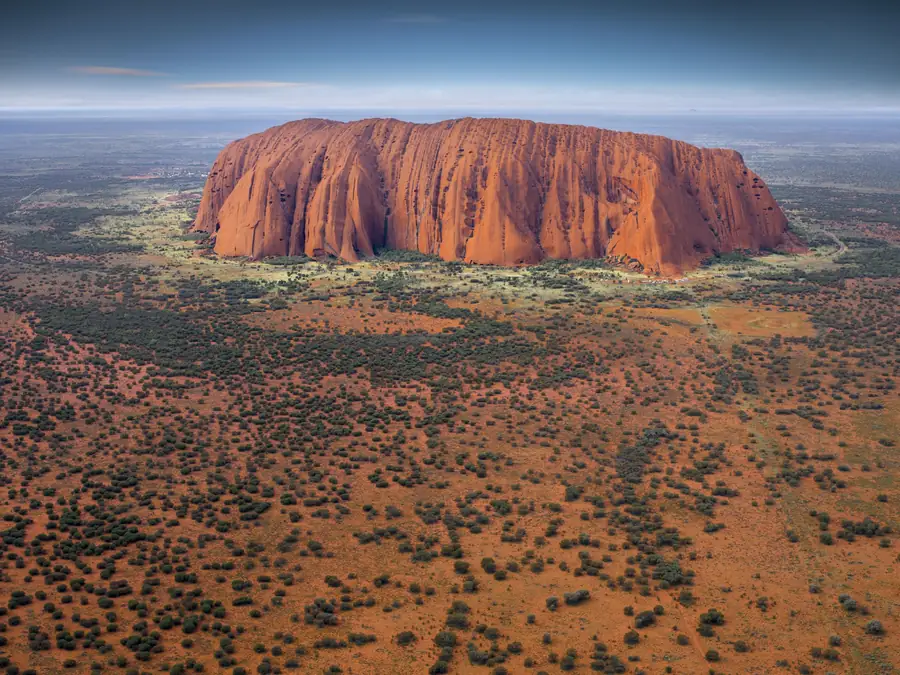
Beneath the red dust of the desert floor, this massive sandstone mountain continues for another six kilometers into the earth, leaving only its uppermost crust visible to the human eye.
About Uluru
The history of Uluru is a narrative of endurance, beginning in a time when Australia was part of the supercontinent Gondwana and the Red Centre was an inland sea. For the Anangu, the history of the rock is synonymous with the law of the land, passed down through oral tradition and ceremonial songlines that predate the pyramids by twenty millennia. European contact in the late 19th century brought pastoralists and eventually tourists, who often viewed the rock through a colonial lens of conquest. The 1980s marked a radical shift toward reconciliation, as the world began to listen to the Anangu's pleas for the protection of their sacred sites. Today, the park is managed as a joint partnership, ensuring that the ancient stories of the Kuniya and Liru are protected alongside the geological wonders of the site.
What Uluru actually is
Rising from the spinifex plains of the Northern Territory, a singular ark of arkose sandstone dominates the horizon with a gravity that feels almost celestial. Uluru represents the scorched, beating heart of the Australian outback, a monolith so vast that it creates its own weather patterns and atmospheric moods. The environment around the base carries the scent of sun-baked iron and dry eucalyptus, a sharp and ancient perfume that defines the Red Centre. As the sun moves across the sky, the rock shifts through a spectrum of impossible colors, from a bruised purple at dawn to a radiant, glowing ochre by midday. Walking the perimeter, you realize that the smooth surface seen from a distance is actually a complex architecture of deep fissures, hidden caves, and permanent waterholes that have sustained life for tens of thousands of years. Every curve and indentation in the stone tells a story of ancestral beings, making the rock feel less like a geological relic and more like a living participant in the desert landscape.
“Rising from the spinifex plains of the Northern Territory, a singular ark of arkose sandstone dominates the horizon with a gravity that feels almost celestial.”
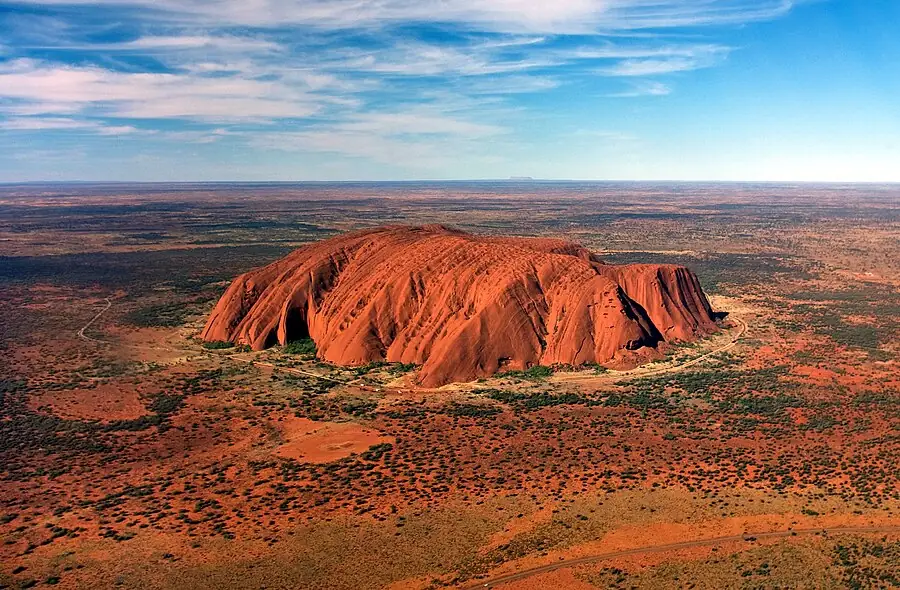
Uluru, Australia
Geological forces began folding this massive
Geological forces began folding this massive slab of rock roughly 500 million years ago, pushing a vertical bed of sandstone toward the sky during a period of tectonic upheaval. While early explorers like William Gosse gave it the name Ayers Rock in 1873, the Anangu people have been its traditional custodians for over 30,000 years, viewing the monolith as a record of the Tjukurpa, or creation time. Every indentation in the stone represents the path of ancestral beings like the Mala hare-wallaby or the Kuniya python woman. The 20th century saw a complex struggle for land rights, culminating in the historic 1985 handback where the title was returned to the Anangu. The most recent turning point occurred in 2019, when the climb was permanently closed out of respect for the site's spiritual significance, finally allowing the rock to exist in peace as a sanctuary.
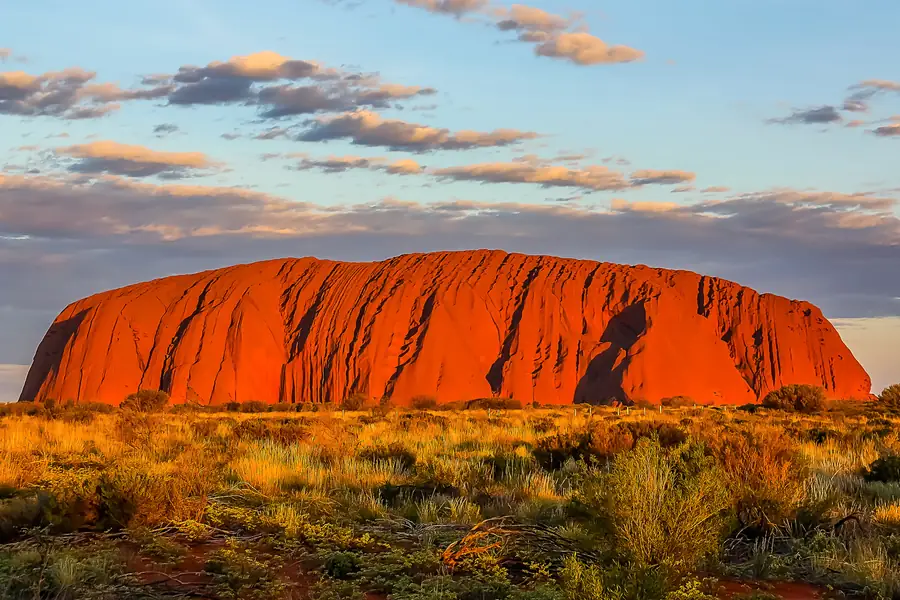
Uluru, Australia
Standing at the Mutitjulu Waterhole
Standing at the Mutitjulu Waterhole in the early morning, The profound silence is only broken by the melodic, liquid call of a butcherbird echoing off the high stone walls. The light filters into the canyon in dusty shafts, illuminating ancient rock art that remains remarkably vivid against the dark, textured sandstone. A trace of the radiating heat from the rock long after the sun has begun to dip, a steady pulse of energy that seems to vibrate through the soles of your boots. Most people focus on the distant sunset viewing areas, but The delicate life thriving in the shadows: the tiny, vibrant wildflowers and the resilient desert oaks that grow in the cracks. The moment that stays with you is the Field of Light installation at twilight, when 50,000 glass spheres begin to glow like a terrestrial galaxy, mirroring the brilliant stars that emerge in the vast desert sky above.
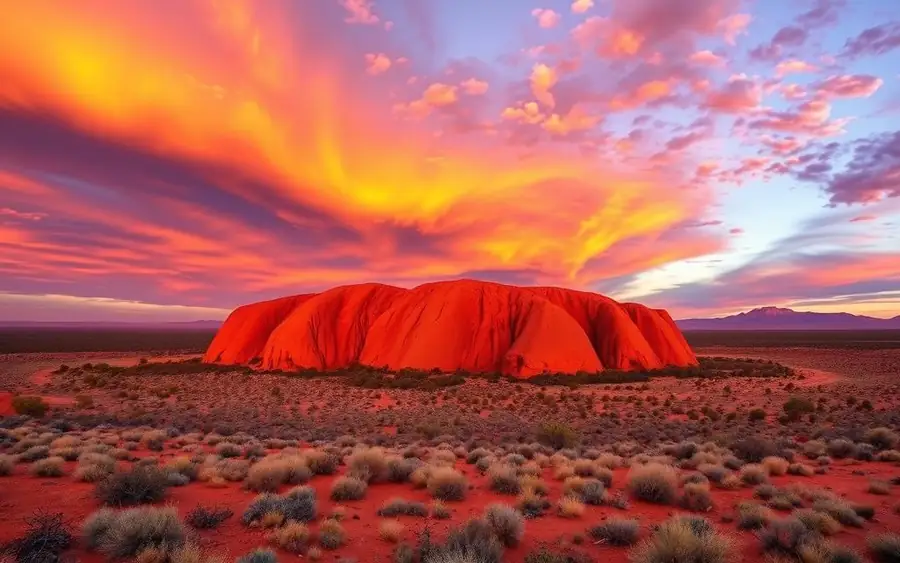
Uluru, Australia
Access to this remote corner
Access to this remote corner of the world usually involves a flight to Ayers Rock Airport, a small desert hub like an outpost on another planet. From there, a short drive across the dunes leads to the Yulara resort complex, the only base of operations for exploring the national park. For those with a thirst for the long haul, the drive from Alice Springs takes roughly five hours along the Lasseter Highway, a journey of straight lines and shimmering heat mirages. This road trip provides a necessary sense of scale, forcing you to earn the first glimpse of the monolith as it slowly rises from the flat, red earth on the distant horizon.
“Access to this remote corner of the world usually involves a flight to Ayers Rock Airport, a small desert hub like an outpost on another planet.”
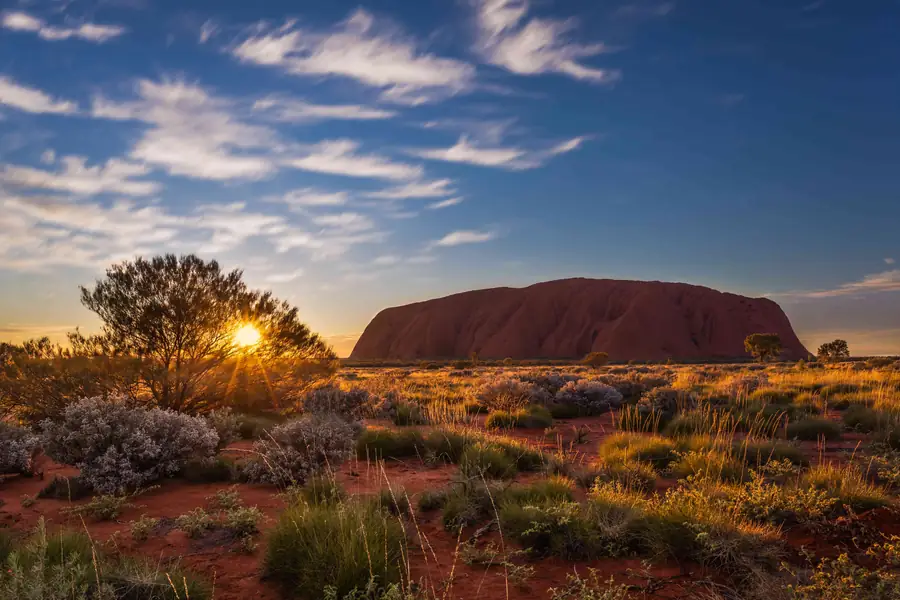
Uluru, Australia
Uluru, Australia
The Experience
Right away, the wind whistling through the brain-like formations of the rock, a haunting, flute-like sound that carries the weight of the desert's isolation. The light at sunset is a physical event, transforming the monolith into a glowing ember that seems to illuminate the surrounding scrubland from within. A strange sense of smallness as you stand in the shadow of the Kantju Gorge, where the vertical walls disappear into the blue ether above. The thing most visitors overlook is the honeycomb weathering on the western face, a delicate lacing of the stone that looks like petrified foam. The moment that stays with you is the sudden drop in temperature at dusk, when the desert air turns crisp and the scent of damp earth rises from the hidden waterholes.
Why It Matters
Uluru matters as a global symbol of Indigenous resilience and as one of the few places on earth where a living culture remains inseparably tied to a specific geological feature. It is a dual UNESCO World Heritage site, recognized both for its unique natural beauty and its deep cultural landscape. Humanly, it challenges the visitor to move beyond the visual and engage with a way of seeing the world that values story and spirit over mere observation.
Why Visit
The Grand Canyon is a void and Everest is a peak, but Uluru is a presence that feels like it is watching you back. You visit because it is a spiritual reset, a place where the modern noise of the world is swallowed by a silence that is thirty thousand years old. It offers a perspective on time that makes your own worries feel as fleeting as a desert breeze.
Insider Tips
- 1
Walk the full ten-kilometer base loop starting at dawn to see the rock's personality change as the shadows retreat from the deep, hidden caves.
- 2
Look for the No Photography signs at specific sacred sites like the Mala Puta; respecting these boundaries is the most meaningful way to honor the local culture.
- 3
Carry at least three liters of water even for short walks, as the desert air saps moisture from your body far faster than you can feel.
- 4
Join a guided walk with an Anangu ranger to hear the creation stories in the places they actually happened, rather than reading them from a plaque.
- 5
Check the weather for rain; on the rare days it pours, the rock turns a dark charcoal grey and hundreds of temporary waterfalls cascade down the slopes.