“British surveyors designed this corner of the Tasman Peninsula to be a 'natural penitentiary,' a prison without walls where the only escape was across a narrow strip of land guarded by savage dogs.”
About Port Arthur Historic Site
Between 1833 and 1877, more than 12,500 convicts passed through these sandstone gates, many of them skilled craftsmen whose labor built the very walls that held them captive. The site was a noisy city of industry, producing ships, shoes, and bricks, all under a regime of total surveillance that aimed to turn 'deviants' into productive colonial subjects. By the mid-19th century, the focus shifted from physical toil to mental reform, leading to the construction of the 'Silent Prison,' a precursor to modern maximum-security facilities. The fires of the late 1800s destroyed many of the wooden structures, but the resilient stone shells remained, eventually attracting 'ruin hunters' who sought a romanticized version of Tasmania's convict past. Today, it is a UNESCO World Heritage site that meticulously balances the preservation of its dark heritage with the peaceful dignity of a memorial garden.
What Port Arthur Historic Site is
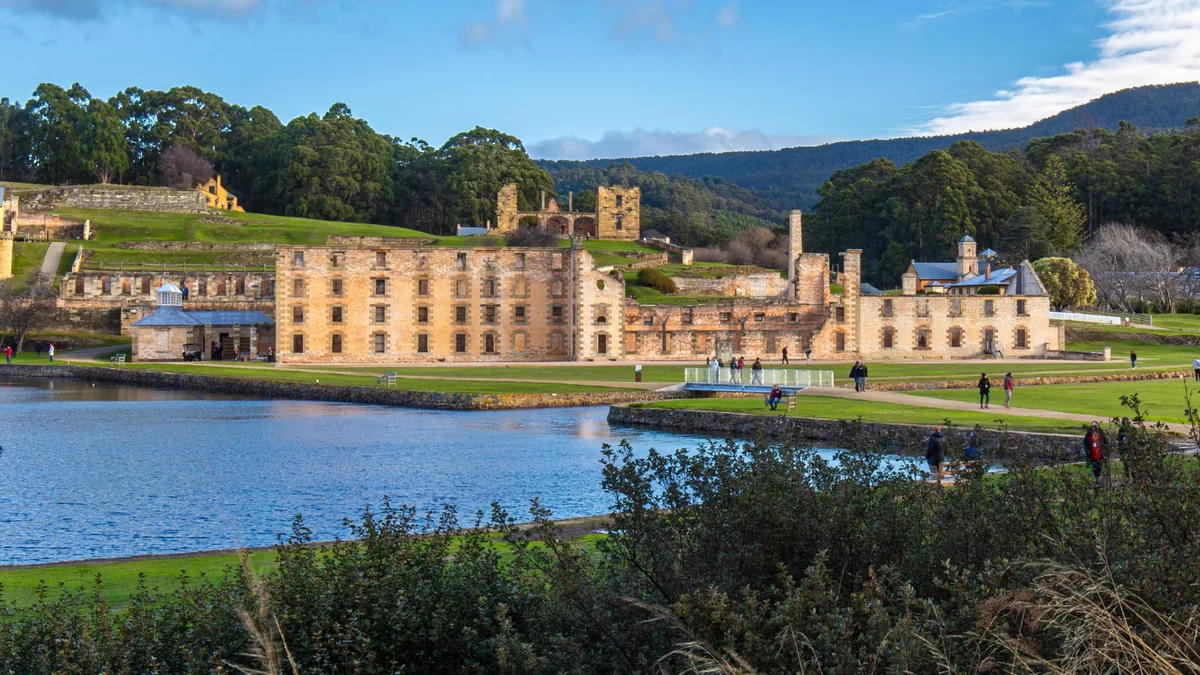
Deep within the jagged coastline of the Tasman Peninsula, a collection of sandstone ruins sits in a landscape so deceptively calm that the eyes struggle to reconcile the beauty with the brutality. Port Arthur was once the machine room of the British Empire's colonial punishment system, a place where the air today tastes of salt spray and damp eucalyptus. The sprawling site is anchored by the roofless shell of the Great Penitentiary, its empty arched windows framing a sky that offered little hope to the men once tethered within. The crossing of the manicured English gardens toward the crumbling stone hospital, the heavy contrast between the deliberate Victorian order and the wild, untameable Southern Ocean roaring just beyond the bay. Every meticulously carved stone tells a story of survival, discipline, and the sheer weight of isolation in a land that was meant to be a natural cage.
Deep within the jagged coastline of the Tasman Peninsula, a collection of sandstone ruins sits in a landscape so deceptively calm that the eyes struggle to reconcile the beauty with the brutality.
modest timber station, 1830
Port Arthur began as a modest timber station in 1830, but it quickly morphed into a sprawling industrial prison designed to break the spirits of the 'worst' convicts through hard labor and psychological conditioning. George Arthur, the Lieutenant Governor whose name the site carries, envisioned a panopticon of reform where silence and separation were more effective than the lash. The 1850s saw the construction of the Separate Prison, a chilling experiment in solitary confinement where prisoners wore hoods to remain anonymous even to each other. After the penal colony closed in 1877, the site was nearly swallowed by forest and bushfires, only to be reclaimed as a place of memory. A darker chapter was added in 1996, when a modern tragedy fundamentally changed the nation’s laws, making the site a dual monument to the resilience of the human spirit across two very different centuries.
Standing inside the Separate Prison,
Standing inside the Separate Prison, The absolute, ringing silence that was once enforced as a weapon of the state. The light enters the cells through high, narrow slits, casting cold bars across the floorboards that still carry the faint, dry scent of old timber and lime wash. A sudden drop in temperature stepping into the punishment cells, where the darkness is so thick it seems to have physical weight. Almost all visitors stick to the main paths, but The lonely ruins of the dockyards where the sound of the wind through the grass mimics the ghostly rhythm of a blacksmith's hammer. What lingers with you is the boat trip to the Isle of the Dead, where over a thousand bodies lie in unmarked graves, the water of the harbor reflecting a sky that feels endless and indifferent to the dramas of the shore.
Reaching the Tasman Peninsula involves
Reaching the Tasman Peninsula involves a ninety-minute drive from Hobart along the Arthur Highway, a route that winds through ancient temperate rainforests and past the dramatic geological formations of Eaglehawk Neck. This narrow strip of land was once guarded by a line of starved dogs to prevent escapes, a reminder that you are entering a natural prison. The road opens up to reveal the site suddenly, the sandstone ruins appearing like a misplaced English cathedral against the backdrop of the Australian bush. Arriving by sea on a chartered ferry provides a more visceral understanding of the site's isolation, approaching the same grey docks that thousands of shackled men once viewed as the end of the world.
This narrow strip of land was once guarded by a line of starved dogs to prevent escapes, a reminder that you are entering a natural prison.
The Experience
Right at the start is the way the light catches the chisel marks on the sandstone blocks, each one a product of the anonymous labor of a man whose name was replaced by a number. Audible here of the gulls screaming over the harbor provides a sharp, piercing contrast to the hushed, library-like atmosphere of the ruins. A strange, haunting peacefulness in the church ruins, where the lack of a roof allows the Tasmanian forest to peer over the walls. The thing most visitors overlook is the Point Puer Boys' Prison across the water, the first of its kind in the British Empire, where the tragedy of lost youth feels particularly poignant. What sticks with you is the feeling of the heavy iron keys in the museum, realizing the physical reality of a life measured in locks and bars.
Why It Matters
Port Arthur matters as a physical archive of the British penal system's evolution and as a primary landmark in the story of Australia's founding. It represents a global shift in how society viewed punishment, moving from the public spectacle of pain to the private discipline of the mind. Culturally, it is a site of deep national mourning and reflection, a place where the layers of colonial and modern history overlap in the cold Tasman soil.
Why Visit
Hobart has the art and the mountains, but Port Arthur has the silence that forces you to listen to the past. You visit because the beauty of the gardens and the horror of the cells create a tension you won't find at any other historic site. It is the only place where the landscape itself was used as a structural part of a prison, making the view of the bay both a sanctuary and a cell.
✦ Insider Tips
- 1
Take the final ghost tour of the evening to experience the ruins when the shadows are at their longest and the wind through the empty archways creates an entirely different soundscape.
- 2
Look for the convict thumbprints occasionally visible in the handmade bricks of the penitentiary walls; they are the most intimate connection you can find to the men who built this place.
- 3
Walk out to the far end of the dockyards to see the slipways where the 'convict navy' once built ships that were paradoxically used to patrol their own confinement.
- 4
Spend time in the Asylum museum to read the handwritten letters of the inmates, which offer a heartbreakingly human perspective that the stone ruins cannot provide.
- 5
Bring a warm layer even in mid-summer, as the weather on the Tasman Peninsula can shift from sunshine to a freezing Antarctic blast in a matter of minutes.