“More than 103,000 names are etched into bronze here, yet the building was designed to feel like a quiet garden where a mother could finally say goodbye to a son buried half a world away.”
About Australian War Memorial
Bean’s dream was born in the trenches of 1916, fueled by the realization that Australia was a young nation being defined by an old world's catastrophes. He insisted that the memorial should not glorify war, but rather document the character of those who endured it, leading to a collection that ranges from massive heavy artillery to pocket-sized diaries. The cornerstone was laid in 1929, but the building grew in phases, mirroring the country’s own path through the 20th century. In 1993, the remains of an unknown soldier from the Western Front were interred in the Hall of Memory, providing a focal point for a nation that had previously had no central place of pilgrimage. The recent expansion projects continue this arc, integrating the stories of modern peacekeeping and contemporary conflicts into the original sandstone heart.
Standing at the northern terminus of Anzac Parade
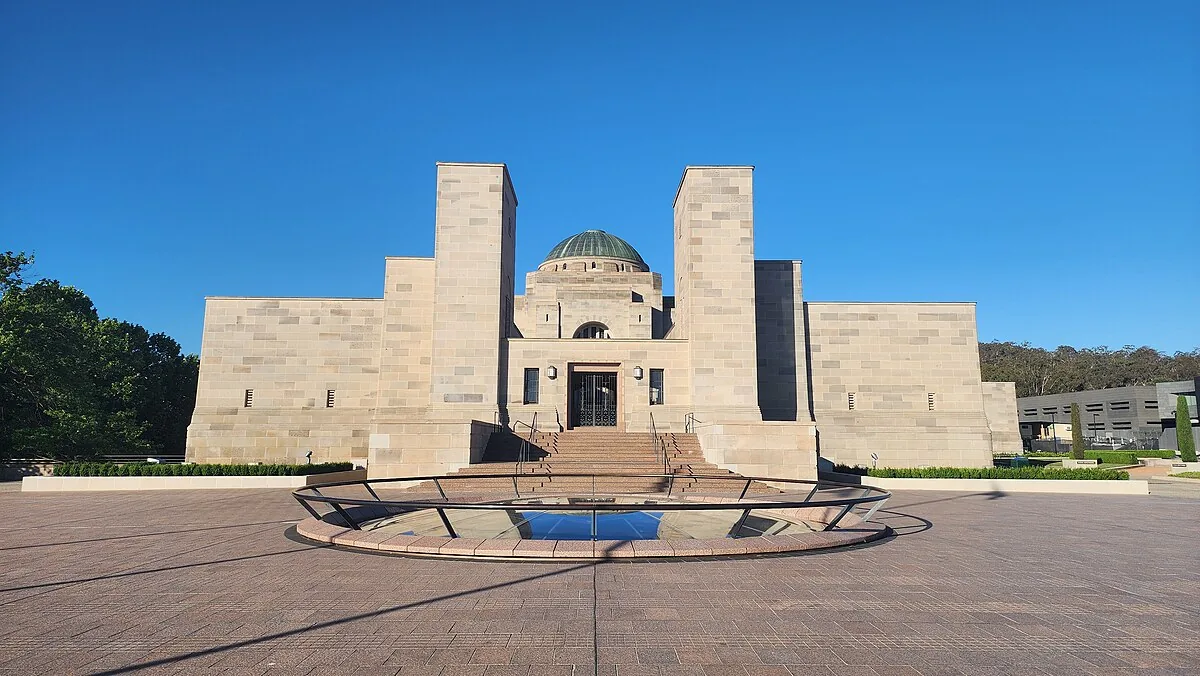
Standing at the northern terminus of Anzac Parade, the Australian War Memorial rises against the crimson-tinged backdrop of Mount Ainslie with a solemnity that anchors the entire capital. The Byzantine-inspired copper dome, weathered to a soft verdigris, surmounts a sandstone structure that feels more like a sacred tomb than a traditional museum. Within the courtyard is often sharp and cool, smelling of rosemary and damp stone, while the constant, rhythmic bubbling of the Pool of Reflection provides a liquid soundtrack to the silence. Along the cloisters of the Roll of Honour, thousands of paper poppies wedged into the cracks beside names etched in bronze, their vivid red petals fluttering in the mountain breeze. It represents a rare space where national grief is handled with such architectural grace that it becomes a place of profound, quiet beauty.
Standing at the northern terminus of Anzac Parade, the Australian War Memorial rises against the crimson-tinged backdrop of Mount Ainslie with a solemnity that anchors the entire capital.
Charles Bean, Australia’s official war historian
Charles Bean, Australia’s official war historian, stood on the blood-soaked ridges of Gallipoli and conceived of a place where the families of fallen soldiers could grieve for those who would never come home. His vision was a 'temple and a museum,' a site that would hold both the cold machinery of war and the warm, fragile memories of the people who operated it. The Great Depression and the onset of a second global conflict delayed the opening until 1941, but the delay only deepened the site’s significance. Architects Emil Sodersten and John Crust fused Art Deco lines with Byzantine grandeur, creating a space that could contain the expanding narrative of Australian service. Over the decades, the memorial has evolved to include the Hall of Memory and the Tomb of the Unknown Australian Soldier, ensuring the site remains a living archive of the country's formative struggles.
Inside the Hall of Memory, the light
Inside the Hall of Memory, the light is fractured into millions of colored shards by one of the world's largest mosaic compositions, casting a celestial glow over the silent tomb below. The noise changes moving into the aircraft halls, where the low hum of cinematic projections recreates the vibration of Lancaster bombers. A hint of the temperature drop significantly within the cloisters, where the bronze panels of names seem to radiate a permanent, metallic chill. Most people focus on the massive tanks and planes, but The small, handwritten letters and worn personal trinkets in the galleries that bridge the gap between history and a human life. What lingers with you is the Last Post Ceremony at dusk, when the haunting, lonely notes of a bugle echo across the water, marking the transition from the day's movement into the night's eternal watch.
Reaching the memorial is a ritual
Reaching the memorial is a ritual in itself, best experienced by walking up the broad, red-gravel boulevard of Anzac Parade from the shores of Lake Burley Griffin. This approach offers a direct line of sight from the Parliament House to the memorial, symbolizing the relationship between the people who make the laws and the people who defend them. Local buses run frequently from the Canberra city center, and plenty of cycling paths lead through the surrounding parklands. Arriving on foot allows the scale of the building to reveal itself slowly, the sandstone walls growing larger against the hills until you finally climb the steps and leave the city behind.
Reaching the memorial is a ritual in itself, best experienced by walking up the broad, red-gravel boulevard of Anzac Parade from the shores of Lake Burley Griffin.
The Experience
Immediately, the way the sun strikes the gold-leaf mosaics in the Hall of Memory, making the tall glass figures appear to breathe as the light shifts. Audibly, the of your own footsteps on the stone floor feels amplified, an echo of the thousands of souls whose silence you are sharing. A smooth, worn texture of the wooden pews in the quiet alcoves, places designed for a grief that has no words. The thing most visitors overlook is the sculpture garden behind the main building, where the art is framed by the grey-green leaves of the Australian bush. What stays with you is seeing a veteran touch a specific name on the bronze wall, their fingers tracing the metal as if it were skin.
Why It Matters
The Australian War Memorial matters as the most significant cultural institution in the country, acting as the repository of the national soul. It is a world-class archive that treats a soldier’s diary with the same reverence as a fighter jet. Culturally, it serves as the site where Australia’s complex identity, built on sacrifice, mateship, and a fierce independence, is most visibly and movingly articulated.
Why Visit
Canberra has the politics and the art, but the memorial has the heart. You visit because it is the only place that explains what it truly means to be Australian through the lens of those who gave everything for the idea. It offers a cinematic and emotional intensity that makes a typical history lesson feel two-dimensional.
✦ Insider Tips
- 1
Attend the Last Post Ceremony at 4:45 PM; each day a different individual from the Roll of Honour is remembered with their personal story read aloud.
- 2
Look for the 'G for George' Lancaster bomber in the Anzac Hall, an incredible piece of aviation history that survived ninety combat missions over Europe.
- 3
Walk to the top of the steps at the entrance and look back toward Parliament House for the most perfectly aligned architectural view in the Southern Hemisphere.
- 4
Find the small, hidden courtyard containing the eternal flame; the heat from the fire creates a shimmering distortion against the cool blue of the pool.
- 5
Use the free lockers for your bags so you can walk the long cloisters without any weight, allowing the scale of the memorial to be felt physically.