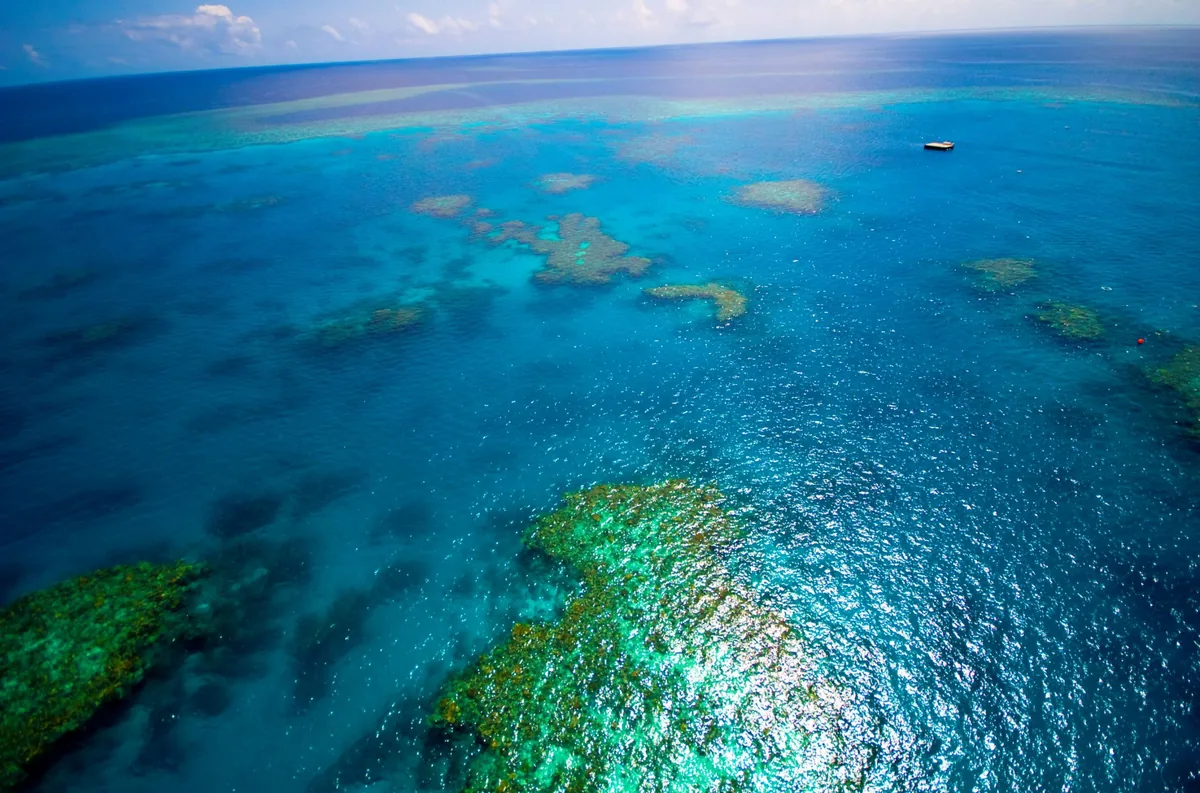
Visible from the cold silence of outer space, this sprawling aquatic metropolis is the only living structure on Earth built by billions of tiny organisms working in unconscious, perfect unison.
About Great Barrier Reef
The reef we see today grew on the backs of its ancestors, as coral polyps built limestone skeletons atop submerged hills once the sea levels rose after the Pleistocene epoch. Traditional owners have navigated these waters for millennia, following seasonal migrations of dugongs and turtles that remain central to their cultural heritage. Modern history saw the reef designated as a Marine Park in 1975, a move triggered by public outcry over proposed oil drilling and limestone mining. This protection was solidified in 1981 with its inscription as a UNESCO World Heritage site, acknowledging its status as the most biodiverse ecosystem on the planet. Today, scientists at the Australian Institute of Marine Science work tirelessly to develop heat-resistant coral strains, ensuring the reef's story continues into a warmer century.
What Great Barrier Reef actually is
Glancing out from a low-flying de Havilland, the Coral Sea appears as an endless bolt of indigo silk, suddenly interrupted by fractured splinters of neon turquoise and bone-white sand. This is the world’s largest living masterpiece, a biological fortress stretching over 2,300 kilometers along the Queensland coastline. The reef is not a single entity but a sprawling mosaic of nearly 3,000 individual systems, each a frantic, silent metropolis beneath the waves. As you descend toward the outer edges, the air thickens with the scent of salt and sun-bleached limestone. The water here possesses a clarity that feels almost optical, allowing sunlight to pierce through the depths and ignite the coral gardens below in a riot of lilac, gold, and deep ochre.
Marine geologists suggest the current living
Marine geologists suggest the current living structure began its ascent roughly 20,000 years ago, following the retreat of the last ice age, though the foundational limestone platforms date back nearly half a million years. For the Aboriginal and Torres Strait Islander peoples, the reef is a sea country woven into their spiritual identity, a landscape of ancestral songlines that predate the rising sea levels. Captain James Cook famously encountered the reef’s jagged reality in 1770 when the HMS Endeavour was nearly swallowed by a coral outcrop, an event that put this labyrinth on European maps. Over the last century, it has moved from a resource for pearlers and fishermen to a high-stakes frontline for marine conservationists fighting to preserve the delicate thermal balance required for the polyps to thrive.
Sinking below the surface, the cacophony
Sinking below the surface, the cacophony of the boat's engine vanishes, replaced by a rhythmic, metallic crackling sound produced by millions of snapping shrimp and the scraping of parrotfish beaks against the limestone. The weightless sensation of drifting over a drop-off is paired with the sight of giant clams, their velvet mantles shimmering in electric blues and purples. A remnant of the surge of the swell pulling you gently across the reef flat, a slow-motion dance with green sea turtles and inquisitive Maori wrasse. Those who come focus on the schools of fish, but The architectural complexity of the staghorn and brain corals, which create a jagged, three-dimensional forest. What stays with you is the 'coral snow' of a mass spawning event, when the ocean turns into a swirling, starlit galaxy under the light of a November full moon. Cairns and Port Douglas serve as the primary launching pads, where a fleet of high-speed catamarans departs daily for the outer reef edges. Those seeking a more intimate connection often opt for seaplanes departing from Hamilton Island, landing in sheltered lagoons that feel entirely disconnected from the modern world. For the adventurous, live-aboard vessels offer the chance to reach the remote Ribbon Reefs, where the water is deeper and the marine life more pelagic. This route through the Great Barrier Reef Marine Park is a lesson in perspective, emphasizing just how fragile and vast this aquatic wilderness is as the mainland fades into a thin, hazy line of green on the western horizon.
The Experience
Right away, the peculiar, chalky taste of the water and the way the light bends into dancing hexagonal patterns on the sandy floor of the lagoon. In your ears of your own breathing becomes a meditative hum, punctuating the silence of a world where colors seem to vibrate with their own internal energy. You get a sudden chill of a thermocline, a reminder that the deep, open ocean is never far away. The thing most visitors overlook is the macro-life; the translucent nudibranchs and tiny blennies that inhabit the smallest crevices of the coral heads. What stays with you is the eye contact with a gentle, ancient-looking turtle, a brief recognition across the boundaries of species in a wilderness that feels both infinitely old and heartbreakingly fragile.
Why It Matters
The Great Barrier Reef matters as a biological library of life, housing ten percent of the world's total fish species and thousands of organisms found nowhere else. It acts as a massive natural breakwater for the Australian coast, a product of the power of microscopic life to shape the physical geography of a continent. Culturally, it is a global barometer for the health of our oceans, making its survival a shared human responsibility.
Why Visit
Other reefs are beautiful, but this is a landscape on a planetary scale that humbles the human ego. You visit because there is no other place where you can witness a multi-thousand-kilometer living organism in its natural state. It offers a sensory immersion that shifts your understanding of what life on this planet can achieve when left to its own quiet, persistent devices.
✦ Photo Gallery
7 photos of Great Barrier Reef · click to enlarge
Best Season
🌤 Visit between June and October to enjoy the dry season's crystal-clear visibility and the chance to witness the majestic migration of humpback whales through the coral lagoons.
Quick Facts
Best time to visit
Visit between June and October to enjoy the dry season's crystal-clear visibility and the chance to witness the majestic migration of humpback whales through the coral lagoons.
Getting there
In Cairns, Australia; reach Cairns first, then continue to the site.
Location
Cairns, Australia
Type
attraction
Coordinates
-16.4000°, 145.8000°
Insider Tips
- 1
Opt for a 'live-aboard' vessel to reach the outer reefs where the coral is healthiest and the larger pelagic species like reef sharks and rays are more active.
- 2
Look for the 'Great Eight' marine species, including clownfish and giant clams, to truly appreciate the diversity of the reef's most famous residents.
- 3
Choose an eco-certified operator that participates in the 'Eye on the Reef' program, allowing your visit to contribute directly to citizen-science monitoring.
- 4
Wear a full-body lycra stinger suit even in winter; it protects not just against the rare jellyfish, but also against the intense tropical sun without polluting the water with chemicals.
- 5
Visit the Lady Elliot Island at the southernmost tip to see a coral cay actually formed from bird guano and coral rubble, offering a unique terrestrial perspective.