“Four hundred hectares of ancient, sand-loving wilderness sit perched above the skyscrapers of Perth, proving that the bush can successfully stare down the glass and steel of the modern world.”
About Kings Park and Botanic Garden
Mooro Katta was a traditional site for ceremonies and hunting for thousands of years before colonial surveyors designated it a government reserve in 1831. While other cities cleared their central heights for luxury housing, Perth’s early leaders fought to preserve the scrub, creating one of the largest inner-city parks on the planet. The Western Australian Botanic Garden was added within the park in 1965, specifically to showcase the 3,000 species of unique flora that thrive in the state’s nutrient-poor soils. It became a site of deep national memory in the 1920s when the State War Memorial was erected, followed by the planting of the Honor Avenues, where thousands of eucalyptus trees stand as living monuments to fallen soldiers. Today, it remains a site of reconciliation, where indigenous heritage and botanical science are woven into a single, cohesive landscape.
What this is
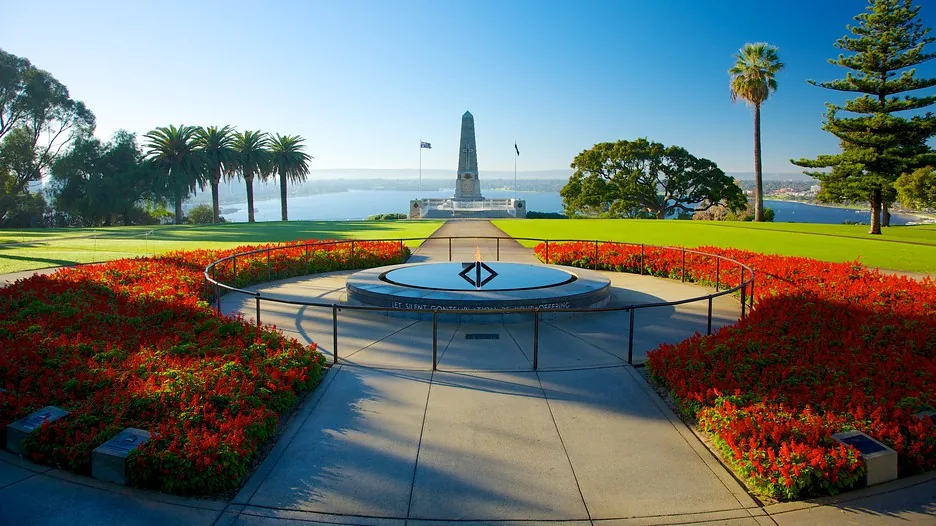
Perched on the rugged limestone crest of Eliza Bluff, this sprawling expanse of green and grey-gold bushland is a wild crown for the city of Perth. Kings Park and Botanic Garden is an anomaly in the world of urban planning, being significantly larger than New York’s Central Park and consisting largely of untamed, prehistoric scrub. Tracing the edge of the scarp, the Swan River stretches out below in a wide, shimmering ribbon of cobalt, while the glass towers of the central business district seem close enough to touch. Nearby, There is a sharp, resinous perfume of crushed eucalyptus and the honeyed scent of blooming banksias. It acts as a physical bridge between the hyper-modern skyline of Western Australia’s capital and the ancient, resilient flora that has occupied this sandy soil for millennia.
Perched on the rugged limestone crest of Eliza Bluff, this sprawling expanse of green and grey-gold bushland is a wild crown for the city of Perth.
The Whadjuk Noongar people knew this
The Whadjuk Noongar people knew this high ground as Mooro Katta or Kaarta Gar-up, a place of immense spiritual power long before a single European sail appeared on the horizon. In 1872, John Forrest, the first Premier of Western Australia, made the visionary decision to set aside this land for public use, protecting it from the voracious appetite of the expanding colonial town. The park officially opened in 1895, named after King Edward VII, and has since evolved from a mere leisure ground into a global center for biodiversity research. It was here that scientists perfected the art of germinating the state's iconic smoke bushes and everlasting daisies, turning a patch of bush into a living laboratory. The arrival of the Gija Jumulu, a massive 750-year-old Boab tree transported 3,200 kilometers from the Kimberley in 2008, added a literal giant to the park’s narrative, symbolizing the enduring strength of the northern wilderness within the southern city.
Visiting info
Standing on the Lotterywest Federation Walkway, The gentle sway of the glass-and-steel bridge beneath your feet moving through the canopy of towering Karri and Marri trees. The audio element is a lively, percussive chatter of red-wattlebirds and the occasional screech of a black cockatoo overhead. A sudden drop in temperature moving from the sun-drenched floral displays into the shaded sanctuary of the bushland trails, where the ground is a soft carpet of dry leaves and grey sand. Most people congregate near the Eternal Flame of the State War Memorial, but The quiet brilliance of the Gija Jumulu Boab tree, its bulbous, silver-grey trunk etched with the wisdom of centuries. The piece that stays with you is watching the sunset from the Fraser Avenue lookout, when the lemon-scented gums turn a ghostly white and the city lights begin to flicker like fallen stars on the river’s surface.
Reaching this hilltop sanctuary
Reaching this hilltop sanctuary is a simple, pleasant ascent from the Perth city center, either by the free blue CAT bus or a steep, rewarding climb up the Jacob’s Ladder staircase. Those driving will find winding roads that disappear into the scrub, leading to secluded parking groves where the city noise is instantly replaced by the rustle of the wind. Inside the park from the northern end provides a transition from the manicured lawns of the suburbs into the wilder, heart-of-the-park bushland. This approach allows the scale of the landscape to reveal itself slowly, culminating in the sudden, expansive reveal of the river and city skyline at the southern edge.
Reaching this hilltop sanctuary is a simple, pleasant ascent from the Perth city center, either by the free blue CAT bus or a steep, rewarding climb up the Jacob’s Ladder staircase.
The Experience
First, the way the light catches the iridescent plumage of a splendid fairy-wren as it darts between the needle-like leaves of a hakea bush. The environment vibrates with the low hum of honeybees during the spring wildflower festival, a sound that feels like the very pulse of the park. You get a rough, corky texture of the banksia cones and the cool, metallic surface of the sculptures that dot the gardens. The thing most visitors overlook is the DNA Tower, a double-helix staircase that offers a 360-degree view of the Indian Ocean to the west and the Darling Scarp to the east. What remains with you is the scent of the first winter rains hitting the hot, red dust of the paths, a fragrance that signals the rebirth of the entire landscape.
Why It Matters
Kings Park matters as a defiant stronghold of Western Australian biodiversity, protecting species that exist nowhere else on the globe. It is a sacred space of remembrance, holding more war memorials than any other park in Australia within its shaded avenues. Humanly, it is the city's collective backyard, a place where the history of the Whadjuk people and the identity of modern Perth residents find a rare, harmonious meeting point.
Why Visit
Sydney has the harbor and Melbourne has the gardens, but Perth has the bush itself brought into the heart of the city. You visit because it offers a visceral, unpolished encounter with the flora of the oldest continent on earth without leaving the urban grid. It provides a sense of perspective that only a 750-year-old tree and a billion-year-old river can give you.
✦ Insider Tips
- 1
Climb the 101 steps of the DNA Tower at sunrise for a panoramic view that stretches from the ocean to the hills before the morning haze sets in.
- 2
Look for the 'Whispering Wall' near the State War Memorial, where the curved granite allows you to hear a soft murmur from the opposite end.
- 3
Walk the Law Walk trail at dusk to see the local brushtail possums emerging from the tree hollows as the city lights begin to glow.
- 4
Visit the Aspects of Kings Park gallery to find authentic, locally-made glasswork and jewelry inspired by the park’s unique botanical forms.
- 5
Pack a picnic for the Synergy Parkland area to enjoy the giant prehistoric dinosaur sculptures that roam the lawns near the lake.