“A professional gambler spent eighty million dollars to dig a three-story hole in a Tasmanian cliffside, filling it with antiquities and art that explores the messy intersection of sex and death.”
About MONA (Museum of Old and New Art)
This was originally home to the Moorilla Estate vineyard and a modest museum, but David Walsh’s vision required something far more ambitious and architecturally violent. Architect Nonda Katsalidis was tasked with creating a structure that vanished into the landscape, using the raw sandstone walls as the primary interior finish. Since its 2011 opening, the museum has hosted 'Dark Mofo,' a winter festival that celebrates the dark and the macabre, further cementing Hobart’s status as a capital of the unconventional. The museum continues to evolve, adding new wings like the 'Pharos' pavilion, which houses light-based works that play with the limits of human perception. It remains a privately funded experiment in cultural provocation, entirely free from the bureaucratic constraints of state-run galleries.
What this is
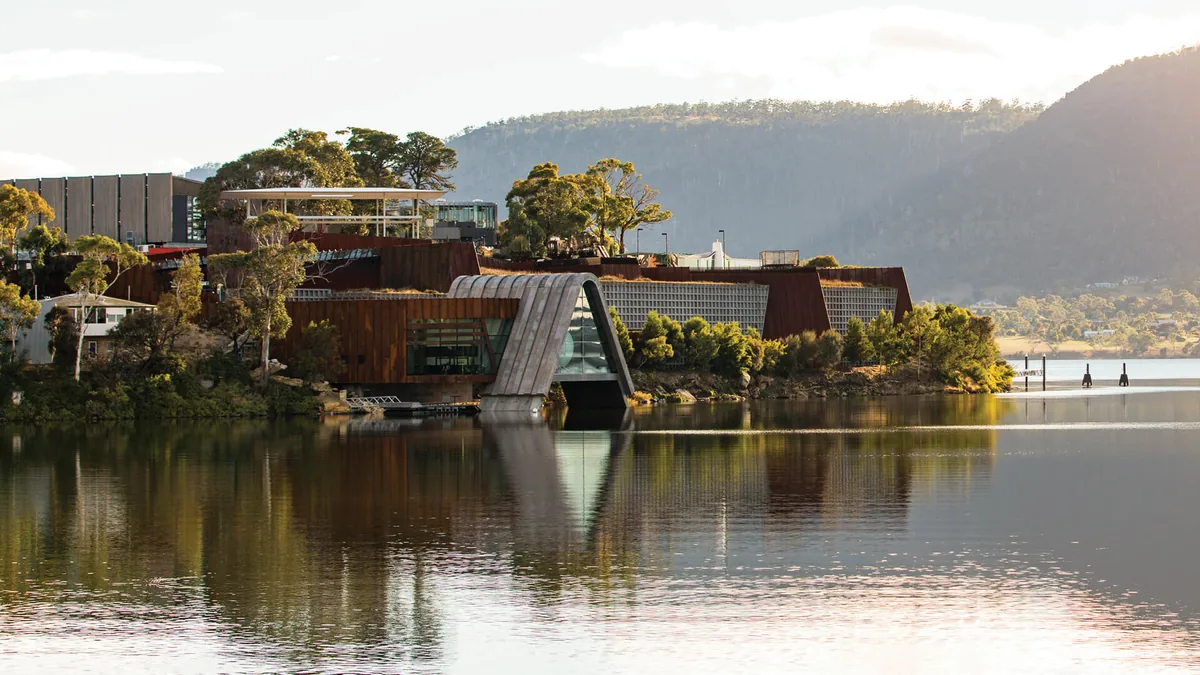
Approaching the Berriedale peninsula by water, the museum appears not as a building, but as a rusted, windowless fortress of Corten steel anchored into the Triassic sandstone of the Derwent River. This is a subterranean labyrinth, a deliberate descent into the belly of a cliff where the traditional rules of the white-cube gallery are gleefully incinerated. Once you pass through the mirrored entrance, a spiral staircase drops you seventeen meters below the earth into a cavernous vault where the air is cool, slightly damp, and smelling of raw rock and ancient dust. There are no wall labels to guide you, no forced educational narratives, only a handheld device that whispers secrets about the art as you drift through the darkness.
Approaching the Berriedale peninsula by water, the museum appears not as a building, but as a rusted, windowless fortress of Corten steel anchored into the Triassic sandstone of the Derwent River.
casinos, opened MONA, 2011
David Walsh, a professional gambler who made his fortune by outsmarting the world’s casinos, opened MONA in 2011 on the site of his former Moorilla Museum of Antiquities. He described it as a 'subversive Disneyland,' a playground for adults funded by the proceeds of mathematical probability and high-stakes risk. The architecture itself is a marvel of engineering, requiring the excavation of 35,000 cubic meters of sandstone to create three levels of galleries that lie entirely beneath the vineyard-covered surface. Walsh’s personal collection is the heartbeat of the place, an eccentric mix that places 2,500-year-old Egyptian sarcophagi alongside contemporary installations that mimic the human digestive system. It was a project that single-handedly revitalized the Tasmanian economy, transforming Hobart from a quiet maritime backwater into a global destination for the avant-garde.
Descending the final flight of stairs , The rhythmic, industrial hum of the 'Cloaca Professional' machine, its clinical, glass-encased intestines producing a scent that is undeniably, uncomfortably organic. The lighting is deliberate and dramatic, picking out the gold leaf on a funerary mask while leaving the surrounding sandstone walls in deep, velvety shadow. The grit of the rock face under your hand as you navigate the narrow passages, where the silence is often broken by the clinking of glasses from the subterranean bar. Those who come are drawn to the flashing neon of the larger installations, but The quiet, unsettling intimacy of the 'Library of Abstinence,' where the paper feels brittle and It smells of old cedar. What lingers with you is standing before the 'Snake' by Sidney Nolan, a towering wall of 1,620 individual paintings that seems to pulse with a life of its own in the dim light. You discover a sense of total dislocation from the world above, as if the river and the vineyards have been replaced by a sprawling, intellectual dreamscape.
Taking the high-speed catamaran from Hobart’s
Taking the high-speed catamaran from Hobart’s Brooke Street Pier is the only way to arrive with the proper sense of drama. The ferry, adorned with camouflage patterns and life-sized plastic sheep, streaks up the Derwent River in about twenty-five minutes, offering views of the rugged Tasmanian coastline. If you choose the Posh Pit, you can sip local sparkling wine while reclining on velvet lounges, a fittingly decadent introduction to the Walsh experience. Alternatively, a short drive or bus ride from the city center brings you to the gates of the Moorilla Estate, where you can walk through the vineyards before descending into the museum’s core. This transition from the bright, windy Tasmanian outdoors to the dark, silent interior is a fundamental part of the experience, stripping away the mundane before the art takes hold.
Taking the high-speed catamaran from Hobart’s Brooke Street Pier is the only way to arrive with the proper sense of drama.
The Experience
The opening moment is the way the Triassic rock walls seep with moisture after a heavy rain, a tactile reminder that you are standing inside the earth’s crust. Overhead, is a mix of hushed, confused whispers and the sharp, occasional laughter of someone encountering a particularly absurd piece of contemporary sculpture. A vibration of the ferry's engine still in your legs as you begin the descent, a physical transition that marks your entry into Walsh’s world. The thing most visitors overlook is the 'Void,' a massive, empty space that forces you to confront the sheer scale of the excavation. What stays with you is emerging back into the Tasmanian sunlight after hours in the dark, where the world looks strangely hyper-real and the air tastes impossibly sweet.
Why It Matters
MONA matters because it proved that a single, uncompromising private vision could disrupt the global art world from one of its most remote corners. It challenges the sanctimony of traditional museums by inviting the viewer to react emotionally rather than academically. Culturally, it has defined the 'MONA effect,' showing how art can act as a powerful catalyst for the economic and social rebirth of a city.
Why Visit
Other museums treat art like a sacred relic; MONA treats it like a conversation at a very strange dinner party. You visit because there is no other place on the planet where you can view ancient Roman coins while holding a beer and listening to a machine digest its lunch. It is a visceral, unapologetic experience that demands you have an opinion.
✦ Insider Tips
- 1
Upgrade to the 'Posh Pit' on the ferry for free-flowing local wine and canapés that make the river crossing feel like a private celebration.
- 2
Look for the 'O' device at the entrance; it replaces all wall text with interviews, music, and the owner’s own blunt, often hilarious commentary.
- 3
Head straight to the underground bar for a glass of Moorilla's own Pinot Noir to steady your nerves before tackling the more provocative galleries.
- 4
Visit on a Tuesday if you can, as the museum is closed to the public and the vineyard remains a quiet spot for a long, indulgent lunch.
- 5
Search for the secret 'tunnel' entrance that leads through a mirrored wall into the light-based Pharos wing for a disorienting experience.