“Twenty thousand pieces of hand-cut glass hover above you in a ceiling that turns the simple act of looking upward into a dizzying, kaleidoscopic immersion in pure light.”
About National Gallery of Victoria
Founded in 1861 during the height of the Victorian gold rush, the institution is Australia's oldest and most visited public art museum. It spent its first century sharing space with the State Library before moving to its dedicated bluestone home on the south bank of the Yarra in 1968. The collection was significantly bolstered by the Felton Bequest, a massive gift from a local industrialist that allowed the gallery to compete with major European museums for works by Rembrandt, Tiepolo, and Turner. Throughout the mid-20th century, the gallery became a battleground for the 'Antipodeans,' a group of artists who sought to define a uniquely Australian style against the tide of international abstraction. Today, the gallery operates across two sites, with the St Kilda Road building focusing on international treasures while its sister site at Federation Square champions the domestic story.
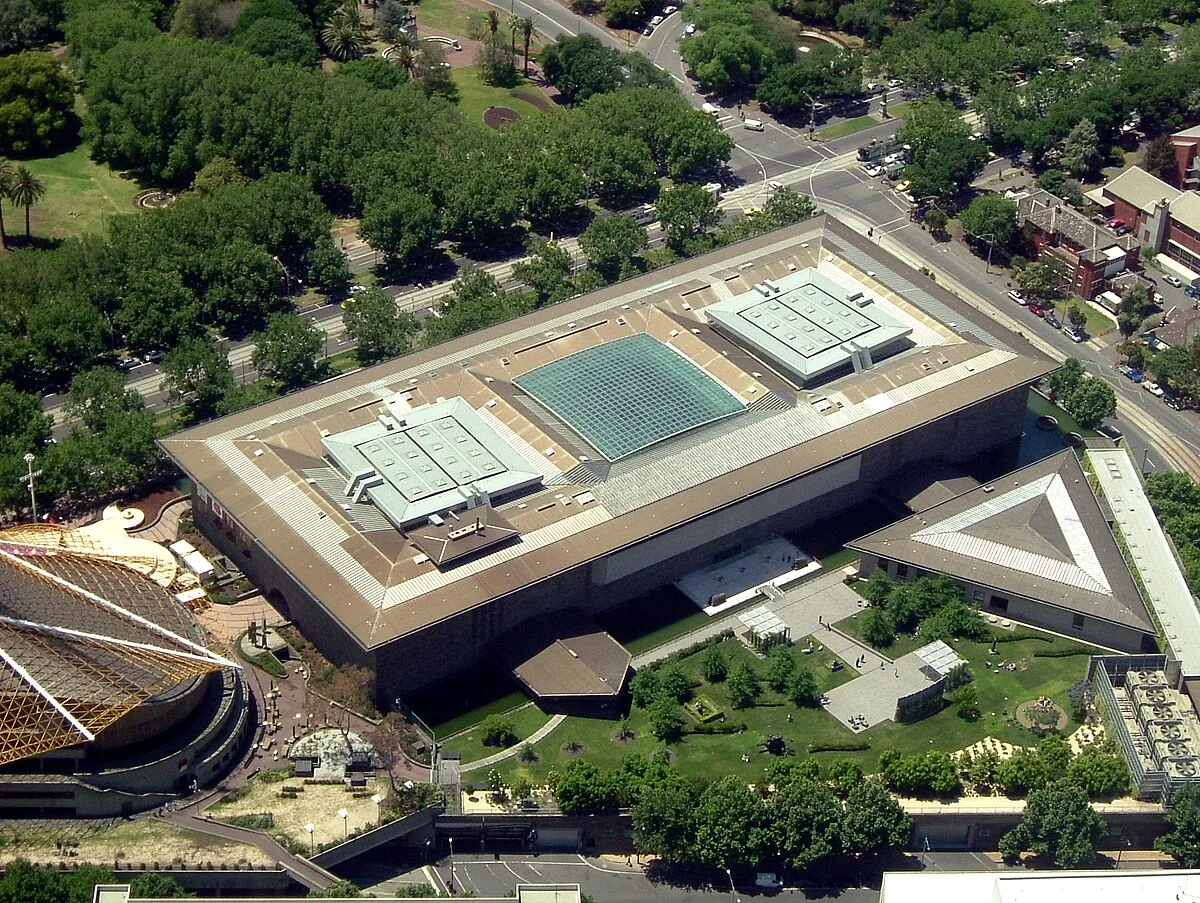
Approaching the bluestone monolith on St Kilda Road
Approaching the bluestone monolith on St Kilda Road, you encounter a landmark that breathes with the city of Melbourne itself. The National Gallery of Victoria, or the NGV International as locals call it, presents a formidable grey facade that seems to hold the weight of history, yet it is softened by a continuous sheet of water cascading down the glass entrance. Through this water wall feels like a baptism into a different realm where the urban hum of passing trams and city traffic is instantly swallowed by an expansive, airy silence. The building is a masterpiece of mid-century brutalism refined by a sense of playfulness, most evident in the way the sunlight dances across the moat that surrounds the perimeter. Inside, the architecture transitions from the solid, earthy texture of Victorian basalt to the ethereal brilliance of the Great Hall, creating a journey that is as much about the space as it is about the art it contains.
Approaching the bluestone monolith on St Kilda Road, you encounter a landmark that breathes with the city of Melbourne itself.
Sir Roy Grounds, one
Sir Roy Grounds, one of the most influential figures in Australian modernism, designed this fortress of culture to stand as the centerpiece of the Victorian Arts Centre in the 1960s. He drew inspiration from the traditional moated castles of Europe but executed his vision with a distinctly Australian stoicism, choosing the dark, volcanic bluestone that defines the local landscape. Opening its doors in 1968, the gallery marked a shift in how the nation engaged with the world, moving away from purely colonial influences toward a broader, more sophisticated global perspective. In the early 2000s, Italian architect Mario Bellini led a major renovation that opened up the internal courtyards, flooding the formerly dark galleries with natural light. This evolution ensured the building remained a living, breathing part of the 21st century while preserving the bold, geometric integrity of Grounds’ original sketches.
Lying flat on your back on the woollen carpets of the Great Hall, The world above you dissolve into a kaleidoscopic fractured sky. This is Leonard French’s stained-glass ceiling, a colossal jewel of twenty thousand hand-cut pieces of glass that cast shifting prisms of indigo, scarlet, and gold across the floor. You catch here is a soft, reverent murmur, broken only by the distant echo of footsteps on the staircase. A strange, weightless tranquility as you drift between the high-ceilinged galleries, moving from the austere quiet of the European masters to the vibrant, energetic spaces dedicated to contemporary Asian and African works. The bulk of visitors move quickly toward the famous blockbusters, but The peaceful sculpture gardens in the rear, where It smells of wet stone and native fern. What remains with you is the walk back through the water wall at dusk, when the lights of the city begin to shimmer through the glass, blurring the line between the curated sanctuary and the wild energy of the street. Reaching the gallery is a centerpiece of the Melbourne experience, situated just a short stroll across the Princes Bridge from Flinders Street Station. The walk takes you over the Yarra River, where the breeze often carries a hint of eucalyptus from the nearby botanical gardens. Countless trams run along St Kilda Road, dropping passengers directly in front of the massive bluestone archway. This boulevard is the city's cultural artery, and arriving on foot allows you to appreciate the deliberate symmetry of the building as it rises from its moat, a solid anchor amidst the flickering shadows of the surrounding elm trees.
The Experience
The temperature change as you step into the bluestone halls, where the air is kept at a crisp, museum-standard chill that carries a faint, clean scent of floor wax and old canvas. The light in the Asian galleries is subtle and focused, making the ancient bronze and porcelain appear to glow from within. The mass of the plush, acoustic-dampening quality of the gallery floors, which seems to slow your pace and encourage a longer gaze. The thing most visitors overlook is the intricate pattern of the bluestone walls themselves, where the bubbles in the volcanic rock create a natural, organic texture that contrasts with the precise geometry of the building. What sticks with you is the sound of the water wall outside, a constant, white-noise hum that creates a sensory boundary between the chaos of the city and the curated peace within.
The temperature change as you step into the bluestone halls, where the air is kept at a crisp, museum-standard chill that carries a faint, clean scent of floor wax and old canvas.
Why It Matters
The National Gallery of Victoria matters as the cultural memory of the city, housing a collection that spans millennia and continents. It is proof of the wealth and ambition of 19th-century Melbourne, yet it has successfully reinvented itself as a modern, accessible forum for contemporary global issues. Humanly, it provides a democratic space where the world’s greatest artistic achievements are accessible to everyone, free of charge, in a building that is an artwork in its own right.
Why Visit
Other galleries have the prestige, but the NGV has an architectural soul that makes the act of visiting an event in itself. You visit because of the stained-glass ceiling and the water wall, features that turn a museum trip into a tactile, absorbing visit. It offers a sense of scale and ambition that you simply won't find in the more traditional, white-cube galleries elsewhere.
✦ Insider Tips
- 1
Touch the glass on the water wall as you enter; the vibration of the cascading water is a surprisingly grounding sensory experience.
- 2
Visit on a Friday night during the major exhibition seasons for live jazz and a cocktail bar set up right in the middle of the 18th-century European galleries.
- 3
Look for the 'hidden' courtyard galleries on the upper levels, which often house smaller, more experimental installations in a much quieter atmosphere.
- 4
Check the schedule for the free daily highlights tour, which often reveals the scandalous backstories behind the most famous paintings in the collection.