Melbourne nearly demolished this palace of industry to build a car park, forgetting that its soaring dome once held the very first breath of Australia’s fledgling democracy in 1901.
About Royal Exhibition Building
The building was the centerpiece of the 1880 International Exhibition, an event so massive it attracted twice the population of Melbourne at the time. Architect Joseph Reed drew from Byzantine, Romanesque, and Renaissance styles, creating a 'temple of progress' that could be seen from miles away. After the exhibition era faded, the hall served various lives: an emergency hospital during the 1919 Spanish Flu, a migrant reception center, and a venue for Olympic weightlifting in 1956. In the 1970s, it narrowly escaped demolition thanks to a passionate grassroots campaign that recognized it as a rare survivor of the international exhibition movement. It finally achieved UNESCO status in 2004, not just as a beautiful structure, but as a result of a global era of shared knowledge and industrial pride.
Royal Exhibition Building in Australia
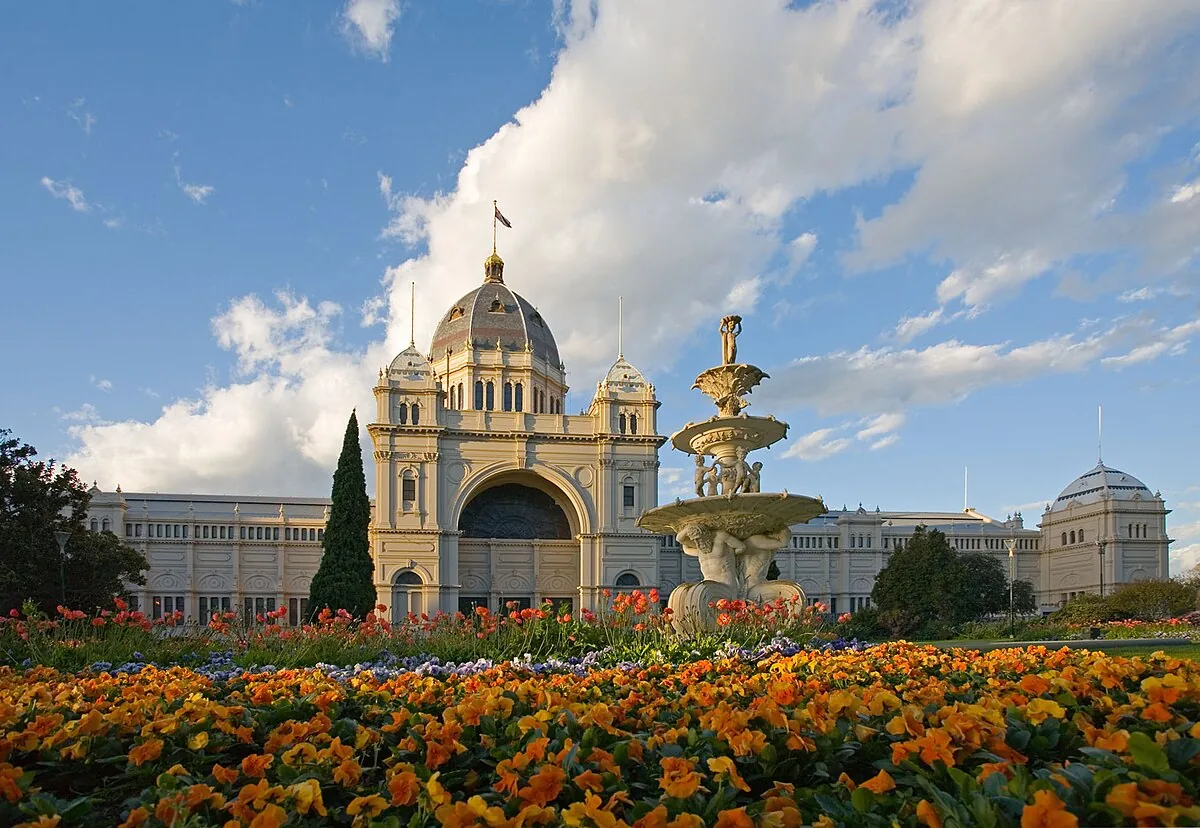
Rising above the manicured greenery of Carlton Gardens, the Great Hall of the Royal Exhibition Building is a defiant cathedral to the optimism of the nineteenth century. Its soaring dome, modeled after the Duomo in Florence, creates a silhouette that feels strikingly European against the bright, sharp light of the Australian sky. The exterior is a wedding-cake layer of cream brick and intricate stonework, softened by the shadows of giant Moreton Bay figs that have stood guard since the 1880s. Walking toward the northern entrance, The gravel crunch beneath your feet and smell the sweet, damp mulch of the gardens mixed with the distant ozone of the city. This structure remains one of the world's last surviving Great Exhibition buildings, a relic of a time when nations gathered to display the fruits of the industrial revolution under a single, magnificent roof.
Joseph Reed, the architect who shaped much of Melbourne's Victorian identity, designed this hall in a frantic fever for the 1880 International Exhibition. The city was then 'Marvellous Melbourne,' flush with gold-rush wealth and eager to prove its worth on the global stage. For six months, over a million people filed through these doors to gawk at steam engines, fine silks, and the latest electric marvels. The building took on its most solemn role in 1901, when it hosted the opening of the first Parliament of the Commonwealth of Australia, effectively serving as the cradle of the nation. It survived the subsequent decades of urban renewal that claimed so many of its contemporaries, including a close brush with the wrecking ball in the mid-twentieth century when it was dismissed as an outdated white elephant. Its survival and eventual recognition as Australia's first UNESCO World Heritage-listed building in 2004 was a victory for those who saw the poetry in its limestone and timber.
Standing beneath the Great Dome,
The way the light filters through the high clerestory windows, illuminating the sprawling hand-painted murals that depict the virtues of industry and the arts. You catch is vast and echoing, where even a soft footfall on the polished timber floorboards carries a resonant, hollow depth. The cool, solid presence of the heavy interior columns, their surfaces smooth and painted in a palette of muted greens and golds. The majority of visitors stick to the ground floor, but The intricate iron lacework of the upper galleries, where the perspective shifts to reveal the true scale of the nave. The piece that stays with you is the Promenade Deck tour, where you emerge onto the roof to find the city's modern glass skyscrapers peering down at you, creating a startling contrast between the ornate Victorian past and the sleek, vertical present. What you catch first is the scent of dry, old wood and floor wax, a comforting, library-like aroma that lingers in the stagnant air of the higher reaches. Reaching the building involves a short, pleasant walk from the northern edge of Melbourne's central business district, crossing the wide boulevards into the serenity of Carlton Gardens. The city's iconic tram network stops right at the Victoria Parade corner, depositing you into a world that feels decades removed from the nearby traffic. For those arriving by train, Parliament Station offers an exit that leads directly into the southern end of the parkland. This approach through the trees allows the dome to reveal itself gradually, a white crown emerging from the foliage that signals your arrival at the geographic and historical heart of the city.
The Experience
A drop in temperature as you step from the sun-drenched gardens into the cavernous interior, where the air feels still and heavy with the ghosts of a million visitors. The light has a dusty, amber quality that softens the edges of the monumental archways. The slight vibration of the city's tram lines through the floor, a subtle reminder that the modern world is pulsing just beyond these thick Victorian walls. The thing most visitors overlook is the Hochgurtel Fountain outside, whose intricate figures were designed to represent the 'taming' of the Australian wilderness. What sticks with you is the view from the balcony, where the symmetry of the gardens perfectly mirrors the disciplined order of the building’s internal grid.
Why It Matters
The Royal Exhibition Building matters because it is the only major hall from the 1880 and 1888 world fairs that still stands in its original parkland setting. It is a physical record of the 'International Exhibition' phenomenon that defined the nineteenth century. Humanly, it represents a bridge between colonial identity and national sovereignty, housing the moment Australia officially became a country.
Why Visit
Modern stadiums have the scale and cathedrals have the silence, but only this building has the theatrical grandeur of a world that believed everything was possible through science and art. You visit because it is a rare chance to stand inside the nineteenth century’s version of the future. It offers a sense of architectural optimism that modern buildings rarely attempt to replicate.
✦ Photo Gallery
Best Season
🌤 Visit in March during the Melbourne International Flower and Garden Show when the hall is filled with the scent of thousands of lilies and the surrounding parkland is at its most vibrant.
Quick Facts
Best time to visit
Visit in March during the Melbourne International Flower and Garden Show when the hall is filled with the scent of thousands of lilies and the surrounding parkland is at its most vibrant.
Getting there
In Melbourne, Australia; reach Melbourne first, then continue to the site.
What's nearby
Queen Victoria Market and National Gallery of Victoria are also in the area.
Location
Melbourne, Australia
Type
attraction
Coordinates
-37.8047°, 144.9714°
Insider Tips
- 1
Book the Promenade Deck tour well in advance to access the rooftop views that were off-limits to the public for over a century.
- 2
Look for the original 1901 federation murals in the dome, which were carefully restored to their vibrant, original colors using eighteenth-century techniques.
- 3
Walk the path between the building and the Melbourne Museum at night to see the facade illuminated by a soft, cinematic white light.
- 4
Search for the small, discreet markings on the floorboards that still indicate where various national displays were positioned during the 1880 exhibition.
- 5
Enter through the southern doors at midday when the sun is directly overhead to see the light perfectly centered within the Great Hall’s axis.