Nearly ten thousand early Melburnians still rest beneath the asphalt of the fruit sheds, making this vibrant food hall quite literally the most spirited marketplace in the Southern Hemisphere.
About Queen Victoria Market
The market began its life as a series of disparate stalls for hay and corn before consolidating into a municipal powerhouse in the late 1870s. It was a site of tension and triumph, where Chinese market gardeners, Italian immigrants, and Greek merchants slowly wove their cultures into the Australian diet. The Meat and Fish Hall, with its decorative parapets and cool interior, was completed in 1869, predating the official market designation by nearly a decade. During the mid-20th century, it became the primary distribution point for the city’s fresh food, a role that survived even as the surrounding neighborhoods modernized. Its preservation in the 1970s remains one of the city's greatest heritage victories, ensuring that the legacy of the Old Melbourne Cemetery and the early pioneers remains part of the daily urban fabric.
What Queen Victoria Market actually is
Seven hectares of sprawling Victorian sheds and active open-air aisles form the culinary heart of Melbourne, a place where the city’s immigrant history is written in the price of heirloom tomatoes and the scent of roasting coffee. Queen Victoria Market is a gritty, glorious survivor of a bygone era, its grand facade hiding a labyrinth of commerce that has outlived countless supermarkets and high-rise developments. Through the gates, you are immediately enveloped by a sensory storm where There is a brine of fresh oysters, the yeast of sourdough, and the metallic tang of the butcher’s hall. It is a cathedral of the everyday, where the rituals of grocery shopping are elevated to a performance involving shouting fruit mongers and the rhythmic thumping of scales.
“Queen Victoria Market is a gritty, glorious survivor of a bygone era, its grand facade hiding a labyrinth of commerce that has outlived countless supermarkets and high-rise developments.”
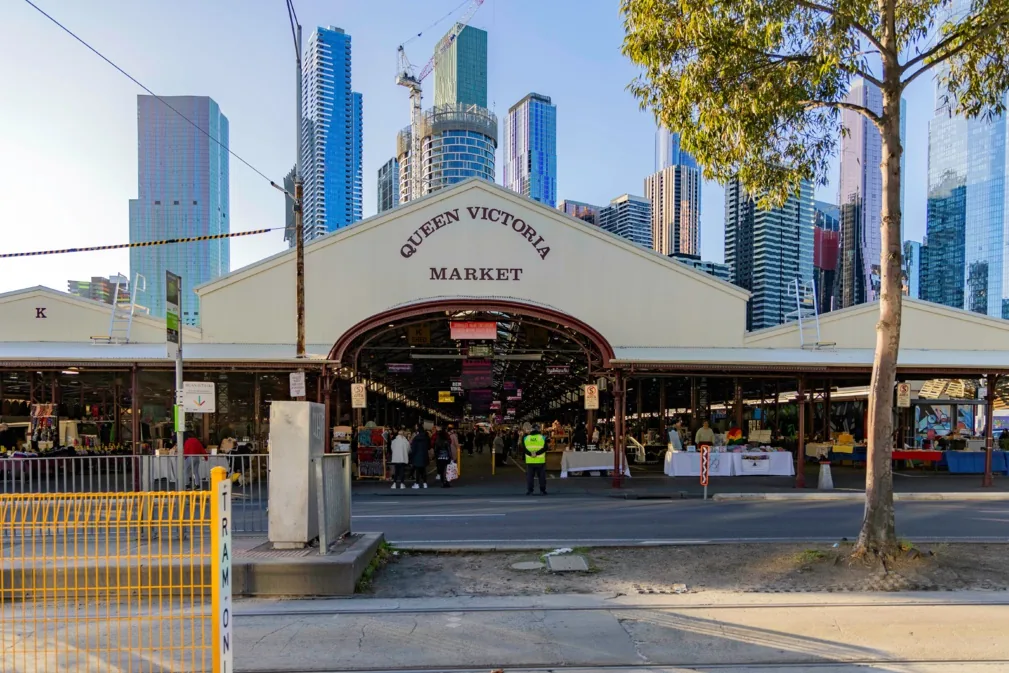
Queen Victoria Market, Australia
Opening officially, 1878
Opening officially in 1878, the market occupies a site with a dark and layered history, having been built directly over the top of Melbourne's first general cemetery. While the grander monuments were moved, thousands of early settlers still lie beneath the asphalt of the upper fruit and vegetable sheds, a fact that adds a quiet, ghostly weight to the early morning trade. Throughout the late 19th and early 20th centuries, the market grew in fragments, with the magnificent Meat and Fish Hall standing as a prime example of Victorian architecture with its lofty ceilings and intricate tile work. It survived numerous attempts at demolition in the 1970s, saved only by a fierce campaign from locals who refused to let their heritage be paved over for office blocks. Today, it remains the largest open-air market in the Southern Hemisphere, a living bridge between the colonial past and the hyper-diverse present.
Standing in the center of the Deli Hall , The sound of the city fades into a localized roar of bartering and the sharp clatter of espresso cups. The light at mid-morning filters through the clerestory windows in dusty, golden shafts, illuminating mountains of aged Manchego and strings of cured chorizo. The sense is the sudden chill of the Meat Hall, where the air smells of sawdust and cold iron, and the butchers possess a vocal range that can be heard three aisles away. The majority stick to the souvenir stalls, but The quiet expertise of the produce vendors who can tell you the exact farm where a head of garlic was pulled from the earth. The piece that stays with you is the first bite of a hot jam donut from the vintage van outside, the sugar coating your fingers while the winter wind whistles through the iron rafters. The vibrant, caffeinated energy of a city that takes its food with a side of historic soul. Reaching the market is a central part of the Melbourne morning, usually involving a ride on the free city circle tram that stops right at the intersection of Elizabeth and Victoria Streets. The walk from the central business district takes you through the evolving northern edge of the city, where the scent of baking bread begins to overpower the urban exhaust. For those driving, the upper car park offers a rare expanse of open space, though navigating the narrow lanes during peak Saturday trade requires a level of patience usually reserved for saints. Arriving on a Tuesday or Thursday morning allows for a more contemplative experience, where the pace is slower and the interaction with the stallholders becomes the highlight of the journey.
The Experience
The opening moment is the temperature drop as you enter the thick-walled stone halls, where the scent of brine and sawdust feels like a step back into the 19th century. Overhead, is an unfiltered melody of 'dollar-a-bag' chants and the hissing of milk frothers at the coffee counters. You come across a sticky warmth of a paper bag filled with donuts and the weight of a heavy wheel of brie in your satchel. The thing most visitors overlook is the intricate wrought-iron work on the shed pillars, which still bears the marks of a century of use. The piece that stays with you is standing at a communal table at 8:00 AM, surrounded by chefs and retirees alike, all unified by the simple pursuit of the perfect borek.
Why It Matters
Queen Victoria Market matters as a democratic sanctuary where high-end gastronomy and budget-friendly trade coexist without pretense. It is a physical timeline of Melbourne's migrant success stories, reflecting every wave of arrival through the changing varieties of olives, spices, and cheeses on offer. Humanly, it is a rare urban space that forces people to interact, haggle, and share a meal in an increasingly digital world.
Why Visit
Other cities have modern food halls with polished floors, but Melbourne has a living, breathing relic that still gets its hands dirty. You visit because the atmosphere is unmanufactured and the history is literally under your feet. It offers the kind of grit and authenticity that cannot be replicated by a developer's blueprint.
Insider Tips
- 1
Head to the American Doughnut Kitchen van early in the morning; the line moves fast, but the jam is hottest and the dough softest before the lunch rush.
- 2
Look for the borek shop in the Deli Hall for a three-dollar lunch that has sustained Melbourne students and artists for decades.
- 3
Avoid visiting on Mondays and Wednesdays when the market is closed, or you will find only empty sheds and circling seagulls.
- 4
Search for the specific spice merchants who will blend a custom dukkah or curry powder for you right on the spot.
- 5
Bring your own reusable bags and containers; the vendors appreciate the sustainability and you will avoid the inevitable plastic struggle of a heavy produce haul.