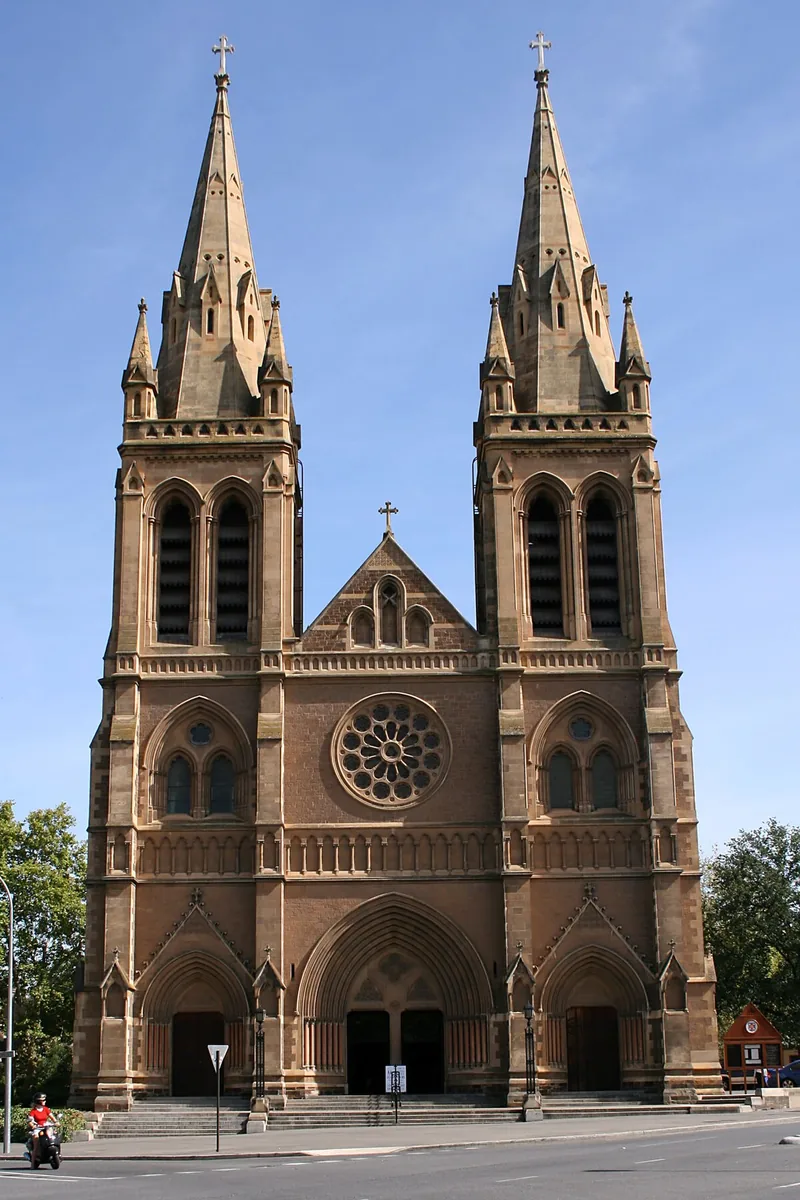
Cricket commentators call it the 'Cathedral End' for a reason, as these twin spires have stood watch over every boundary hit at the world’s most beautiful oval since 1902.
About St Peter's Cathedral
The cathedral’s birth was marred by a scandalous Supreme Court case in 1855, which stripped the Anglican Church of its original site in the city center. This forced Bishop Augustus Short to look toward the suburban heights of North Adelaide, where construction finally commenced in 1869 under the watchful eye of architect Edmund Wright. Over the next four decades, the building grew in bursts of stone and glass, surviving economic depressions and shifting architectural tastes. The Great West Window was installed in 1890, a masterpiece depicting Christ in Majesty that survived the long voyage from London’s glass studios. By the time the bells were dedicated in 1947, the cathedral had evolved from a controversial colonial project into the spiritual heart of the state, serving as a silent witness to South Australia’s transition from a distant outpost to a sophisticated modern capital.
About St Peter's Cathedral
Rising above the manicured greenery of North Adelaide, the twin limestone spires of St Peter's Cathedral act as a Gothic anchor in a city defined by its orderly grid. This is not the dark, brooding Gothic of Northern Europe, but a sun-drenched interpretation crafted from warm South Australian sandstone and Tea Tree Gully limestone. The facade, inspired by the grand lady of Paris, Notre Dame, greets you with a magnificent rose window that catches the low afternoon sun, igniting the interior in a slow-motion explosion of color. Walking toward the entrance, the city’s roar softens into a gentle hum passing through the heavy timber doors into a sanctuary where the air feels several degrees cooler and noticeably stiller. It is a space of immense verticality, where the eyes are instinctively pulled upward toward the intricate vaulted ceilings and the soft, dusty light filtering through decades of storied glass.
of South Australia, 1847
Bishop Augustus Short arrived in the fledgling colony of South Australia in 1847 with a thousand pounds and a vision for a mother church, but the path to its completion was anything but holy. A bitter legal battle ensued over his original choice of land in Victoria Square, leading the Bishop to eventually secure this acre of North Adelaide soil. The first foundation stone was laid on St Peter’s Day in 1869, beginning a construction saga that would span thirty-five years and multiple architects. While the original plans were drafted by William Butterfield, they were later refined by local architect Edmund Wright to better suit the colonial aesthetic and budget. The cathedral was built in five distinct stages, mirroring the growing wealth and confidence of Adelaide itself, with the final spires only reaching their full height in 1902. It remains a physical archive of the city’s early Protestant establishment, funded by the pennies of the faithful and the deep pockets of the colonial elite.
Standing in the nave during a morning rehearsal , The soundscape is dominated by the thunderous, rib-shaking resonance of the organ’s 3,500 pipes. The light at this hour is particular, casting long, violet shadows across the encaustic floor tiles and illuminating the fine, suspended dust motes like a veil of silver. A sense of the smooth, cool texture of the carved oak pews and the rougher, honest grain of the massive reredos behind the altar, which is widely considered one of the finest timber carvings in the Southern Hemisphere. The majority of visitors look straight at the high altar, but The quiet intimacy of the Lady Chapel, where the air smells faintly of beeswax and spent lilies. The element that stays with you is the 'Cathedral end' of the nearby Adelaide Oval during a cricket match, when the spires peek over the stadium stands, blending the sacred with the national religion of sport. The presence of the weight of history in the memorials lining the walls, telling tales of explorers and pioneers who once knelt on these very stones.
Located on Pennington Terrace, the cathedral
Located on Pennington Terrace, the cathedral is a centerpiece of the North Adelaide landscape and is easily reached via a twenty-minute walk from the city center across the River Torrens. Many visitors choose to arrive via the free city connector bus, which stops just a few meters from the main gates. Arriving on foot allows you to appreciate the deliberate contrast between the modern architecture of the Adelaide Oval next door and the ancient, pointed arches of the cathedral. The approach from King William Road offers the most iconic view, where the building suddenly emerges from behind a screen of Moreton Bay figs, its golden stone glowing against the often-cloudless South Australian sky.
The Experience
How the light catches the crimson glass in the war memorial windows, casting a bloody, reverent glow over the names of the fallen. Audibly, the of the bells, known for their rare and complex peals, creates a rhythmic vibration that you can feel in your chest as you walk the perimeter gardens. A hint of the transition from the dry, eucalyptus-scented heat of the parklands to the damp, stone-heavy atmosphere of the interior. The thing most visitors overlook is the intricate carving of the pulpit, where tiny, hidden figures of saints emerge from the dark wood. The detail that stays with you is the sudden hush that falls over the nave at dusk, when the shadows of the vaulted arches stretch across the floor like the ribs of a great stone ship.
Why It Matters
St Peter's Cathedral matters as a rare southern example of French-influenced Gothic Revival architecture, standing as a monument to the craftsmanship of 19th-century stonemasons. It represents the 'City of Churches' moniker at its most ambitious, acting as a cultural hub for music and state ceremony. Beyond its religious function, it is an essential piece of Adelaide’s skyline, providing a sense of permanence and European heritage in a landscape of modern glass.
Why Visit
Other cathedrals offer history, but St Peter's gives a particular marriage of colonial grit and high-church beauty. You visit because the acoustics are among the best in the country, turning a simple choral evensong into a transcendent auditory event. It is a place where you can find absolute silence just a stone's throw from the city's most energetic sporting stadium.
✦ Photo Gallery
Best Season
🌤 Visit in November or December when the jacarandas are in bloom nearby, their purple flowers providing a stunning natural frame for the golden sandstone of the spires.
Quick Facts
Best time to visit
Visit in November or December when the jacarandas are in bloom nearby, their purple flowers providing a stunning natural frame for the golden sandstone of the spires.
Getting there
In Adelaide, Australia; reach Adelaide first, then continue to the site.
What's nearby
Adelaide Botanic Garden is also close by.
Location
Adelaide, Australia
Type
attraction
Coordinates
-34.9128°, 138.5981°
Insider Tips
- 1
Attend a Choral Evensong service on a Sunday evening to experience the full acoustic power of the choir and organ in their intended setting.
- 2
Look for the 'Cathedral End' of the Adelaide Oval from the northern parklands to see why this is considered the most scenic backdrop in world cricket.
- 3
Join a guided tour on Wednesday at 11:00 AM to gain access to the more hidden memorials and learn the specific stories behind the stained glass scenes.
- 4
Search for the 'Bishop’s Throne,' an incredibly detailed piece of woodwork that many people walk right past on their way to the main altar.
- 5
Take a moment to sit in the gardens on the southern side; the perspective of the spires from here is the most photogenic and least crowded.