“A king tide once flooded the front rows so deeply that patrons watched the film with their feet tucked onto their chairs, while the screen reflected perfectly in the rising saltwater.”
About Sun Pictures
Ted Hunter’s transition from merchant to cinema mogul in 1916 marked the birth of a cultural icon that has outlasted almost every other theater of its kind. The venue served as the social glue for a frontier town populated by divers from Japan, Malaysia, and the Philippines, though it remained a site of colonial segregation until well into the 1960s. Lord Southborough and a party of pearlers were among the first to grace its jarrah floorboards, witnessing the transition from silent film to the first 'talkies' in 1933. It survived the aerial bombardment of World War II, which claimed the lives of many in the harbor just blocks away, and stood firm against the 170-kilometer-per-hour winds of Cyclone Rosita in 2000. Today, it works as a listed heritage site, no longer a place of social division but a communal sanctuary for film lovers.
What Sun Pictures actually is
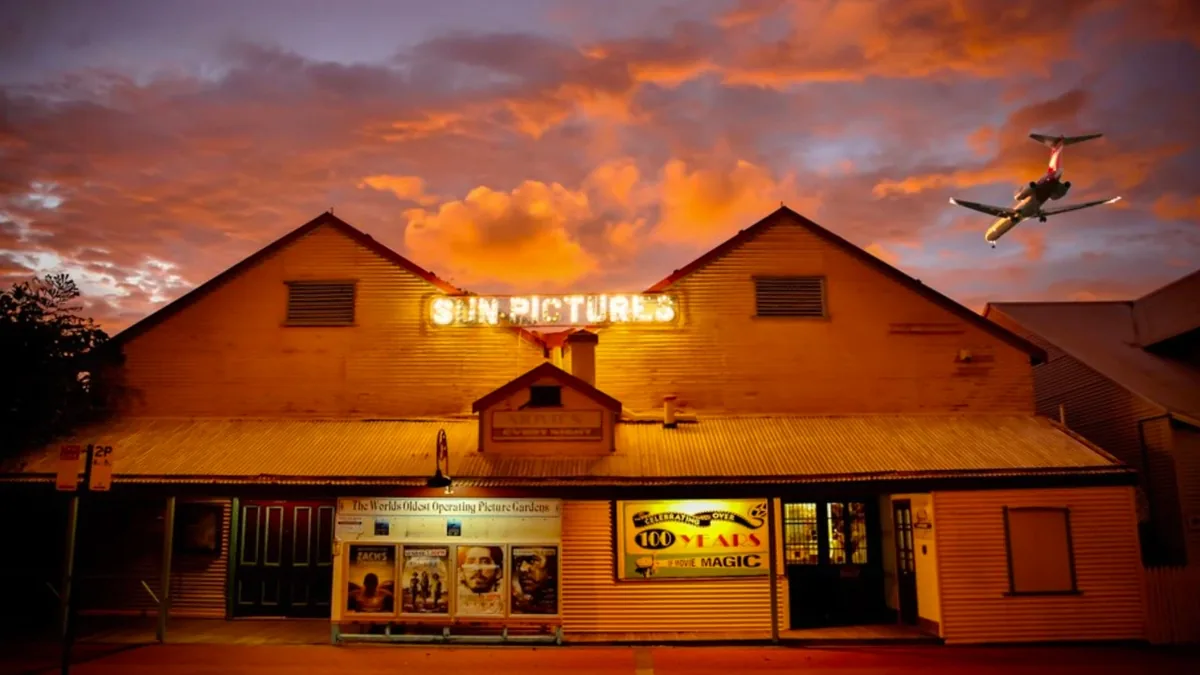
Deep in the centre of Broome’s Chinatown, a weathered corrugated iron fence holds back the modern world to preserve a cinematic ritual that has remained largely unchanged for over a century. Sun Pictures is the world’s oldest operating picture garden, a place where the silver screen meets the velvet darkness of the Kimberley sky. Entering through the modest lobby, you leave behind the red dust of the street for an auditorium of jarrah wood and canvas deckchairs, all open to the elements. The area here is a thick, tropical cocktail of salt from the nearby Roebuck Bay, the faint sweetness of frangipani, and the buttery aroma of popcorn. It is a theater that breathes with the tides, where the cinematic experience is dictated as much by the lunar cycle as it is by the film reel.
Deep in the centre of Broome’s Chinatown, a weathered corrugated iron fence holds back the modern world to preserve a cinematic ritual that has remained largely unchanged for over a century.
Master pearler Ted Hunter originally constructed
Master pearler Ted Hunter originally constructed this site as a high-end emporium for Asian imports, but by 1916, the lure of the flickering image proved more profitable. The building was converted into a theater, opening with a silent film and a live pianist in an era when Broome was the pearling capital of the world. Its history is a reflection of the town’s own complex social fabric; for decades, the seating was strictly segregated, with Europeans in the center, Japanese and Chinese residents to the left, and Malay and Aboriginal people behind them. This rigid social geometry eventually dissolved, but the physical structure survived much greater threats, including the Japanese air raids of 1942 and the relentless battering of tropical cyclones. Every time the marsh floods during the king tides, the theater becomes an accidental island, yet the projectors have never stayed dark for long.
Sinking into a sagging canvas deckchair,
The rhythmic creak of timber and the distant, low-frequency hum of a jet engine as a flight descends toward the nearby runway. Audible here of the film is occasionally competing with the rustle of palm fronds and the chirping of geckos that cling to the wooden rafters. The sense is the humidity of the night pressing against your skin, a warmth that is slowly cut by the arrival of a sea breeze moving through the open-air gallery. Those who come are transfixed by the screen, but The way the stars overhead provide a secondary, celestial show that makes the Hollywood drama feel small. The detail that stays with you is the sudden flicker of a bat’s shadow across the beam of the projector, a wild, local edit that reminds you exactly where in the world you are. A mark of the smooth, salt-etched grain of the wooden armrests and the gentle vibration of the audience’s shared laughter under the vast Australian sky.
Finding your way to Carnarvon Street
Finding your way to Carnarvon Street is a simple matter of following the warm glow of the neon sign that has guided locals since the days of silent cinema. Located in the center of old Chinatown, the theater is a short walk from most of the town’s historic hotels and pearling boutiques. Many visitors choose to arrive just as the sun sets over Cable Beach, taking a short taxi ride or a leisurely stroll through the cooling evening air. Arriving early is essential, not for a reserved seat, but to wander through the small museum in the foyer, where the vintage projectors stand like silent, iron sentinels of a bygone age.
Finding your way to Carnarvon Street is a simple matter of following the warm glow of the neon sign that has guided locals since the days of silent cinema.
The Experience
First, the scent of the mangroves drifting in from the tidal flats, a sharp, organic contrast to the artificial sweetness of the concessions. Audible here of the film is punctuated by the occasional 'clack' of a deckchair being adjusted and the soft thud of a falling palm nut on the corrugated roof. The cool, nightly descent of the Kimberley air, making you grateful for the light sweater you nearly left in the car. The thing most visitors overlook is the original projection booth, a small iron fortress that still looks capable of weathering a storm. What remains with you is looking up during a lull in the dialogue to see the Milky Way framed perfectly by the theater's wooden eaves.
Why It Matters
Sun Pictures matters as a living relic of the early 20th-century entertainment boom, providing a rare, tangible link to the social history of the pearling industry. It is a physical embodiment of Broome’s multicultural identity and its legendary resilience against the extremes of the tropical climate. Humanly, it preserves a collective way of seeing that has been lost in the age of the air-conditioned, windowless multiplex.
Why Visit
Modern cinemas try to isolate you from the world, but Sun Pictures invites the world into the movie. You visit because there is a profound magic in watching a blockbuster while a real tropical breeze moves through the room and real planes roar overhead. It is a sensory experience that reminds you that cinema was always meant to be a public, outdoor celebration.
✦ Insider Tips
- 1
Check the flight schedule for the Broome airport; the sight of a Boeing 737 flying low over the screen is a loud, iconic part of the Sun Pictures experience.
- 2
Choose a seat toward the back to avoid the occasional dampness of the front rows if a king tide is pushing through the town's drainage system.
- 3
Visit the foyer museum twenty minutes before the feature starts to see the hand-cranked projectors that powered the theater in the silent era.
- 4
Bring a light scarf or long trousers; even in the tropics, the sea breeze coming off Roebuck Bay can feel surprisingly chilly once you are stationary.
- 5
Don't worry about the geckos on the screen; locals consider their chirping a sign of good luck and a standard part of the evening's soundtrack.