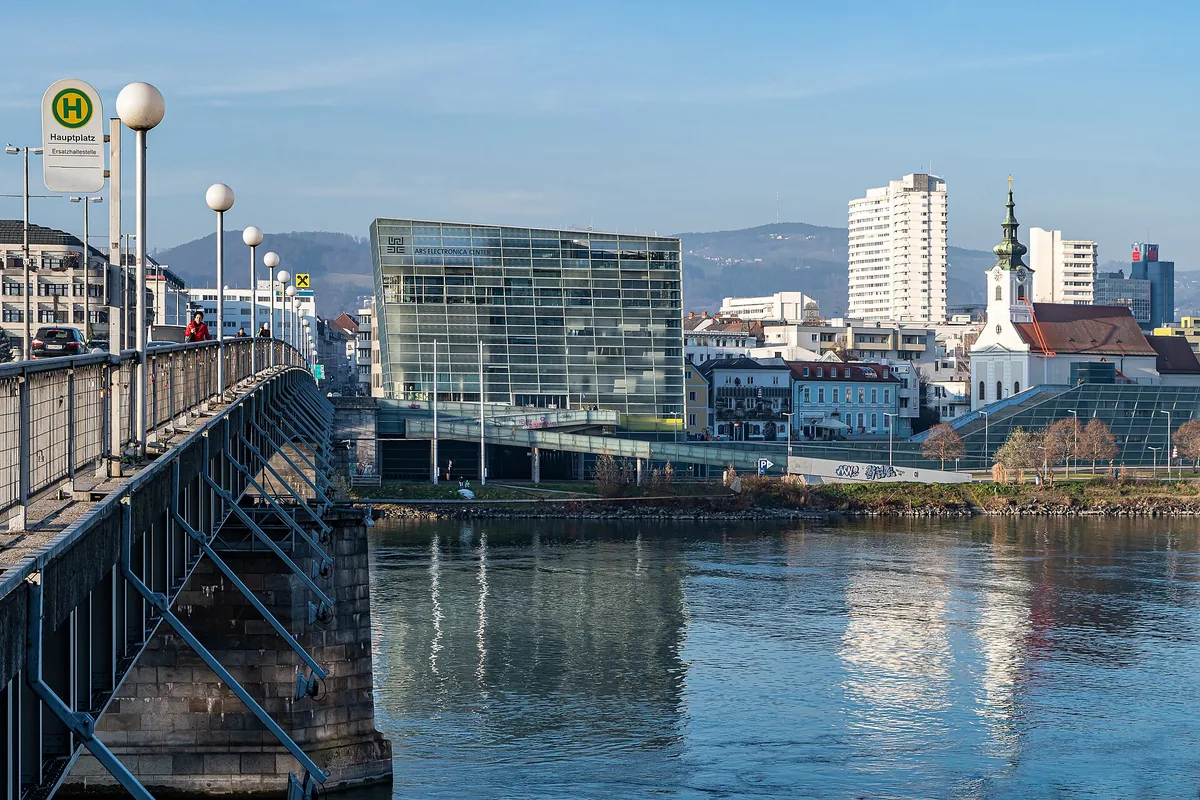
“A 5,000-square-meter glass facade functions as a giant, programmable light sculpture, housing a basement where you can edit your own DNA or walk through a digital recreation of the cosmos.”
About Ars Electronica Center
The center grew out of a small festival in 1979 that aimed to explore how computers would change our lives long before most people had ever seen one. By 1996, the first permanent building opened its doors, but the landmark achieved its current iconic status during a massive 2009 renovation that added the 5,000-square-meter LED glass skin. This expansion was led by the city's desire to shed its industrial image and embrace a future rooted in the 'creative industries.' It has since become a global crossroads where the CERN in Switzerland and NASA in the United States regularly collaborate on artistic projects. The history here isn't found in ancient dust, but in the rapid, iterative cycles of software and the evolving relationship between the human hand and the digital code.
What Ars Electronica Center actually is
Night falls over the Danube, and a giant glass ship docked on the northern bank of Linz begins to pulse with a rhythmic, multicolored glow. The Ars Electronica Center, often called the Museum of the Future, is a translucent monolith that is a living laboratory for the collision of art, technology, and society. Inside, the sterile white corridors of traditional galleries are replaced by dark, immersive spaces hummed through by the low drone of high-powered servers and the soft whirring of robotic limbs. Here, A slight metallic tang and the ozone scent of high-performance electronics, yet the atmosphere is anything but cold. It represents a rare space where the complex abstractions of artificial intelligence and biotechnology are rendered tactile, allowing visitors to reach out and touch the blueprints of the coming century.
Night falls over the Danube, and a giant glass ship docked on the northern bank of Linz begins to pulse with a rhythmic, multicolored glow.
Linz was once a soot-stained industrial powerhouse, a city defined by steel production and the heavy labor of the post-war era. In 1979, a group of visionaries launched the first Ars Electronica Festival, a daring bet that the digital revolution would become the new forge of human culture. This movement eventually found a permanent home in 1996, but the landmark we see today was vastly expanded for Linz’s stint as the European Capital of Culture in 2009. Architect Andreas Treu designed the double-layered glass facade to function as a giant screen, turning the building itself into a medium for digital art. Over the decades, it has evolved from a simple exhibition space into a global research hub where engineers and artists work side-by-side to interrogate the ethics of our digital shadow. It stands today as the primary monument of the city’s successful transition from iron to silicon.
Standing in the center of Deep Space 8K , The ground beneath your feet vanishing as 16-by-9 meter laser projections wrap the room in a three-dimensional rendering of the Galactic Center or the high-resolution brushstrokes of a Van Gogh. Overhead, the space is an enveloping, 360-degree journey that makes The literal vibration of a supernova or the delicate rustle of a digital forest. You discover a strange, empathetic spark as you interact with social robots that track your facial expressions with unsettling accuracy. The light in the biotechnology lab is cool and clinical, contrasting with the vibrant, liquid colors of the algae bioreactors that bubble softly in the corner. Most people overlook the quiet balconies on the upper floors, but The way the river reflects the building’s shifting LED colors, blurring the line between the natural water and the synthetic light. The piece that stays with you is the 'Machine Learning' exhibit, where you realize the algorithm is learning from your movements in real-time, turning your own presence into a piece of flickering data.
Reaching the center requires a simple
Reaching the center requires a simple stroll across the Nibelungen Bridge from Linz’s main square, a walk that offers the best perspective of the building's glowing skin. The Pöstlingberg tram also stops right at the doorstep, its vintage aesthetic providing a sharp, delightful contrast to the futuristic glass facade. Many travelers arrive by boat, catching sight of the illuminated monolith as they drift down the Danube from Vienna or Passau. This riverfront approach highlights the building’s role as a lighthouse for the city, a glowing beacon that signals the end of the old industrial age and the dawn of something entirely new.
Reaching the center requires a simple stroll across the Nibelungen Bridge from Linz’s main square, a walk that offers the best perspective of the building's glowing skin.
The Experience
First, the peculiar, hushed focus of the researchers in the open-view labs, where the sound of pipettes and clicking keyboards creates a rhythmic, modern lullaby. The light in the 'Deep Space' chamber is so intense that it seems to have physical weight, pressing against you as you dive through a 3D model of the human circulatory system. The cool, brushed aluminum of the interactive consoles, a texture that defines the tactile experience of the museum. The thing most visitors overlook is the 'Global Shift' terrace, which provides a panoramic view of the Linz steelworks across the water, a visual reminder of the city's heavy metal roots. What remains with you is the realization that the art isn't just on the walls, it is flowing through the cables, the light, and even your own bio-signals as you move through the space.
Why It Matters
Ars Electronica Center is the world's most significant junction for media art and digital culture, serving as a secular cathedral for the information age. It matters because it removes technology from the hands of corporations and places it into the hands of the public for questioning and play. Culturally, it acts as a mirror, reflecting our own fears and hopes about the future of the human species in an increasingly synthetic world.
Why Visit
Art museums usually ask you to look at the past, but this is the only place where you can actually play with the tools of the future. You visit because it breaks the 'do not touch' rule of traditional galleries, inviting you to become a scientist, an artist, and an explorer in a single afternoon. It offers a sensory depth that makes standard interactive exhibits feel like relics from a different century.
✦ Insider Tips
- 1
Book a specific time slot for the Deep Space 8K presentation in advance, as the high-resolution 3D tours of the universe often sell out during busy weekends.
- 2
Look for the 'Citizen's Lab' on the lower floors where you can bring your own samples for microscopic analysis, turning your visit into a personal scientific expedition.
- 3
Visit the Main Deck at twilight to watch the glass facade begin its nightly light show, which is often synchronized with live data from the city's environment.
- 4
Take the stairs rather than the elevator to see the hidden light installations tucked into the building's glass 'skin' layers.
- 5
Dine at the Cubus restaurant on the top floor; the floor-to-ceiling windows provide a view of the Danube that makes the building feel like it is floating on the water.