“Nine hundred years of military history rest upon this cliff, yet the only time this invincible fortress ever surrendered was to a general who didn't fire a single shot.”
About Hohensalzburg Fortress
The first stones were laid by Archbishop Gebhard von Helfenstein in 1077, a man who desperately needed a high-altitude sanctuary during his power struggle with the Emperor. His successor, Leonhard von Keutschach, gave the fortress its current silhouette around the turn of the 16th century, marking his reign with the image of a turnip, his family crest, which can still be found carved into fifty-eight different locations throughout the castle. The interior spaces, particularly the Golden Hall, were decorated with a level of luxury that rivaled the finest palaces in Italy, featuring blue-and-gold marbleized pillars and intricate Gothic carvings. As the centuries turned, the castle’s role shifted from a defensive powerhouse to a prison for high-ranking rebels and eventually to a barracks. Today, it is a perfectly preserved capsule of the Middle Ages, having escaped the widespread destruction common to many other European strongholds.
What Hohensalzburg Fortress actually is
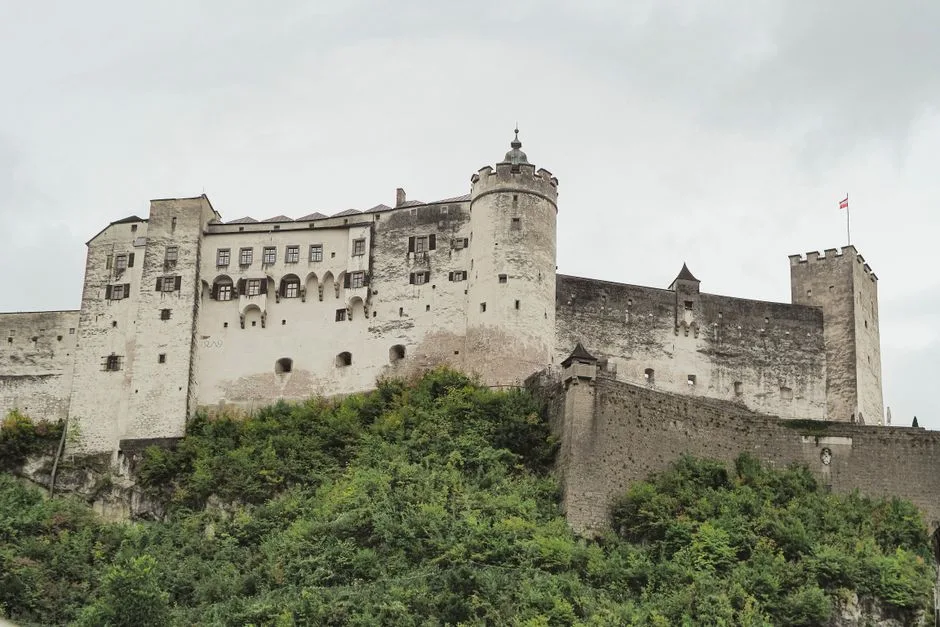
High atop the Festungsberg, a massive limestone sentinel keeps watch over the spires of Salzburg, its white walls appearing to grow directly out of the jagged grey rock. Hohensalzburg Fortress stands as one of the largest and best-preserved medieval castles in Europe, a sprawling complex that has never been conquered by force. The space up here feels different than in the valley below; it is thinner, sharper, and carries the scent of mountain pine and old stone. Moving through the heavy iron-clad gates, the city’s baroque elegance vanishes, replaced by a spread of sturdy bastions, hidden courtyards, and thick defensive ramparts. It remains a physical manifestation of the power held by the Prince-Archbishops, a brooding crown that ensures the city below never forgets its feudal past.
High atop the Festungsberg, a massive limestone sentinel keeps watch over the spires of Salzburg, its white walls appearing to grow directly out of the jagged grey rock.
Origins
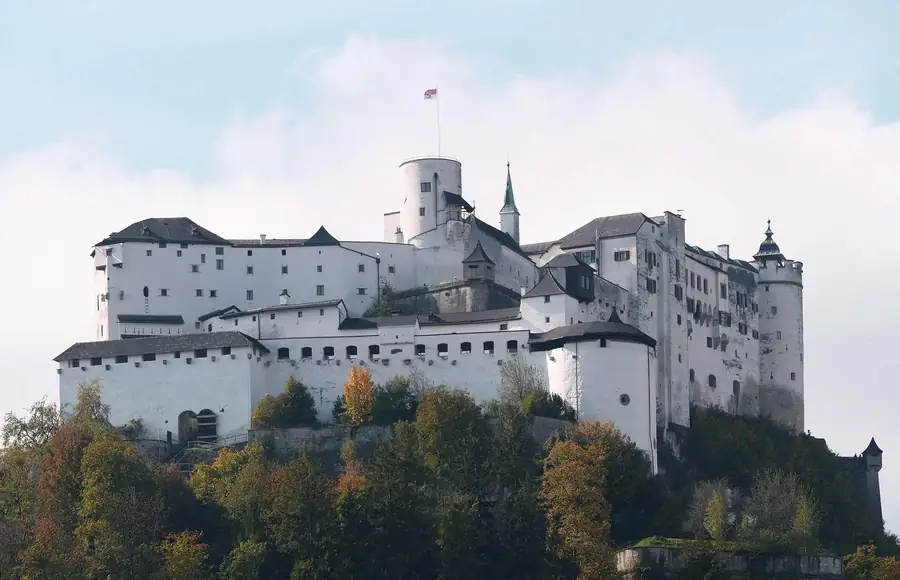
Archbishop Gebhard began this monumental undertaking in 1077 during the Investiture Controversy, seeking a refuge that could withstand the shifting political winds of the Holy Roman Empire. Through the centuries, his successors expanded the wood-and-stone fort into a sophisticated citadel, with Leonhard von Keutschach adding the most lavish touches around 1500. Keutschach was the ruler who transformed the fortress from a mere military outpost into a residence fit for royalty, installing the intricate Gothic woodcarvings and the famous 'Salzburg Bull' organ. Despite its intimidating appearance, the fortress saw very little actual combat; its most significant challenge came during the German Peasants' War in 1525, when it successfully weathered a lengthy siege. By the time Napoleon’s troops arrived in the early 19th century, the castle was surrendered without a fight, transitioning from a feared stronghold into a military barracks and eventually a world-famous monument.
Standing on the Kuenburg Bastion,
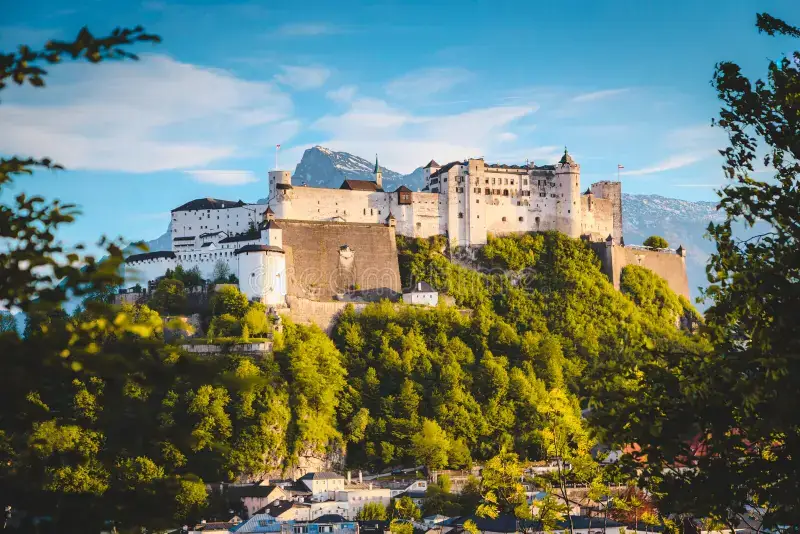
Standing on the Kuenburg Bastion, The wind whipping off the Untersberg mountain, a cooling force that makes the stone under your palms feel icy even in mid-summer. Sound-wise is a mix of the low, mechanical hum of the funicular and the distant, rhythmic pealing of the cathedral bells far below. You get a grit of ancient dust as you run your hands along the walls of the Golden Chamber, where the gilded ceiling buttons resemble a star-filled sky captured in wood. Most people rush toward the panoramic views, but The wear on the stone steps of the torture chamber, a somber reminder of the absolute authority once exercised within these walls. What stays with you occurs in the late afternoon, when the long shadows of the battlements stretch across the rooftops of the Altstadt, and the fortress seems to glow with a pale, ghostly light that separates it from the modern world. Reaching the summit is a choice between a modern mechanical ascent or a traditional climb on foot. The Festungsbahn, a sleek funicular that has operated in various forms since 1892, whisk you from the Festungsgasse to the upper courtyards in under a minute. For those who prefer the tactile experience of the mountain, a steep, winding path begins behind the cemetery of St. Peter’s Abbey. This climb allows you to see the fortress reveal itself layer by layer, from the outer defensive walls to the towering keep. Every turn offers a new perspective on the red-tiled roofs of Salzburg, making the arrival at the top feel like a hard-earned reward rather than a simple transit.
The Experience
The temperature plunging the moment you step into the inner keep, where the walls are nearly two meters thick and the sunlight rarely reaches the floor. The space smells of damp earth and centuries of hearth-fire, a scent that seems baked into the very pores of the limestone. A strange sense of isolation as you look through the narrow arrow-slits, seeing the world below as a miniature, toy-like version of reality. Most people overlook the 'Salzburg Bull,' a massive mechanical barrel organ from 1502 that still bellows across the valley three times a day. What stays with you is standing on the highest observation deck during a mountain storm, watching the clouds collide with the towers while the grey rock beneath your feet vibrates with the sound of thunder.
The temperature plunging the moment you step into the inner keep, where the walls are nearly two meters thick and the sunlight rarely reaches the floor.
Why It Matters
Hohensalzburg is the ultimate symbol of the 'Rome of the North,' representing the absolute fusion of religious and secular power that defined Salzburg for nearly a millennium. It matters as a rare, untouched example of medieval defensive architecture that survived the modernization of the 19th century. Humanly, it represents the lengths to which a society will go to protect its heart, carved directly into the mountain itself.
Why Visit
London has the Tower and Edinburgh has the Crag, but Hohensalzburg offers an architectural scale that feels like a fantasy novel brought to life. You visit because it provides a perspective on the Alps that no city-bound building can match, offering a panoramic view that bridges the gap between the urban baroque and the wild mountain peaks. It is the only place where you can feel the true weight of the Middle Ages while looking down on a Mozart-filled valley.
✦ Insider Tips
- 1
Take the early morning funicular to reach the bastions before the sun clears the mountains, allowing you to see the city in a soft, blue shadow.
- 2
Look for the 'turnip' crests of Archbishop Leonhard von Keutschach; finding all fifty-eight is a local challenge that takes you into the castle's most obscure corners.
- 3
Visit the Marionette Museum within the fortress walls for a strangely beautiful look at the city’s theatrical history through handmade wooden figures.
- 4
Walk down the mountain via the 'Nonnberg' path to see the oldest nunnery in the German-speaking world sitting against the fortress walls.
- 5
Stop at the castle tavern for a beer on the terrace; the altitude seems to make the local Salzburg brews taste crisper than they do in the town below.