Twenty-six hundred copper tiles were dipped in boiling gold just to prove to a skeptical public that the Holy Roman Emperor was not, in fact, broke.
About Goldenes Dachl
Maximilian I was a master of self-promotion, and the Golden Roof was his most enduring campaign. By adding this lavish extension to a relatively modest building, he created a permanent throne in the public eye. The artwork surrounding the balcony is a complex web of political messaging, including coats of arms from the Emperor’s various territories and images that bridge the gap between the chivalry of the Middle Ages and the burgeoning humanist ideals of the Renaissance. Even the inscriptions were designed to baffle; to this day, the characters on the banner held by the figures in the relief have never been fully deciphered, remaining a lingering linguistic puzzle from the sixteenth century. The building eventually passed into the hands of the city, transitioning from a royal box to a beloved symbol of Tyrolean independence and cultural pride.
What Goldenes Dachl actually is
Deep at the core of Innsbruck’s medieval Altstadt, a sudden flare of light often stops travelers in their tracks, as if a chest of pirate treasure had been pried open above a public square. The Goldenes Dachl, or Golden Roof, consists of 2,657 fire-gilded copper tiles that cap a grand three-story balcony. This architectural flourish was built to serve as a royal box for the Emperor, a place where he could sit in upholstered luxury and watch the life of the city unfold below. The space in the surrounding Herzog-Friedrich-Strasse carries the alpine chill of the Nordkette mountains, mixed with the buttery scent of fresh strudel from the nearby cafes. Standing beneath it, The weight of the late Gothic era, where power was expressed not just through stone walls but through the defiant, shimmering brilliance of pure gold.
“Deep at the core of Innsbruck’s medieval Altstadt, a sudden flare of light often stops travelers in their tracks, as if a chest of pirate treasure had been pried open above a public square.”
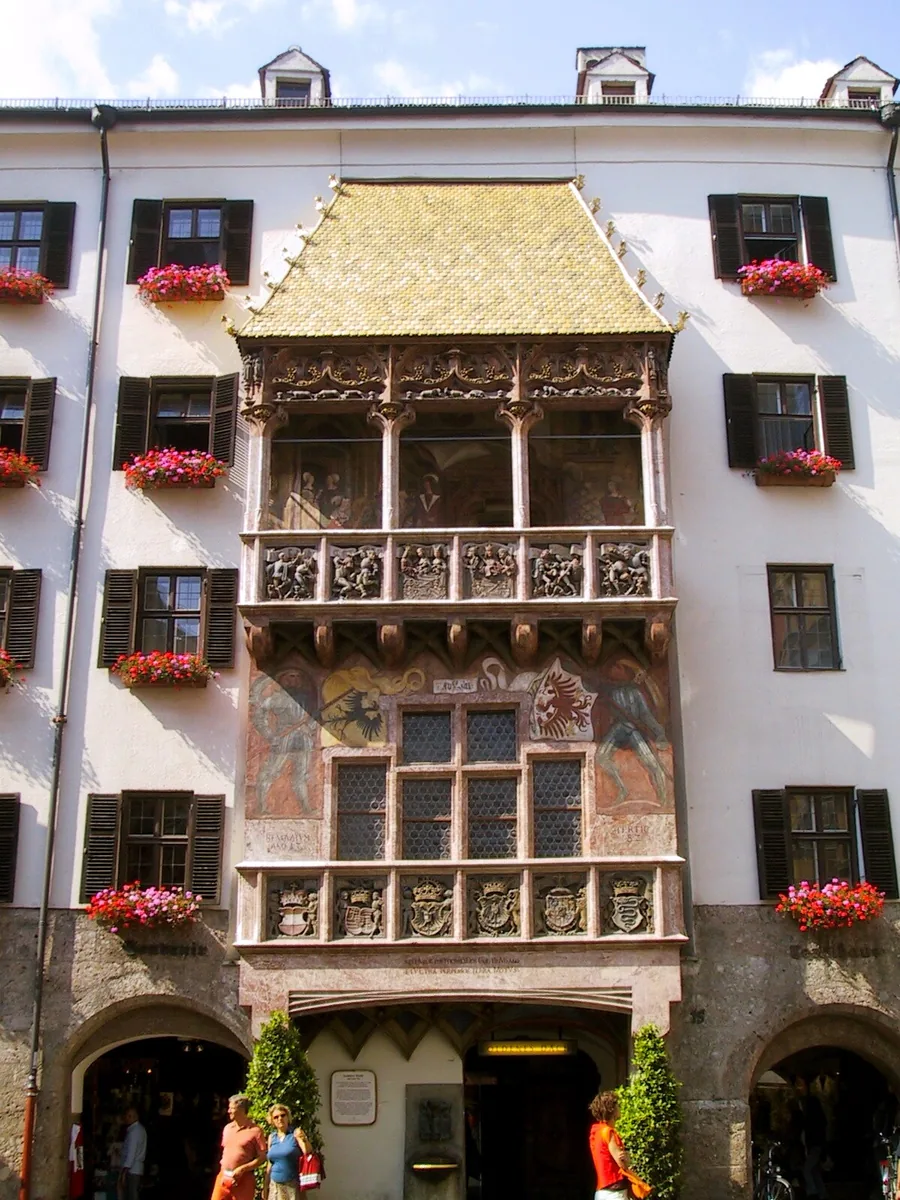
Goldenes Dachl, Austria
Background
Emperor Maximilian I commissioned this ornate loggia around the year 1500 to celebrate his marriage to Bianca Maria Sforza and to silence rumors of imperial insolvency. He chose an existing residence built by Archduke Friedrich IV, known as 'Empty Pockets,' and transformed it into a shimmering billboard of Habsburg prestige. The reliefs on the balcony depict the Emperor with both his wives, alongside images of court jesters and acrobats, reflecting a ruler who understood the value of public spectacle. Over the centuries, these tiles survived the occupation of foreign armies and the biting salt of alpine winters. During the Second World War, the entire structure was encased in a massive concrete 'bomb waistcoat' to protect it from the falling debris of air raids, emerging unscathed in 1945 to reclaim its position as the sparkling crown of the Tyrol.
Looking up from the cobblestones, the glare of the tiles is so intense at midday that it can momentarily white out your vision. What hits is the incredibly fine detail of the frescoes beneath the roof, showing scenes of everyday life and imperial heraldry that have retained their pigment against all odds. The hum of the square is a pleasant chaos of street musicians and the clatter of footsteps on stone, a noise that seems to soften entering the museum housed within the building. Inside, There is a strange intimacy standing in the very room that leads to the balcony, imagining the Emperor leaning against the railing to wave at a jousting tournament. The thing most visitors overlook is the cryptic 'Moresca' dancers depicted in the reliefs, their bodies contorted in strange, energetic poses that feel unexpectedly modern. Starting with the way the gold turns a deep, molten orange as the sun dips behind the Karwendel peaks, casting a long, regal shadow across the square.
Innsbruck’s main railway station
Innsbruck’s main railway station is a ten-minute walk from the historic center, making it easily accessible for those arriving from Salzburg or Munich. The path leads you through the Maria-Theresien-Strasse, a wide boulevard that eventually narrows into the medieval alleys of the Altstadt. Those visiting arrive on foot, as the entire area surrounding the Golden Roof is a strictly enforced pedestrian zone. This car-free environment ensures that the only sounds you hear are the bells of the nearby cathedral and the collective intake of breath when people first turn the corner and see the gold reflecting the sky.
“Innsbruck’s main railway station is a ten-minute walk from the historic center, making it easily accessible for those arriving from Salzburg or Munich.”
The Experience
The texture of the old buildings nearby, their heavy stone arches providing a dark frame for the brilliance of the roof. The light at ten in the morning is particularly sharp, hitting the tiles at an angle that makes each one distinguishable as an individual scale on a golden fish. Part of the cool draft coming from the vaulted 'Lauben' walkways that line the square, offering a shadowed retreat from the sun-drenched center. Most visitors overlook the intricate stone gargoyles that peer down from the corners, their weathered faces a stark contrast to the perfectly preserved gold. The piece that stays with you is standing in the center of the square after a light rain, when the wet cobblestones catch the yellow reflection and the entire street seems to turn into a river of liquid light.
Why It Matters
The Goldenes Dachl is the most important late Gothic monument in the Tyrol and a crucial artifact of the reign of Maximilian I. It matters as a rare example of imperial architecture that was designed specifically for public interaction rather than private seclusion. Culturally, it anchors Innsbruck's identity, serving as a record of the city's golden age as a center of European politics and art.
Why Visit
Vienna has the palaces, but Innsbruck has the jewel box. You visit because the Golden Roof represents a moment when architecture was used as pure theater, a three-story stage set that has remained standing for half a millennium. It is the only place where you can stand in the middle of a modern city and feel the literal glow of the Renaissance on your face.
Insider Tips
- 1
Climb the nearby Stadtturm (City Tower) to see the roof from an elevated perspective; looking down on the tiles reveals the intricate way they were layered to shed mountain snow.
- 2
Look closely at the relief of the 'Moresca' dancers; they are performing a Moorish dance that was a favorite entertainment at the 15th-century court.
- 3
Visit the museum inside to see the original reliefs; the ones on the exterior of the building are actually high-quality copies placed there to protect the originals from pollution.
- 4
Stand at the junction of Herzog-Friedrich-Strasse and Hofgasse for the best angle to photograph the roof against the backdrop of the snowy mountains.
- 5
Check out the 'Whispering Arch' nearby; the acoustics of the stone doorway allow you to hear a whisper from someone on the opposite side of the arch.