Human beings have been mining salt from these mountains for seven thousand years, long before the first stone was laid for the pyramids or the Roman Forum.
About Hallstatt-Dachstein Salzkammergut
The Hallstatt period began around 800 BC, marked by a wealth that allowed miners to be buried with exquisite jewelry and weapons from as far away as the Middle East. Salt was the engine of this prosperity, preserved in the mountain's cool, dry interior along with the oldest wooden staircase in Europe, discovered in the depths of the mines. During the 14th century, a pipeline made of thirteen thousand hollowed-out tree trunks was constructed to transport brine from Hallstatt to the boiling houses in Ebensee, an engineering marvel of the medieval world. The village became a UNESCO World Heritage site in 1997, not merely for its beauty, but for the unbroken chain of salt production that linked the Iron Age to the modern chemical industry.
In brief
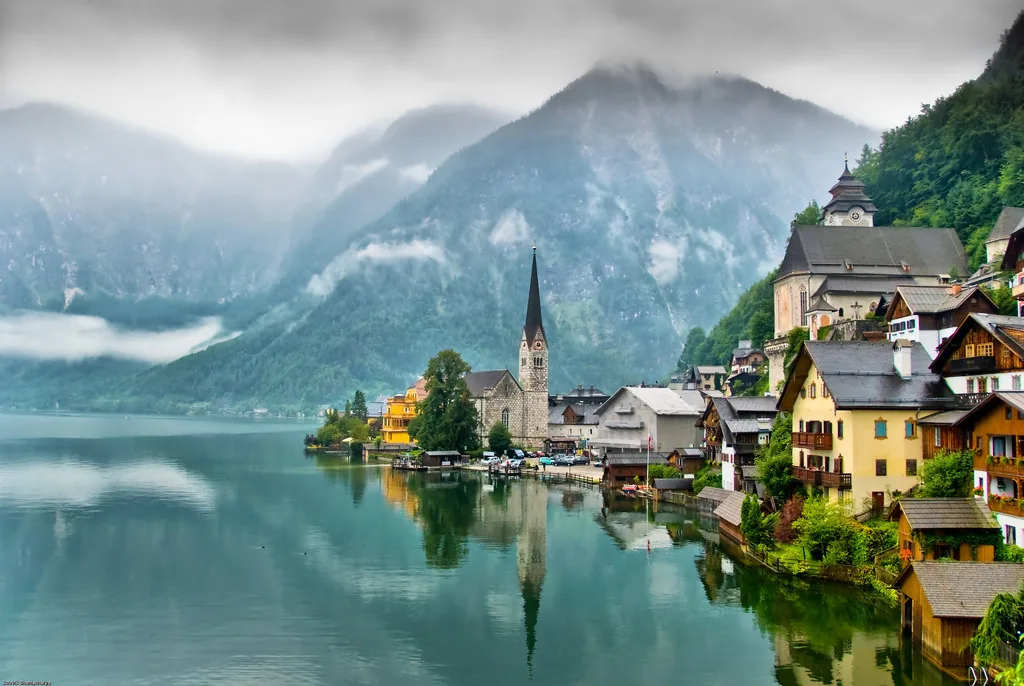
High alpine peaks cast long, jagged shadows across a lake so dark and still it looks like polished obsidian. The Hallstatt-Dachstein Salzkammergut region is a vertical landscape where human life has clung to the narrowest of ledges for over seven thousand years. Houses built of timber and stone stack on top of one another like nesting boxes, connected by steep wooden staircases and narrow alleys that smell of woodsmoke and damp slate. Above the village, the Dachstein massif rises in a wall of gray limestone, its glaciers feeding the waterfalls that hiss through the mountain crevices. This region is a living record of the salt trade, where the wealth of white gold transformed a remote mountain pocket into a center of prehistoric innovation. The mood is thick with a sense of antiquity, filtered through the cool, oxygen-rich air of the Upper Austrian Alps.
Seven millennia ago, Neolithic settlers discovered that the mountain held a heart of salt, beginning an industrial odyssey that predates the Roman Empire. These early miners carved tunnels deep into the rock using bronze picks and leather backpacks, creating a culture so distinct that an entire period of the Early Iron Age bears the name Hallstatt. The salt was a catalyst for global trade, carried across mountain passes to be exchanged for Baltic amber and Mediterranean glass. Throughout the centuries, the Habsburgs maintained a strict monopoly over the mines, treating the Salzkammergut as their private treasury. The isolation of the village was so absolute that until the late nineteenth century, it was accessible only by boat or over the treacherous mule trails of the high passes. This seclusion preserved the medieval layout of the town, ensuring that the architecture evolved with the mountain rather than against it.
Standing on the edge of the Hallstätter See in the early morning, The silence is broken only by the rhythmic splash of a traditional wooden flat-boat. The mist clings to the water's surface, slowly peeling back to reveal the reflected symmetry of the Lutheran church spire. You get a temperature drop as you ascend the salt mine funicular, where the lush greens of the valley give way to the sterile, glittering white of the subterranean salt chambers. Inside, the space the mountain is constant and metallic. The intricate wood carvings on the balconies, where geraniums spill out in a riot of red against the blackened larch wood. The piece that stays with you is looking down from the Skywalk platform, where the village looks like a miniature toy set pinned between the crushing weight of the limestone and the infinite depth of the water.
Reaching this alpine cradle requires
Reaching this alpine cradle requires a scenic journey by train from Salzburg or Vienna, usually involving a change at Attnang-Puchheim. The final approach is the most memorable, as the train pulls into a lonely station on the opposite side of the lake, leaving travelers to cross the water on a ferry named 'Stefanie.' This short voyage provides the definitive view of the village appearing from behind the mountain folds. For those driving, the road passes through a tunnel carved directly into the rock face above the town, leading to parking areas that signify the end of the motorized world. From there, the village is entirely pedestrian, requiring a slow, deliberate walk into a realm where the clock seems to have stopped around the time the first salt barrels were rolled toward the shore.
The Experience
The scent of the air changes as you climb, moving from the humid, floral sweetness of the lakeside to the dry, ozone-charged breeze of the Dachstein plateau. The light at mid-day is exceptionally sharp at this altitude, catching the glints of mica in the rocks and making the lake appear a deep, saturated indigo. A remnant of the weight of history in the Bone House, where rows of hand-painted skulls serve as a silent a result of the village's lack of burial space. A large share of visitors overlook the ancient stone carvings on the mountain paths that mark the boundaries of the old salt districts. What sticks with you is the sound of the evening bells echoing across the water, a chime that has signaled the end of the working day for miners since the Middle Ages.
Why It Matters
Hallstatt-Dachstein Salzkammergut is the quintessential example of an industrial landscape that has maintained its aesthetic and ecological integrity for millennia. It matters as a rare site where the evolution of mining technology can be traced through a single, continuous location. Humanly, it represents a triumph of adaptation, where a community flourished in a vertical world that most would have found uninhabitable.
Why Visit
Salzburg has the music and Vienna has the palaces, but Hallstatt has the primordial soul of the Alps. You visit because it is the only place where you can touch the same salt veins that sustained Iron Age kings and look out over a landscape that remains exactly as they saw it. It is a masterclass in the enduring relationship between stone and spirit.
✦ Photo Gallery
Best Season
🌤 Visit in May or early June; the apple trees are in blossom against the snow-dusted peaks, the waterfalls are at their most thunderous, and the summer crowds have yet to saturate the narrow alleys.
Quick Facts
Best time to visit
Visit in May or early June; the apple trees are in blossom against the snow-dusted peaks, the waterfalls are at their most thunderous, and the summer crowds have yet to saturate the narrow alleys.
Getting there
In Hallstatt, Austria; reach Hallstatt first, then continue to the site.
Location
Hallstatt, Austria
Type
attraction
Insider Tips
- 1
Take the ferry across the lake from the train station even if you are driving; the approach from the water is the only way to grasp the village's vertical scale.
- 2
Look for the 'Salt-Line' hiking trail which follows the world's oldest pipeline for a quieter perspective of the valley away from the main tourist routes.
- 3
Visit the Catholic Parish Church's cemetery at dusk to see the grave lanterns lit, creating a flickering field of light against the dark mountain backdrop.
- 4
Buy a bag of the locally mined 'Bergkern' salt from the small shops in the upper town; it contains eighty-four minerals and tastes noticeably different from processed salt.