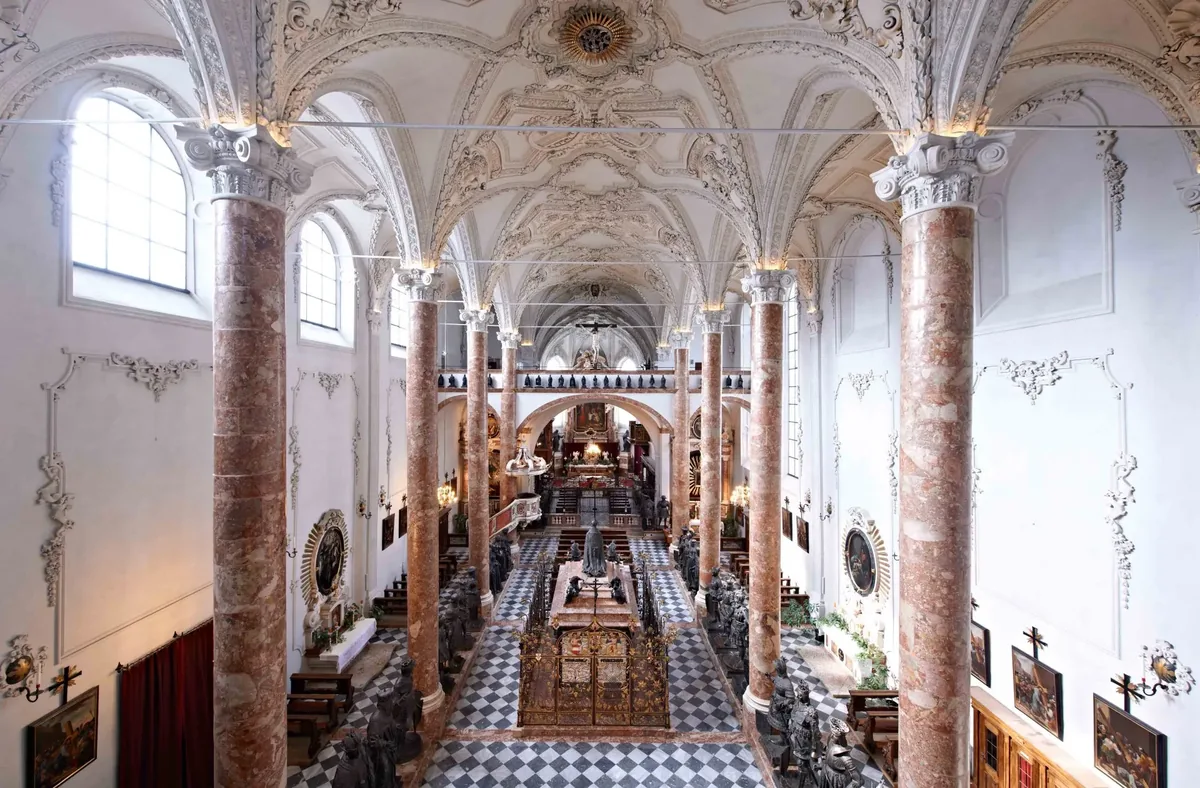
Twenty-eight massive bronze giants stand guard over a magnificent imperial tomb, yet the Emperor for whom they were built is buried over five hundred kilometers away in a completely different city.
About Hofkirche
Maximilian I, the 'Last Knight,' conceived of his memorial as a way to anchor his dynasty in the hearts of his subjects forever. Construction began in the early 1500s, pulling in the greatest artists of the Northern Renaissance, including Peter Vischer the Elder and Alexander Colin. The project was so ambitious it nearly bankrupted the local mint, and by 1553, when the church was finally dedicated, the Renaissance had already begun to shift into the Baroque. The 'Black Men' were actually cast in various foundries across the region, with the last figures completed decades after the Emperor’s death. In the centuries since, the Hofkirche has survived fires and the collapse of the Habsburg Empire, remaining a silent witness to the transition of Tyrol from a royal stronghold to a modern alpine hub.
Deep within the jagged alpine embrace of Innsbruck, a quiet courtyard gives way to one of the most startling visual paradoxes in Europe. The Hofkirche, or Court Church, appears modest from the cobblestones of the Universitätsstraße, but the interior holds a spectral gathering that has stood in silent vigil for centuries. Twenty-eight larger-than-life bronze figures, known locally as the 'Schwarzmander' or Black Men, flank the central nave, their dark metal surfaces gleaming with a dull, haunting luster. The air inside is cool and carries the faint, dry scent of ancient oak and beeswax. As the light filters through the high Gothic windows, it catches the intricate detail of bronze armor and heavy robes, creating long, dramatic shadows that dance across the marble floor. This is not just a place of worship; it is a hollowed-out theater of memory where the line between the living and the eternal feels remarkably thin.
Emperor Maximilian I spent the better part of his reign obsessing over how he would be remembered, commissioning a tomb so grand it required eighty life-sized bronze statues to surround it. When he died in 1519, the project was far from finished, and a bitter irony unfolded: the Emperor was buried in Wiener Neustadt, far from the monument he had envisioned. His grandson, Ferdinand I, eventually moved the massive cenotaph to Innsbruck and built this church specifically to house it, though only twenty-eight of the intended figures were ever cast. These bronze giants represent a family tree of epic proportions, including real ancestors like Rudolf of Habsburg and legendary heroes like King Arthur. Albrecht Dürer himself contributed to the designs, ensuring that the sheer artistry of the metalwork would eventually overshadow the fact that the central sarcophagus remains empty to this day.
Walking between the rows of bronze figures, you notice the incredible, lifelike textures captured in metal, from the delicate lace of a queen’s collar to the heavy, scarred plates of a knight’s greaves. The soundscape is characterized by a heavy, reverent silence, occasionally punctuated by the muffled creak of a wooden pew or the distant, melodic chime of the silver chapel’s bells. You feel the smooth, cold surface of the red marble columns, a stark contrast to the intricate, warm woodcarvings of the organ gallery. Most visitors focus on the knights, but you notice the mournful, dignified expressions of the bronze women, their hands eternally clasped in prayer. The moment that stays with you is standing at the foot of the empty tomb of Maximilian, where the white marble reliefs are so finely carved they appear to be made of silk rather than stone. You notice the way the dust motes drift in the sunbeams, seemingly the only things moving in a hall where time has been frozen in bronze.
The church sits on the edge of Innsbruck's Altstadt, a short walk from the Golden Roof and the Imperial Palace. Most travelers arrive by foot, weaving through the narrow, frescoed streets of the old town until the stone entrance of the Franciscan monastery appears. For those coming from further afield, the city's sleek tram system stops at nearby Museumstraße, placing you within a two-minute walk of the heavy oak doors. Entering the Hofkirche feels like a sudden departure from the vibrant, outdoor energy of the Tyroleal Alps into a shadowy, subterranean pocket of history where the mountains are replaced by pillars of stone.
The Experience
You notice the peculiar, metallic chill that seems to radiate from the bronze figures, a cold that persists even when the sun is baking the mountains outside. The light is dim and amber, reflecting off the polished marble floor to create an underwater atmosphere that makes the dark statues feel even more imposing. You feel a sense of being watched as you walk down the central aisle, the empty eyes of the bronze kings and queens following your progress with a fixed, sixteenth-century gaze. The thing most visitors overlook is the Silver Chapel on the upper level, where the walls are lined with embossed silver and the cedar wood ceiling carries a scent that has lingered for four hundred years. The moment that stays with you is the contrast of the bright, white marble cenotaph against the dark metal of its guardians, a visual representation of the Emperor’s soul protected by the weight of his lineage.
Why It Matters
The Hofkirche is the most significant monument to the Habsburg dynasty in the Alps and a masterpiece of German Renaissance sculpture. It matters because it bridges the gap between the medieval cult of the hero and the modern museum, preserving a level of bronze-casting skill that has never been surpassed. Humanly, it is a staggering testament to the vanity of power and the enduring human desire to leave a physical mark on the world.
Why Visit
Vienna has the crypts and Salzburg has the cathedrals, but only Innsbruck has the 'Black Men.' You visit because it offers a mood that is entirely unique—a mixture of grand theater and intimate chapel that feels more like a film set than a tourist site. It is the only place where you can stand eye-to-eye with the legends of the Holy Roman Empire and feel their physical presence in the room.
✦ Photo Gallery
Best Season
🌤 Visit in December; the low winter sun strikes the bronze figures at a sharper angle, and the scent of the nearby Christmas markets drifts in through the heavy doors, adding a layer of pine and cinnamon to the ancient atmosphere.
Quick Facts
Location
Austria
Type
attraction
Learn More
Wikipedia article available
Insider Tips
- 1
Climb the stairs to the Silver Chapel to see the tomb of Archduke Ferdinand II, which features a rare and incredibly detailed suit of armor displayed as if in use.
- 2
Look closely at the statue of King Arthur; it is widely considered the most beautiful bronze casting of the Renaissance and was designed by Albrecht Dürer himself.
- 3
Visit during the early afternoon on a weekday to avoid the school groups and experience the profound, heavy silence that the 'Black Men' were meant to protect.
- 4
Bring a small flashlight or use your phone to illuminate the white marble reliefs on the central tomb; the carvings depict scenes from Maximilian's life with the detail of a miniature painting.
- 5
Step into the adjoining Tyrolean Folk Art Museum for a ticket that includes the church, allowing you to see the traditional costumes that mirror the robes of the bronze statues.