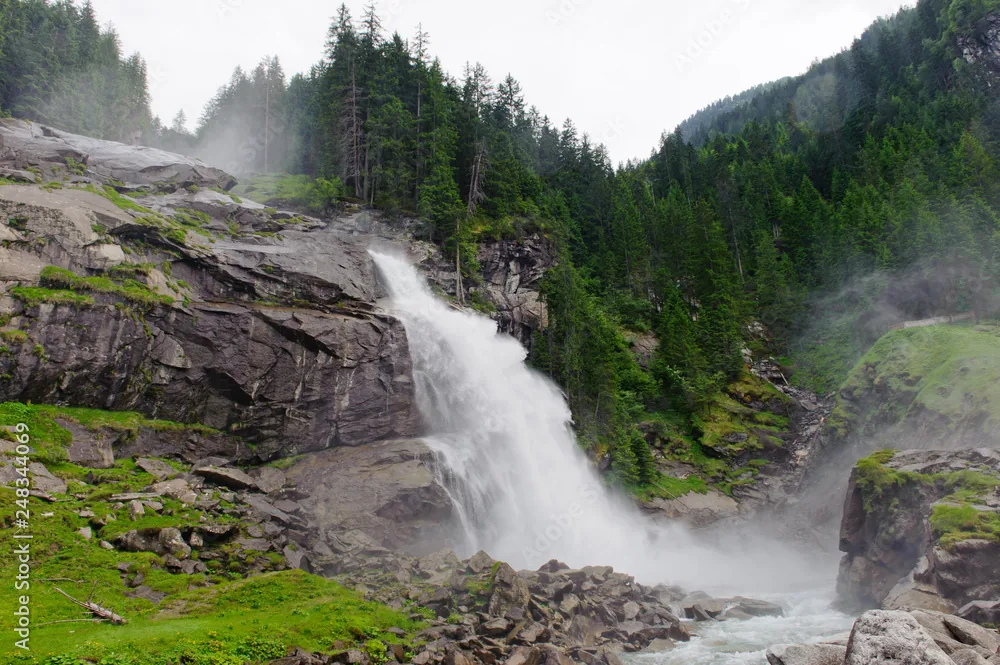
Five hundred million cubic meters of water plunge over these granite cliffs every year, creating a mist so fine it has been medically proven to soothe the lungs of those who breathe it.
About Krimmler Wasserfälle
The history of the Krimml falls is etched into the very granite they traverse, a result of the 'hanging valley' left behind by retreating glaciers twelve thousand years ago. In the early 19th century, only the bravest salt traders and local hunters witnessed this spectacle, often viewing it from treacherous, muddy slopes. The turning point came in 1835 when a small, wooden staircase was built, though it was frequently washed away by the river's spring fury. It was the birth of alpine tourism in the late 1800s that finally saw the creation of a permanent, sustainable trail. Despite numerous proposals to harness the falls for hydroelectric power during the industrial boom, the local community fought to keep the water free, eventually securing its protection as a natural monument that belongs to the mountains rather than the power grid.
Deep in the centre of the Hohe Tauern
National Park, the earth seems to rupture into a vertical explosion of white water and thunder. Krimmler Wasserfälle, falling across three distinct tiers over a drop of 380 meters, is the tallest waterfall in Europe. The air air here is not just breathable; it is transformative, thick with an ionized mist that clings to your skin and fills your lungs with the sharp, cold scent of glacial melt. As the Krimmler Ache river plunges over the granite precipice, it creates a microclimate of mossy rocks and ancient ferns that feel ancient and primeval. Along the winding trail upward, the roar of the water becomes a physical vibration, a steady drumbeat that drowns out the modern world and replaces it with the raw, unyielding power of the Alps. This isn't a place for quiet contemplation from a distance; it is a sensory immersion into the force that carved these valleys over millennia.
Glacial forces during the last ice age carved the deep trough of the Salzach Valley, leaving the higher Krimml valley hanging high above it. This geological cliff created the sheer drop that the river must navigate to reach the basin below. Across centuries, the falls were a wild, inaccessible obstacle for the mule drivers transporting salt over the Krimmler Tauern pass to Italy. It wasn't until 1879 that the Austrian Alpine Club, led by visionary Ignaz von Kürsinger, began constructing a path that would allow travelers to safely ascend the cataract's edge. Kürsinger’s trail was a marvel of Victorian-era engineering, utilizing the natural curves of the slope to provide dramatic viewpoints without disturbing the fragile alpine ecosystem. In 1967, the falls were awarded the European Diploma for Nature Conservation, a recognition of their pristine state and the careful balance maintained between tourism and the wild.
Standing at the Kürsingerplatz, the very base of the lowest fall, The mist is so dense it creates a permanent rainbow even on overcast days. Sound-wise is a chaotic, beautiful roar that makes conversation impossible, forcing you to simply listen to the weight of the water hitting the boulders. Something like a fine, freezing spray on your face that tastes faintly of minerals and high-altitude snow. As you climb the Wasserfallweg, the perspectives shift; looking down from the Bergerblick, the massive river below looks like a thin, silver ribbon. Almost all visitors focus on the water, but The dark, rain-slicked bark of the stone pines that have leaned into the wind for centuries. The detail that stays with you is the '噴霧' or spray-cloud at the middle stage, where the sunlight catches millions of droplets simultaneously, turning the entire forest into a glittering, translucent cathedral of light.
The falls are accessible via
The falls are accessible via the Pinzgau local railway or the post bus from Zell am See, a journey that snakes through some of Salzburg’s most dramatic valley scenery. For those driving, the Gerlos Alpine Road offers a stunning high-altitude approach with views of the falls from across the valley before you even park. The entrance is a short, flat walk from the village of Krimml, but the real journey begins at the trailhead where the paved path starts its steep ascent. Each of the eleven viewpoints along the four-kilometer trail is strategically positioned, allowing you to gauge your progress by the increasing intensity of the wind and the thinning of the air moving toward the upper fall.
The Experience
Opening the visit is the temperature dropping sharply as you approach the base, a localized winter that exists even in the height of August. The environment carries a distinct metallic tang, the smell of water being smashed against rock at high velocity. A constant, rhythmic thrumming in the ground through the soles of your boots, a mark of the sheer mass in motion just meters away. Most who visit overlook the tiny, vibrant alpine flowers that bloom in the spray zone, evolved to thrive in a collection of perpetual rain. The moment that stays with you is the silence that greets you at the very top, where the river is calm and clear just seconds before it vanishes over the edge, a serene preamble to the violence that follows.
Why It Matters
Krimmler Wasserfälle is a rare example of a truly wild natural monument that remains accessible to the public. It matters as a sanctuary for alpine biodiversity and as a world-renowned natural health resort, where the high concentration of negative air ions provides genuine therapeutic benefits. Humanly, it serves as an echo of the sublime power of the natural world, humbling everyone who stands in its spray.
Why Visit
Niagara has the volume and Victoria has the width, but Krimml has the vertical drama of the high Alps. You visit because this is a physical encounter with the raw elements, a place where you can climb alongside the water and feel its character change from a raging torrent to a delicate mist. It is the only place in Europe where the geography makes you feel both incredibly small and entirely alive.
✦ Photo Gallery
Best Season
🌤 Visit in June or July during the snowmelt; the volume of water is at its peak, and the force of the falls creates a dramatic spectacle that pales in comparison to the drier autumn months.
Quick Facts
Best time to visit
Visit in June or July during the snowmelt; the volume of water is at its peak, and the force of the falls creates a dramatic spectacle that pales in comparison to the drier autumn months.
Getting there
In Krimml, Austria; reach Krimml first, then continue to the site.
Location
Krimml, Austria
Type
attraction
Insider Tips
- 1
Pack a high-quality lightweight raincoat even in bright sunshine, as the spray at the lower falls will soak you to the bone in under sixty seconds.
- 2
Walk to the very top fall to find the 'Krimmler Achental,' a surprisingly flat and peaceful alpine valley that feels like a secret world hidden above the roar.
- 3
Look for the endemic mosses on the rocks near the spray zone; some species found here exist nowhere else in the world due to the unique moisture levels.
- 4
Arrive before 9:00 AM to catch the morning light creating rainbows in the lower basin before the shadow of the mountain moves across the valley.
- 5
Wear footwear with exceptional grip, as the wooden railings and stone steps are perpetually slick with fine mist and algae.