The bones of eleven thousand plague victims rest silently beneath the very floor where emperors were married and Mozart’s funeral was held in the winter of 1791.
About Stephansdom
The cathedral we see today is built upon the ruins of two earlier churches, the first dating back to 1137. Its most iconic feature, the 136-meter South Tower, took seventy-five years of meticulous masonry to complete, finally reaching its peak in 1433. Across centuries, it was the tallest structure in the Austro-Hungarian Empire, a height so respected that no other building in the city was permitted to surpass it. Inside, the pulpit is a masterpiece of late-Gothic sculpture by Anton Pilgram, who carved his own face peering out from under the stairs as a permanent, stone signature. The cathedral has functioned as a stone witness to history, from the coronations of kings to the 1945 fire that nearly leveled it, remaining the one constant in the ever-shifting identity of the Austrian state.
What Stephansdom actually is
Rain or shine, the limestone walls of St. Stephen’s Cathedral hold a soot-stained dignity that anchors the spinning energy of Vienna’s First District. This limestone giant, known affectionately by locals as Steffl, is the spiritual compass of the city. High above the cobblestones, the roof is a geometric explosion of 230,000 glazed tiles, shimmering in patterns of zig-zags and imperial eagles that catch the light like the scales of a sleeping dragon. The space near the Giant’s Door often smells of horse-drawn carriages and the faint, sweet scent of Manner wafers from the shop nearby. Inside, the transition from the packed plaza to the cavernous, shadowy nave feels like stepping into a different century where the silence is heavy, cool, and layered with the ghost-scent of frankincense and centuries of melted beeswax.
“Stephen’s Cathedral hold a soot-stained dignity that anchors the spinning energy of Vienna’s First District.”
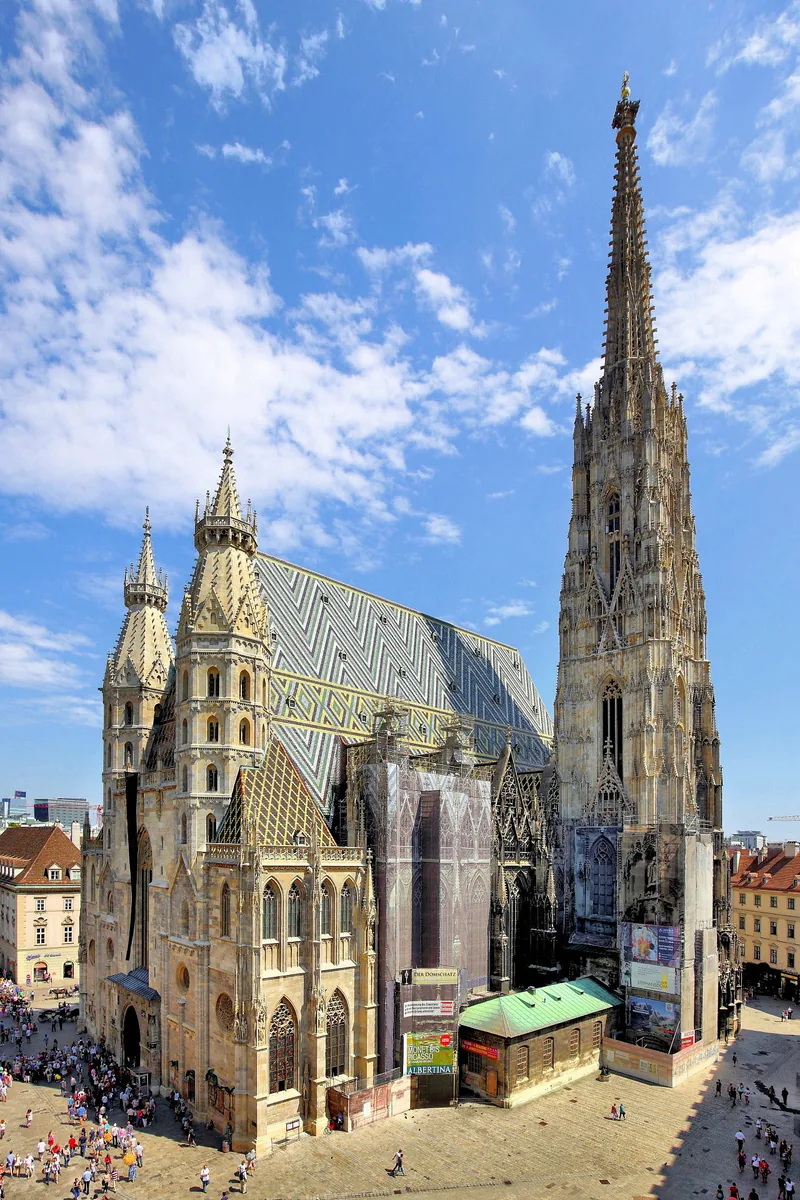
Stephansdom, Austria
the Gothic expansion, 1359
Rudolf IV, the ambitious Duke known as the Founder, laid the first stones of the Gothic expansion in 1359, determined to elevate Vienna’s status to rival the great bishoprics of Europe. The cathedral grew in fits and starts, surviving the Ottoman sieges of 1529 and 1683, during which its high tower was a critical lookout point. One of the most harrowing moments in its long life occurred in the final days of World War II; a fire from nearby shops spread to the roof, causing the great Pummerin bell to fall and shatter on the stone floor. The reconstruction became a symbol of Austrian rebirth, with every province contributing funds or materials to mend the broken heart of their capital. Today, the Pummerin has been recast from the metal of captured Turkish cannons, ringing out only on the most solemn occasions.
Standing in the center
Standing in the center of the nave, The way the light filters through the stained glass to splash bruised purples and deep rubies across the pillars. The sound is a constant, low-frequency hum of whispers and shuffling feet, occasionally pierced by the sudden, crystalline ringing of a handbell during a side-chapel mass. The temperature drop significantly as you descend into the catacombs, where the air is still and the walls are lined with the copper urns of Habsburg viscera and the neatly stacked bones of plague victims. Moving back toward the light, the climb up the 343 steps of the South Tower provides a physical challenge that leaves your heart hammering against your ribs. The piece that stays with you is reaching the narrow watchman’s chamber, where the wind whistles through the stone filigree and the entire city of Vienna opens up in a panoramic map of copper domes and distant Alpine foothills.
Stephansplatz sits at the literal center
Stephansplatz sits at the literal center of the city’s underground network, served by both the U1 and U3 lines. Out of the station’s glass elevators puts you directly in the shadow of the cathedral’s massive west facade. Taxis are restricted in the immediate pedestrian zone, so the final approach is always on foot, ideally through the narrow Kärntner Strasse or the Graben. This walk allows you to see the spire gradually emerge from behind the 19th-century buildings, a vertical needle of stone that seems to stitch the city to the clouds.
“Stephansplatz sits at the literal center of the city’s underground network, served by both the U1 and U3 lines.”
The Experience
Right away, the texture of the 'Giant's Door' is worn smooth in places where millions of hands have touched the stone over eight centuries. The morning light is particularly evocative here, cutting through the incense-heavy air in long, solid shafts that highlight the intricate rib-vaulting of the ceiling. Something like a strange sense of scale as you look up at the massive organ, which seems to vibrate the very air in your lungs when played. Most people overlook the '05' carved into the stone near the main entrance, a secret code used by the Austrian resistance during the Nazi occupation. What lingers with you is the contrast between the dark, somber interior and the sudden, vivid brightness of the roof tiles when viewed from the North Tower elevator, a varied display of color that feels unexpectedly modern.
Why It Matters
Stephansdom is the soul of Vienna, representing a continuity of faith and civic pride that has outlasted every dynasty. It matters as a pinnacle of Gothic engineering and as a repository of Habsburg tradition, housing the entrails of the royal family in its crypts. Humanly, it remains a monument to resilience, rebuilt from ashes by a nation that refused to let its center stay broken.
Why Visit
St. Peter’s in Rome has the scale and Notre-Dame has the fame, but Stephansdom has a gritty, lived-in character that feels inseparable from the streets around it. You visit because it is a vertical history book where you can touch Roman ruins, Gothic stone, and post-war mosaics in a single afternoon. It is the only place where the heartbeat of the city is literally cast in bronze.
Insider Tips
- 1
Look for the two metal bars embedded in the wall near the main entrance; they were standardized measures for bread and cloth used by medieval merchants to prevent cheating.
- 2
Take the elevator to the North Tower to see the Pummerin bell up close; it is much less crowded than the South Tower and offers a better view of the roof tiles.
- 3
Attend the evening 'Giant Organ' concerts to hear the full acoustic power of the nave without the distraction of daytime tour groups.
- 4
Search for the 'Fenstergucker' under the pulpit stairs, a self-portrait of the architect who looks as though he is glancing out of a window.
- 5
Enter through the small side door for early morning mass if you want to experience the cathedral in its intended state of prayerful silence.