“Seventy thousand ancient books are housed in a room that contains not a single candle or lamp, designed by an architect who believed that shadows were the enemies of knowledge.”
About Stift Admont Library
The Benedictine monks of Admont began collecting manuscripts almost immediately after their arrival in 1074, turning their mountain retreat into a vital center of medieval literacy. However, the architectural masterpiece seen today was not realized until 1776, during a period when the abbey was wealthy enough to commission the finest artists of the day. Josef Hueber’s design for the hall was a radical departure from the dark, cramped libraries of the past, opting instead for a unified, light-filled space that celebrated the Enlightenment. Even when the great fire of 1865 consumed the rest of the monastery, the library walls held firm, protected by the monks who formed a human chain to save their most precious volumes. During the Second World War, the library was seized by the state and used as a scientific research facility, yet the books remained remarkably safe, returning to the care of the Benedictines in 1945.
Admont Abbey Library in short
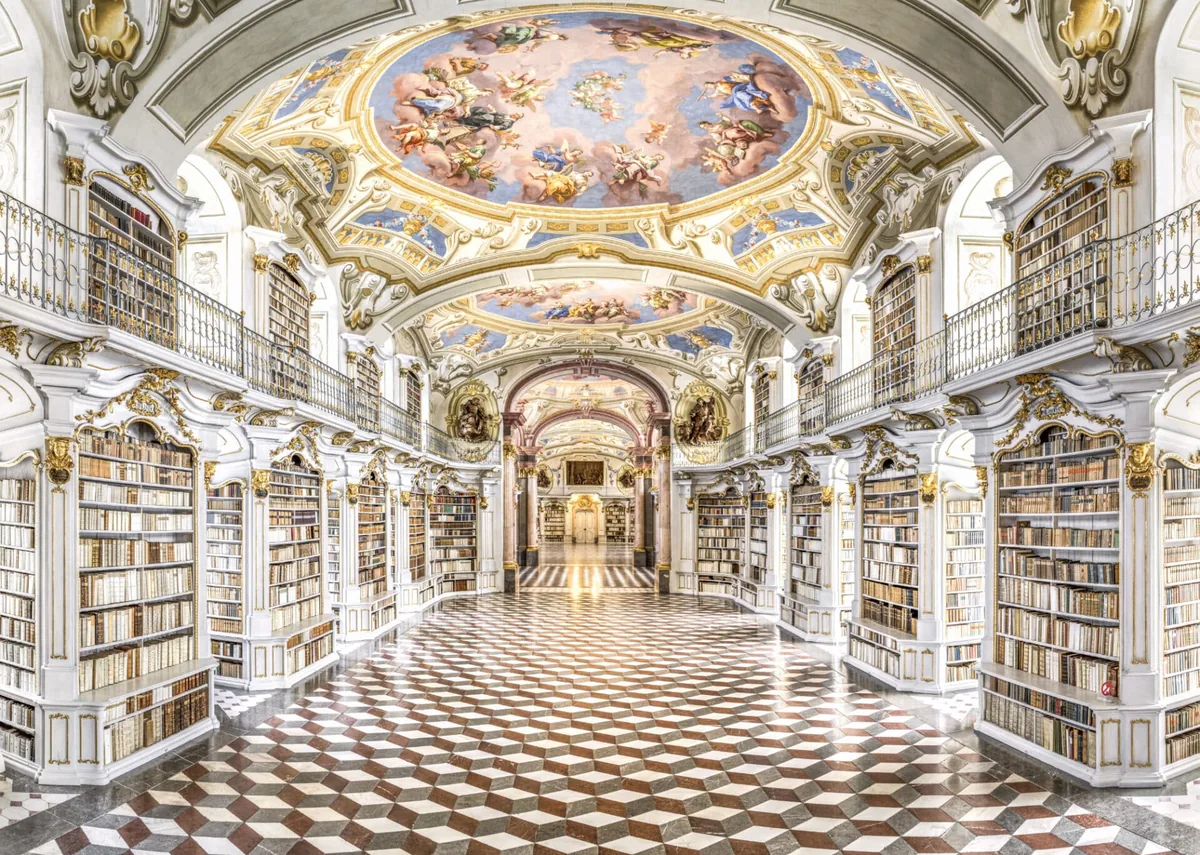
Deep within the Enns Valley, where the limestone peaks of the Gesäuse National Park cut a jagged line against the Styrian sky, sits a room that seems to have been plucked from a dream of the Enlightenment. Admont Abbey Library remains the largest monastic book hall in the world, a vivid expanse of white and gold that defies the typically somber, dusty expectations of an ancient archive. Sunlight pours through forty-eight windows, striking the seven cupolas and making the lime-wood carvings of the Four Last Things look as though they might stir into life. This space is a cathedral of the mind, where the silence is profound and A faint, dry scent of parchment mixed with the cool breath of the surrounding mountains. It represents a rare moment in history where the rigid discipline of monastic life surrendered entirely to the airy, playful elegance of the late Baroque.
Admont Abbey Library remains the largest monastic book hall in the world, a vivid expanse of white and gold that defies the typically somber, dusty expectations of an ancient archive.
the Benedictine monastery, 1074
Archbishop Gebhard founded the Benedictine monastery in 1074, but the library we marvel at today was a product of the mid-eighteenth century, a period when the abbot Matthäus Offner sought to reflect the light of human knowledge in architectural form. Architect Josef Hueber began construction in 1776, famously stating that, like our minds, rooms should be filled with light. While the monastery around it suffered a devastating fire in 1865 that leveled much of the abbey, the library was miraculously spared, leaving its seventy thousand volumes and frescoed ceilings intact. Bartolomeo Altomonte, who was eighty years old when he began the project, painted the immense ceiling cycles, depicting the stages of human knowledge from the arts and sciences to the finality of divine revelation. These paintings survived the centuries without restoration until recently, preserved by the stable mountain climate and the reverence of the monks who continued their scholarly work amidst the wars of the outside world.
Crossing the threshold into the main hall, a sudden, physical lightness as the white-washed bookshelves and gold-leaf details trick the eye into thinking the walls are weightless. You catch of your footsteps is dampened by the vastness of the space, leaving only the soft rustle of the valley wind against the high windows. A trace of the cool temperature of the stone floor, a contrast to the warmth of the golden light that bathes the bookshelves. The majority of visitors find themselves staring upward at the cupolas, but The secret doors disguised as bookshelves, marked by faux-spines that allowed the monks to enter and exit without disrupting the visual symmetry of the room. What sticks with you is standing before Josef Stammel’s 'The Four Last Things' sculptures, where the agonizing detail of Death and Judgment feels startlingly real amidst the otherwise joyous Rococo decor. Immediately, the dust motes dancing in the light shafts, each one highlighting the texture of the white-painted wood and the leather bindings of the seventy thousand volumes that wait in patient, orderly silence. Reaching Admont requires a deliberate journey into the heart of Upper Styria, often by a train that winds through the dramatic river gorges of the Gesäuse. The station sits a short walk from the abbey gates, where the scent of Alpine pine immediately replaces the metallic tang of the tracks. Drivers usually arrive via the A9 motorway, turning off into a landscape where the mountains seem to press in closer with every kilometer. The final approach to the library involves a walk through the abbey’s modern museum wings, a deliberate sensory transition from contemporary art to the timeless, gilded sanctuary of the book hall.
The Experience
First, the absolute stillness of the air, a vacuum of sound that makes the rustle of a page feel like a thunderclap. The light in late September is particularly haunting, hitting the white-painted shelves at an angle that makes the gold leaf glow with a soft, internal fire. There is a texture of the mountain air as you step through the stone corridors, a freshness that somehow permeates even this centuries-old archive. The thing most visitors overlook is the floor’s intricate zig-zag pattern of white, red, and gray marble, which was designed to guide the eye toward the central dome. The detail that stays with you is the realization that the books are all bound in white leather, a specific choice by the abbot to ensure the room remained as bright as possible, even on the grayest Styrian afternoons.
First, the absolute stillness of the air, a vacuum of sound that makes the rustle of a page feel like a thunderclap.
Why It Matters
Stift Admont Library is the ultimate physical manifestation of the Benedictine motto 'Ora et Labora,' representing the 'work' of the mind in its most elevated form. It matters as a rare, perfectly preserved bridge between the theatricality of the Baroque and the intellectual rigor of the Enlightenment. Culturally, it is a reflection of the survival of high art in the face of natural disaster and political upheaval.
Why Visit
Prague’s Clementinum is grand and Dublin’s Long Room is atmospheric, but Admont is the only library that feels as though it was built from light itself. You visit because it is a total sensory immersion into an age where beauty was considered a necessary condition for learning. It is the only place where the books and the architecture conspire to make you feel as though you are standing inside a sunbeam.
✦ Insider Tips
- 1
Look for the 'secret' stairs hidden behind fake book bindings in the corners; these were used by the librarian to access the upper gallery without using the grand central staircase.
- 2
Pay close attention to the statue of 'Death' in the Four Last Things group; the artist used real skeletal anatomy at a time when such study was still controversial.
- 3
Visit the modern art museum within the abbey complex first to provide a sharp, contemporary contrast to the historical weight of the library.
- 4
Check the monastery's herb garden after your visit; the monks have cultivated medicinal plants here for nearly a millennium, and the scent is incredible.
- 5
Ask the guide about the 'Admont Giant Bible,' a 12th-century masterpiece that is occasionally on display in the museum wing.