One hundred thousand hand-bound books sleep in a room of gold and wood, guarded by monks who have occupied this same riverside cliff since the year 1089.
About Stift Melk
The origins are a Roman border post before the Babenberg margraves turned it into their primary castle and burial ground. When the monks arrived in the late 11th century, they brought a tradition of scholarship that transformed Melk into a powerhouse of the 'Melk Reform' movement, influencing monastic life across the German-speaking world. The Great Fire of 1297 nearly erased the medieval structure, but the community’s resilience saw it rebuilt time and again. The most ambitious era began in 1702, when Abbot Berthold Dietmayr ignored the abbey’s debts to commission the current Baroque masterpiece. This gamble paid off, as the building's sheer magnificence helped it survive the secularization waves of the 1780s and the later pressures of the Nazi regime, which saw the abbey school temporarily confiscated. Today, the monks still follow the Rule of Saint Benedict, maintaining the abbey as a living sanctuary of faith and culture.
Stift Melk in Austria
Perched on a granite bluff overlooking the Wachau Valley, the golden walls of Melk Abbey glow with an intensity that seems to radiate from the stone itself rather than reflecting the sun. This Benedictine monastery is a masterpiece of High Baroque architecture, a lemon-yellow citadel that has guarded the Danube River for over nine hundred years. The surroundings here carries a crisp, river-born humidity that softens the scent of ancient parchment and floor wax drifting from the library. Inside, the transition from the stark, monumental courtyards to the explosive gold and frescoed ceilings of the interior feels like moving from a fortress into a jewelry box. It is a spiritual and intellectual anchor for Lower Austria, where the silence of the monastic life coexists with the grandeur of an imperial palace.
“Perched on a granite bluff overlooking the Wachau Valley, the golden walls of Melk Abbey glow with an intensity that seems to radiate from the stone itself rather than reflecting the sun.”
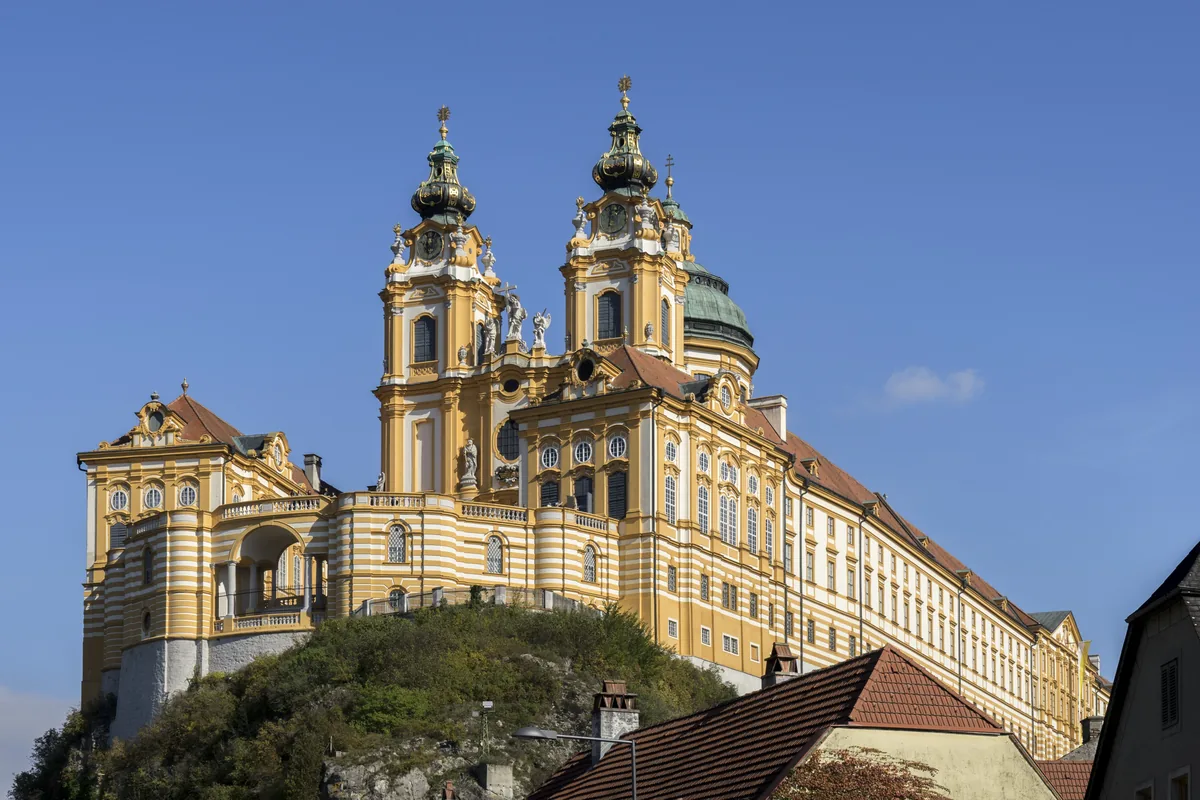
Stift Melk, Austria
Background
Leopold II of the House of Babenberg gifted this rocky outcrop to Benedictine monks in 1089, establishing a center of learning that survived the fires of the Reformation and the sieges of the Ottomans. The current structure is the result of a massive 18th-century reconstruction led by the abbot Berthold Dietmayr and the architect Jakob Prandtauer, who envisioned a building that would proclaim the glory of the Church through sheer visual splendor. Even the Enlightenment-era reforms of Emperor Joseph II, which shuttered many other Austrian monasteries, could not extinguish Melk; the monks cleverly maintained their relevance by running a prestigious school that continues to educate the region's youth today. During the Napoleonic Wars, French troops occupied these halls, yet the abbey's vast wine cellars and extensive library remained remarkably intact, preserving a continuous thread of history that reaches back to the medieval scriptorium.
Walking through the Imperial Wing , the smooth, cool texture of the marble under your fingertips as the hallway stretches toward the horizon in perfect symmetry. The Abbey Library is the sensory heart of the visit, where one hundred thousand volumes bound in calfskin create a profound, earthy smell of old leather and quietude. What registers is the light pouring through the high windows, illuminating the intricate ceiling frescoes by Paul Troger that appear to dissolve the roof into the heavens. Standing on the semi-circular terrace connecting the library to the church, The wind coming off the Danube and hear the distant, low hum of river barges passing below. The moment that stays with you occurs in the Abbey Church, where the sheer volume of gold leaf and the spiraling red marble pillars create a dizzying, beautiful overload of the senses. Straight off, the way the light catches the pink stucco in the Marble Hall, making the entire room feel like it is blushing in the afternoon sun. Trains depart frequently from Vienna’s Westbahnhof, taking travelers through the rolling vineyards of the Wachau to the Melk station in about an hour. From the station, a gentle ten-minute walk through the cobblestone streets of the lower town leads you directly to the foot of the abbey hill. For those seeking a more cinematic approach, arriving by riverboat from Krems allows the abbey to emerge slowly from the horizon, its twin towers silhouetted against the dark greens of the forest. The final ascent involves a series of broad stone steps that force a slow, respectful pace, allowing the scale of the yellow ramparts to fully sink in before you reach the main gate.
The Experience
Right from the start, the peculiar hush that falls over the crowd as they enter the Library, a space that commands a different kind of respect than even the church itself. The floorboards occasionally groan under the weight of history, a sharp contrast to the silent, weightless figures painted on the ceilings above. A remnant of the scale of the landscape from the North Bastion, where the Wachau Valley unfolds like a green velvet fabric, dotted with church steeples and apricot orchards. Most people overlook the intricate 'hidden' doors disguised as bookshelves, which lead to secret spiral staircases used by the monks for centuries. What sticks with you is the vibration of the church organ through the soles of your shoes during a late afternoon service, a sound that makes the red marble columns seem to hum with energy.
Why It Matters
Stift Melk is the pinnacle of Austrian Baroque and a reflection of the endurance of Benedictine scholarship through the centuries. It matters as a rare survivor of the Josephinian reforms and as a repository of medieval manuscripts that are fundamental to European intellectual history. Its existence defines the Wachau Valley, bridging the gap between the natural beauty of the river and the architectural ambition of the Habsburg era.
Why Visit
St. Stephen's in Vienna has the height, but Melk has the theatricality and the riverside drama that no city cathedral can match. You visit because this is the only place where you can stand in a library that inspired Umberto Eco's 'The Name of the Rose' and then step out onto a balcony overlooking the most beautiful bend of the Danube. It is the ultimate expression of when faith meets high art.
Insider Tips
- 1
Arrive at the abbey doors the moment they open to experience the Library in total silence before the river cruise groups arrive.
- 2
Look for the 'Spiral Staircase' at the end of the library tour; the view looking straight down the center is a masterpiece of rococo geometry.
- 3
Walk through the Abbey Park to find the Baroque Garden Pavilion, which houses exotic frescoes of fruits and animals that many hurried tourists miss.
- 4
Visit the 'Melk Altar' by Jörg Breu the Elder in the museum wing to see some of the most vivid and expressive panel paintings of the Danube school.
- 5
Check the schedule for the 'International Baroque Days' during Whitsun if you want to hear world-class music in the abbey's acoustic chambers.