“Eighteen separate wings and over two thousand rooms make up this palace, yet it was never officially finished before the empire that built it simply ceased to exist.”
About The Hofburg
The Hofburg began as a defensive castle around 1275, but by the time the Swiss Gate was erected in 1552, it had become the permanent seat of the Holy Roman Emperors. For six hundred years, no Habsburg emperor felt his reign was complete without adding a new hall or a fresh wing, resulting in a stylistic collage that spans from Gothic to Rococo. Maria Theresa introduced the elegance of the eighteenth century, while Franz Joseph I oversaw the final, gargantuan additions that were meant to symbolize the height of Austro-Hungarian prestige. The palace witnessed the abdication of the last emperor in 1918, marking the end of one of the longest-running dynasties in human history. Throughout the centuries, it functioned as the political, social, and cultural furnace of Central Europe, survived through fires, sieges, and the fall of monarchies to remain the functioning center of the Austrian state.
What The Hofburg actually is
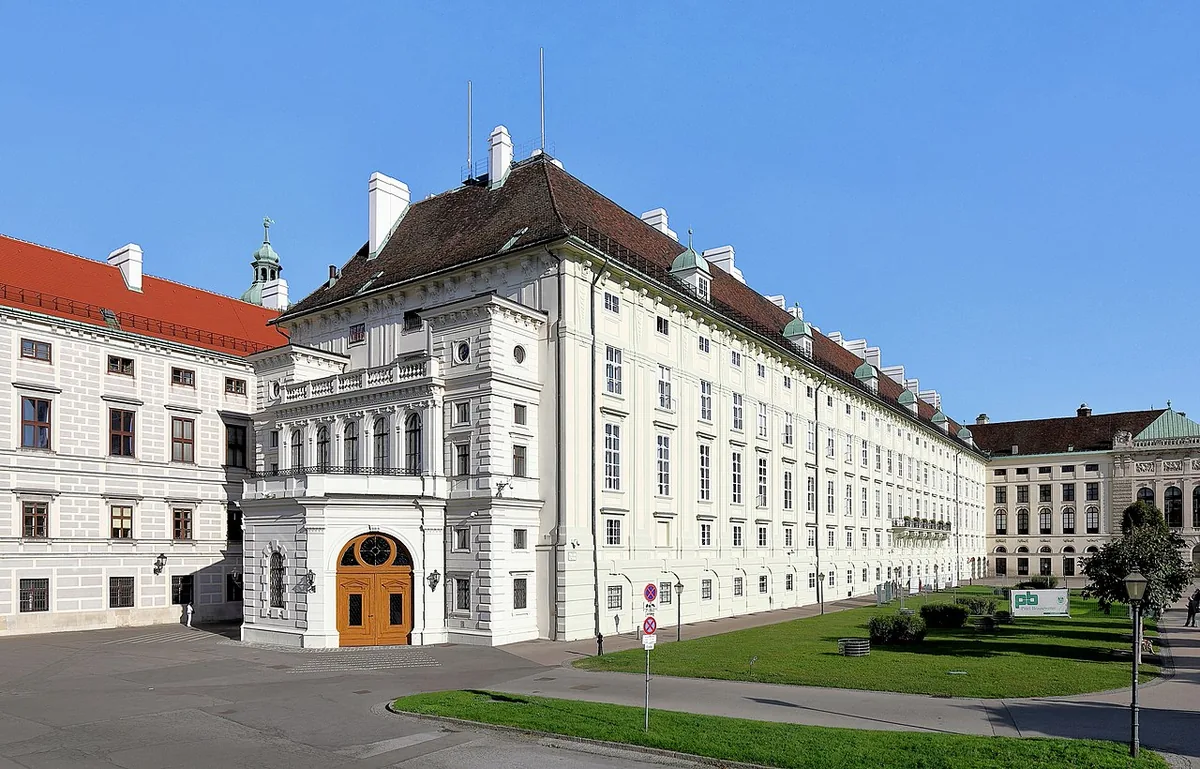
Crossing the threshold of the Michaelertor feels like walking into the gravitational center of a vanished empire. The Hofburg is not merely a palace but a sprawling, limestone city within a city, where eighteen wings and nineteen courtyards weave together seven centuries of architectural ambition. Here, the under the great copper dome carries the sharp, rhythmic clip-clop of Lipizzaner stallions being led to their stables, a sound that has echoed through these arched passageways since the Renaissance. Every facade tells a different story of power, from the severe medieval Swiss Wing to the exuberant, curved granite of the Neue Burg. It remains the beating heart of Vienna, a place where the grandeur of the Habsburgs still feels immediate, whispered through the rustle of gravel and the weight of massive iron gates.
Crossing the threshold of the Michaelertor feels like walking into the gravitational center of a vanished empire.
The complex began as a modest
The complex began as a modest thirteenth-century fortress, but as the Habsburgs climbed the ladder of European royalty, the palace grew with them, never following a single master plan. Each emperor sought to outdo his predecessor, adding private apartments, sprawling libraries, and winter riding schools that eventually consumed entire city blocks. In 1857, Franz Joseph I ordered the destruction of the city’s old defensive walls, paving the way for the Ringstrasse and the final, monumental expansion of the Neue Burg, which was intended to be part of a vast 'Imperial Forum.' The empire collapsed in 1918 before the project could be finished, leaving the palace as a beautiful fragment of an unfinished dream. Since then, it has transitioned from a royal residence to the official seat of the Austrian President, ensuring its halls remain as politically relevant today as they were during the Congress of Vienna.
History
Walking through the Heldenplatz, The sheer scale of the crescent-shaped Neue Burg, its white stone gleaming with a fierce intensity under the midday sun. Overhead, the space is a curious mix of distant violin music from street performers and the hushed, reverent murmurs of crowds moving toward the Sisi Museum. The temperature drop entering the Imperial Treasury, where the air is kept still and dry to protect the thousand-year-old crown of the Holy Roman Empire. The velvet-lined walls seem to absorb all sound, focusing your attention on the glint of emeralds the size of walnuts. What remains with you is standing in the middle of the Josefsplatz at dusk, when the equestrian statues cast long shadows across the cobblestones and the library windows begin to glow with a warm, amber light. The scent of old wood and leather drifting from the National Library, a smell that suggests the accumulated wisdom of a thousand scholars.
Reaching the palace is as simple
Reaching the palace is as simple as finding the center of the city’s historic district, with the U3 subway line stopping at Herrengasse, just a few minutes’ walk from the main entrance. Trams 1, 2, and D also encircle the palace grounds, stopping at Burgring, where you can enter through the sprawling gardens of the Volksgarten. Those who come arrive on foot from the Stephansdom, following the luxury shopfronts of the Kohlmarkt until the massive green dome of the Michaelertrakt looms over the street. The transition from the commercial bustle of modern Vienna to the imperial silence of the courtyards is sudden and complete, requiring nothing more than a single step over a stone threshold.
Reaching the palace is as simple as finding the center of the city’s historic district, with the U3 subway line stopping at Herrengasse, just a few minutes’ walk from the main entrance.
The Experience
Right away, the scent of the rose gardens in the Volksgarten, a sweet, floral perfume that clashes pleasantly with the ozone and dust of the nearby Ringstrasse. The light in the early morning catches the gold leaf on the imperial crests, making them appear to burn against the gray limestone facades. The mass of the weight of the silver in the Silver Chamber, where miles of porcelain and solid gold centerpieces speak of a court that treated dining as a form of high-stakes diplomacy. Those who come overlook the small, unassuming stone markers in the courtyards that indicate where the old city walls once stood. The piece that stays with you is the vibration of the great bells of St. Stephen's echoing through the palace courtyards, a sound that bridges the gap between the sacred and the imperial.
Why It Matters
The Hofburg is the physical embodiment of European history from the Middle Ages to the modern day. It matters because it is not a museum of a dead culture, but a living office of a modern republic housed within the skin of an empire. Culturally, it preserves the traditions of the Spanish Riding School and the Vienna Boys' Choir, ensuring that the intangible heritage of the Habsburgs remains a vibrant part of the city's current life.
Why Visit
Schönbrunn has the gardens and the summer air, but the Hofburg has the grit and the raw power of the imperial machine. You visit because this is where the actual decisions were made that shaped the borders of Europe for centuries. It is the only place where you can stand in the same room as the crown of Charlemagne and the desk of a modern president in a single hour.
✦ Insider Tips
- 1
Enter the complex through the Schweizerhof at 9:00 AM to see the sun hit the Renaissance frescoes of the Swiss Gate without a single tourist in your frame.
- 2
Book a ticket for a morning exercise session at the Spanish Riding School rather than a full performance; it is cheaper and allows you to see the stallions in a more relaxed environment.
- 3
Look for the 'Imperial Treasury' entrance in the oldest part of the palace; it houses the actual spear that supposedly pierced the side of Christ, a relic of staggering historical weight.
- 4
Walk to the Augustinian Church at the edge of the complex to find the tomb of Maria Christina by Canova, a marble masterpiece that most people miss while hunting for royal bedrooms.
- 5
Visit the Austrian National Library just before closing; the late-day light through the high windows makes the wooden bookshelves look like they are glowing from within.