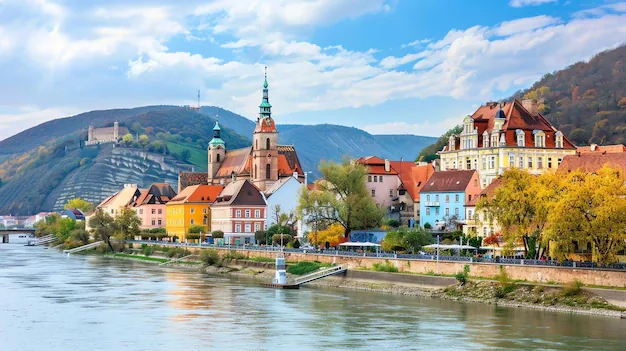
A kidnapped English king once languished in a clifftop cell here, while below him, monks were perfecting the dry white wines that still define the character of these ancient stone terraces.
About Wachau Valley
The valley’s story began with the Venus of Willendorf, a tiny limestone figurine carved nearly 30,000 years ago, signaling that humans have found sanctuary in these riverbanks since the dawn of art. By the time the Romans established a frontier along the Danube, the Wachau was already a legendary corridor for trade. The true architectural transformation occurred between 1702 and 1736, when Jakob Prandtauer designed the Melk Abbey to sit atop a cliff like a celestial fortress, signaling the power of the church. Despite the looming threat of Ottoman invasions and the eventual fall of the Habsburgs, the valley’s vintners continued to repair their dry-stone walls by hand, a tradition that has kept the landscape virtually unchanged for a millennium. Today, it remains a UNESCO World Heritage site, protected not just for its beauty, but for the persistent, manual craftsmanship required to keep its vines alive.
Thirty-six kilometers of the Danube River bend
Thirty-six kilometers of the Danube River bend and twist between the towns of Melk and Krems, carving a landscape so balanced it is like a fever dream of Old Europe. The Wachau Valley is a high-contrast range of steep, terraced vineyards that defy gravity, crowned by the crumbling skeletons of medieval fortresses. The surroundings here carries the sweet, fermented scent of apricot blossoms in the spring and the deep, loamy musk of Riesling grapes as autumn settles into the soil. Below the limestone cliffs, the river flows with a muscular, silk-like grace, reflecting the buttery yellow facades of Baroque abbeys and the terracotta roofs of wine-growing villages. This valley represents a rare pocket of the world where human labor and natural topography have reached a state of permanent, beautiful ceasefire.
Richard the Lionheart once found himself
Richard the Lionheart once found himself pacing the stone floor of a prison cell in Dürnstein after a dispute during the Third Crusade, a reflection of the valley's long-standing strategic importance. The geography of the Wachau was forged by the river cutting through the Bohemian Massif, but its cultural soul was shaped by the monks and vintners who arrived in the Middle Ages. These early settlers recognized that the primary rock and Gneiss soils, combined with a unique climatic intersection of Atlantic and Pannonian air, were perfect for white wine. The massive Benedictine Abbey of Melk was rebuilt in the 18th century as a golden symbol of the Counter-Reformation, acting as a spiritual bookend to the valley. Over the centuries, the region avoided the industrial scarring seen elsewhere in Europe, largely because the terrain was too rugged for factories, leaving the 1,000-year-old stone terraces intact for modern hands to cultivate.
Standing on the deck of a riverboat, you
Standing on the deck of a riverboat, The rhythmic slap of water against the hull and the distant, melodic ringing of church bells that seems to hop from one village to the next. The light in the late afternoon turns the river into liquid gold, illuminating the blue tower of Dürnstein until it glows like a sapphire against the grey rock. You get a grit of the ancient stone walls of a 'Heuriger' wine tavern under your fingers, a cool relief from the sun-drenched vineyards. Just about everyone focus on the famous abbey libraries, but The quiet dignity of the apricot orchards in Spitz, where the trees lean heavy with fruit. The element that stays with you is a silent hike through the ruins of Hinterhaus at dusk, when the wind whistles through the empty window frames and the valley below begins to twinkle with the first amber lights of the evening taverns.
Reaching this stretch of the Danube
Reaching this stretch of the Danube is a seamless transition from the urban pulse of Vienna, with regional trains departing every hour for Melk or Krems. For those who prefer a slower reveal, a bicycle ride along the Danube Cycle Path allows you to feel every change in elevation and catch the smell of river up close. Ferry services connect the major towns, offering a cinematic perspective of the terraces that you simply cannot get from a car window. Arriving by water is perhaps the most authentic way to see the valley, as the scale of the cliffs and the grandeur of the abbeys were always intended to be viewed from the river looking up.
The Experience
The way the air cools significantly as the river enters the narrowest parts of the gorge near the 'Teufelsmauer' rock formation. Audible here is a gentle hum of bicycle tires on paved paths and the soft rustle of grape leaves moving in the Pannonian breeze. The gravity of history in the Dürnstein ruins, where the uneven steps have been smoothed by eight centuries of boots. The thing most visitors overlook is the 'Rollfähre', the cable ferries that use the river's current to glide silently across without an engine. The moment that stays with you is tasting a glass of Federspiel Riesling in a cellar that feels like it was carved from the mountain's very heart, smelling of cold stone and sharp, acidic fruit.
Why It Matters
The Wachau Valley matters as the ultimate marriage of viticulture and architecture, where the very soil dictates the shape of the villages. It is one of the few places in Central Europe where medieval agricultural techniques, specifically the dry-stone terracing, remain the primary driver of the local economy. Humanly, it represents a commitment to quality over quantity, as these steep slopes allow for nothing but careful, hand-picked harvests.
Why Visit
Salzburg has the music and Vienna has the opera, but the Wachau has the light and the liquid history. You visit because this is where the Danube is at its most intimate and dramatic, offering a sensory depth that a city museum cannot replicate. It is the only place where you can spend your morning in a world-class library and your afternoon in a dusty, sun-baked vineyard that hasn't changed since the 1400s.
✦ Photo Gallery
Best Season
🌤 Visit in mid-April to see the valley floor explode into a white sea of 100,000 blossoming apricot trees, or in October when the vineyards turn a fiery, translucent gold under the autumn sun.
Quick Facts
Best time to visit
Visit in mid-April to see the valley floor explode into a white sea of 100,000 blossoming apricot trees, or in October when the vineyards turn a fiery, translucent gold under the autumn sun.
Getting there
In Krems, Austria; reach Krems first, then continue to the site.
Location
Krems, Austria
Type
attraction
Insider Tips
- 1
Look for the 'Vinea Wachau' seal on wine bottles; 'Steinfeder' is light, 'Federspiel' is medium, and 'Smaragd' is the heavy, complex king of the valley's output.
- 2
Skip the main road and walk the 'Welterbesteig' or World Heritage Trail for elevated views that look straight down into the secret courtyards of the winemakers.
- 3
Order 'Marillenknödel', apricot dumplings coated in buttery breadcrumbs, only when the local harvest is in peak season during July.
- 4
Use the small, non-motorized ferries to cross the river; the silence of the crossing provides a rare moment of connection with the Danube’s natural power.
- 5
Visit the abbey at Melk at the very end of the day to see the golden facade burn in the sunset after the largest tour groups have returned to their buses.