A tenth-century saint threw an axe from a mountain peak to decide where to live, inadvertently creating a pilgrimage site that would one day host emperors and operetta stars.
About Wolfgangsee
The lake’s name pays homage to Saint Wolfgang, who retreated here in 976 seeking solitude, but his presence ironically ensured the area would never be lonely again. By the late Middle Ages, the village of St. Wolfgang was the fourth most significant pilgrimage destination in the world, eclipsed only by Rome, Aachen, and Einsiedeln. This religious fervor funded the creation of the Pacher Altar in 1481, a striking achievement of sacred art that remains one of the few of its kind to survive intact. The lake’s secular golden age arrived with the railway in the late 1800s, when the Habsburg court made the Salzkammergut the fashion epicenter of the empire. This period saw the construction of the iconic cog railway and the emergence of the lake as a backdrop for the famous 'White Horse Inn' operetta, cementing its place in the global imagination as the quintessential Austrian summer retreat.
Wolfgangsee in Austria
Glacier-carved and emerald-hued, the Wolfgangsee stretches across the Salzkammergut like a polished gemstone dropped between the limestone teeth of the Osterhorn group and the Schafberg mountain. The water possesses a startling clarity, reflecting a sky that seems larger here than in the narrow valleys further south. Along the shoreline, the three villages of St. Gilgen, St. Wolfgang, and Strobl appear as clusters of frescoed timber and white stone, tethered to the water by bobbing wooden piers. A cool, Alpine breeze usually ripples the surface by mid-afternoon, smelling of pine needles and sun-warmed slate. This lake is the soul of the Austrian Lake District, offering a landscape that feels curated by a master painter where the wildness of the crags is perfectly balanced by the civility of the lakeside promenades.
“Glacier-carved and emerald-hued, the Wolfgangsee stretches across the Salzkammergut like a polished gemstone dropped between the limestone teeth of the Osterhorn group and the Schafberg mountain.”
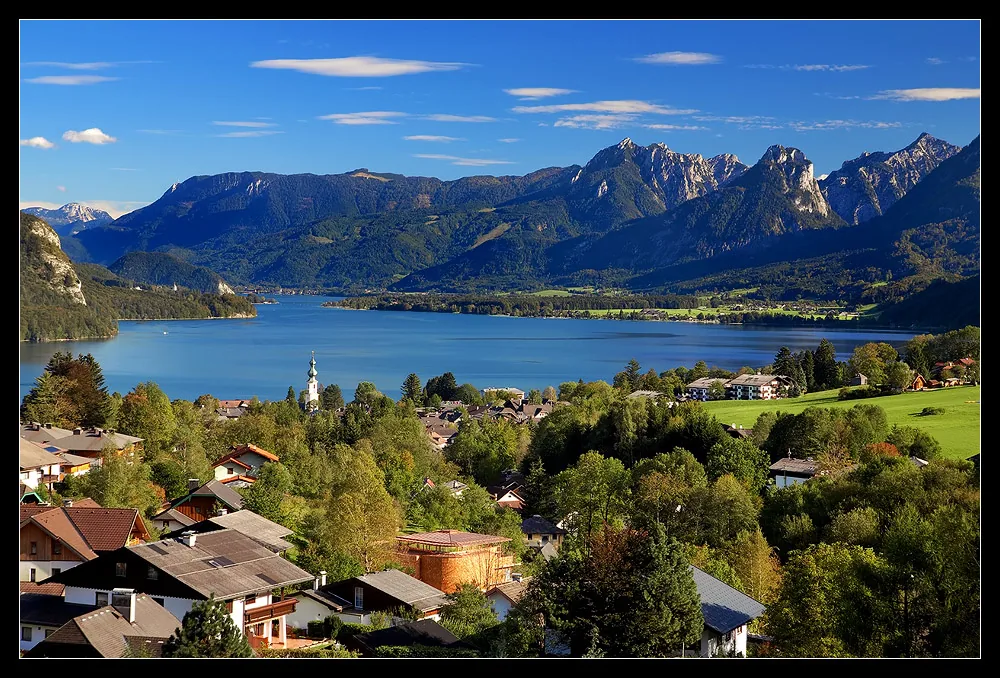
Wolfgangsee, Austria
Saint Wolfgang of Regensburg allegedly threw an axe from the Falkenstein mountain in the tenth century, vowing to build a church wherever it landed. The weapon struck a rocky outcrop by the lake, and the resulting pilgrimage site transformed this remote water into a spiritual beacon for Central Europe. For nearly a millennium, pilgrims braved the narrow mountain passes to reach the winged altar of Michael Pacher, a masterpiece of Gothic woodcarving that still anchors the town of St. Wolfgang. The arrival of the Emperor Franz Joseph I at nearby Bad Ischl in the nineteenth century shifted the lake's destiny once again, turning it from a place of prayer into the summer playground of the Viennese aristocracy. Grand villas rose among the trees, and the Schafbergbahn, Austria's steepest steam cog railway, began puffing its way to the summit in 1893, providing the wealthy with a view that was previously the sole domain of eagles and saints.
Reaching the lake often involves a scenic drive from Salzburg along the B158, a route that winds through the rolling hills of the Fuschlsee before the Wolfgangsee reveals itself in a dramatic panorama near St. Gilgen. Public transport options are equally evocative, with the Postbus offering a reliable link from the Salzburg main station that deposits you directly at the lakeside in about fifty minutes. For a more nostalgic arrival, travelers often take the bus to St. Gilgen and then board one of the historic ferries to reach St. Wolfgang. This water-bound approach allows the mountains to slowly grow in scale, providing a sense of cinematic reveal that no road journey can match.
Visiting Wolfgangsee
Gliding across the water on the Kaiser Franz Josef I paddle steamer, The rhythmic thrum of the engine echoing against the rock walls of the Falkensteinwand. The light in the early morning is particularly ethereal, as the mist peels off the water in thin, ghostly ribbons to reveal the sharp silhouette of the Schafberg. The spray of the lake against your skin, a bracing cold that reminds you of the glaciers that once stood where you now float. The majority of visitors focus on the famous White Horse Inn, but The quiet, moss-covered boathouses tucked into private coves where the only sound is the gentle slap of water against aged pine. What sticks with you is the view from the summit of the Schafberg, where the Wolfgangsee appears as a deep turquoise anchor surrounded by twelve other lakes, each catching the sun like shards of glass. What you catch first is the scent of wild thyme and dry grass on the mountain air, a sharp contrast to the damp, floral sweetness of the village gardens below.
The Experience
At the front is the texture of the lake changes from a smooth, obsidian mirror in the dawn to a chopped, silver-blue surface as the thermal winds kick up around three o'clock. Audibly, the of the Schafbergbahn’s steam whistle carries across the water, a nostalgic, lonely wail that feels like an echo from the turn of the century. A mark of the rough, weathered wood of the lakeside piers under your palms, warm from the afternoon sun. The thing most visitors overlook is the 'Bürglstein' walk between Strobl and St. Wolfgang, a wooden walkway cantilevered over the water that offers a perspective of the lake's depth you can't get from the shore. The moment that stays with you is the sudden silence when the last ferry of the day departs, leaving the lake to the swans and the deepening shadows of the mountains.
Why It Matters
Wolfgangsee serves as the cultural anchor of the Salzkammergut, bridging the gap between medieval mysticism and the sophisticated leisure of the Belle Époque. It matters because it has preserved its architectural and environmental integrity despite its fame, maintaining a balance between a working alpine landscape and a high-culture destination. Humanly, it represents the Austrian 'Sommerfrische' tradition, the restorative power of clear water and mountain air.
Why Visit
Hallstatt has the crowds and Traunsee has the depth, but Wolfgangsee has the light and the literary soul. You visit because it offers a complete sensory cycle, from the sweat of a mountain hike to the elegance of a lakeside concert. It is the only place in the region where the steam-age machinery and the medieval shrines feel like they belong to the same, seamless story.
Insider Tips
- 1
Take the first Schafbergbahn train at 9:00 AM to stand at the summit before the clouds typically gather around the mountain's peak at noon.
- 2
Visit the Pacher Altar during a weekday morning when the church is empty; the light through the south windows hits the gold leaf at the perfect angle to reveal the hidden carvings.
- 3
Rent an electric boat in St. Gilgen and steer toward the Falkenstein cliffs to see the ancient pilgrim paths carved directly into the vertical rock face.
- 4
Look for the 'Zinkenbach' delta near St. Gilgen, where the water is shallow and crystal clear, offering a Caribbean-like sandbar experience in the middle of the Alps.
- 5
Walk the trail from St. Wolfgang to the Schwarzensee, a smaller mountain lake hidden above the main valley, to find the traditional Alpine huts that locals prefer over the busier shore.