“For 492 years, no ordinary person entered without permission on pain of death. The Forbidden City was the center of the Chinese world, administratively, cosmologically, and physically.”
About Forbidden City
Built 1406–1420 under the Yongle Emperor and home to 24 Ming and Qing emperors, the Forbidden City served as China's imperial seat until 1912. The last emperor was evicted in 1924; the site became a public museum that year. UNESCO World Heritage Site since 1987.
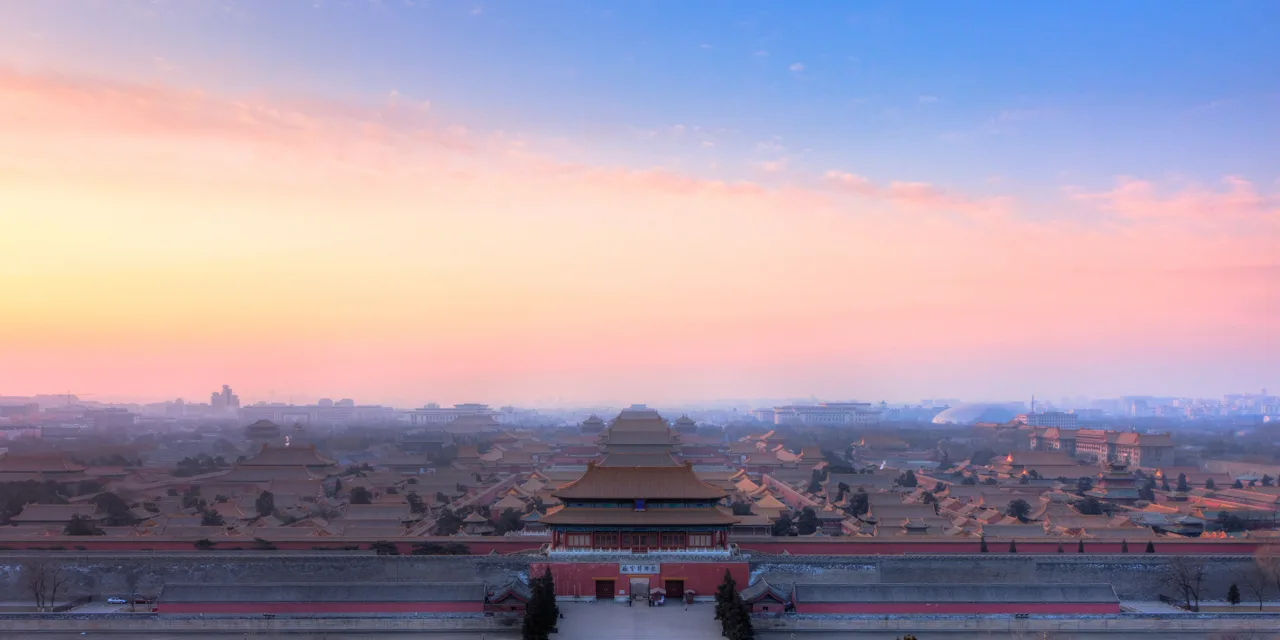
The Forbidden City in central Beijing served
The Forbidden City in central Beijing was the imperial palace of China for nearly five centuries, housing 24 emperors of the Ming and Qing dynasties. The complex covers 72 hectares, contains 980 surviving buildings, and remains the largest collection of preserved ancient wooden structures on earth. No other site in China concentrates this much dynastic history within a single set of walls.
The Forbidden City in central Beijing was the imperial palace of China for nearly five centuries, housing 24 emperors of the Ming and Qing dynasties.
Construction began, 1406
Construction began in 1406 under the Yongle Emperor, who moved the Ming capital from Nanjing to Beijing and needed a palace complex worthy of heaven's mandate. One million workers and 100,000 artisans labored for fourteen years to complete the initial structure. The name, Zijin Cheng, Purple Forbidden City, referred to the purple star of the North Celestial Pole around which all stars revolve, an astronomical analogy for imperial centrality. Ordinary citizens were forbidden entry under penalty of death. The last emperor, Puyi, abdicated in 1912 but continued living in the inner quarters until 1924, when he was finally evicted by a warlord who converted the site to a public museum. UNESCO World Heritage designation came in 1987.
The south-to-north axis through the Meridian Gate, across the Golden Water bridges, through the Gate of Supreme Harmony, and into the sequence of throne halls is the formal ceremonial spine of the Chinese state for five centuries. Walking it produces a cumulative sense of scale that individual buildings don't convey. Beyond the central axis, the side halls, gardens, and treasury collections reward multiple hours. The Palace Museum's permanent collection includes over 1.8 million artifacts; the ceramics and imperial paintings rooms are among the strongest.
The Forbidden City is at the center of Beijing, directly north of Tiananmen Square. Metro Line 1 to Tiananmen East or West stations. Enter through the Meridian Gate (south) and exit through the Gate of Divine Prowess (north) to reach Jingshan Park. Tickets must be booked in advance online; capacity is capped daily.
The Forbidden City is at the center of Beijing, directly north of Tiananmen Square.
The Experience
A south-to-north walk through the ceremonial axis of imperial China, throne halls, courtyards, gardens, and a collection of 1.8 million artifacts, takes a minimum of three hours and rewards considerably more.
Why It Matters
The Forbidden City is the physical embodiment of the Chinese imperial system, its architecture, proportions, and orientation encode a cosmological worldview that governed one of history's largest states for five centuries.
Why Visit
No other single site presents this density of preserved imperial architecture. The experience of moving through the sequence of halls and gates is architectural history made spatial.
✦ Insider Tips
- 1
Book tickets online in advance, the daily capacity cap means walk-up entry is frequently unavailable.
- 2
Allow at least four hours; the side halls and treasury require separate attention from the main axis.
- 3
Enter from the south Meridian Gate and exit north, this aligns with the historical ceremonial direction.