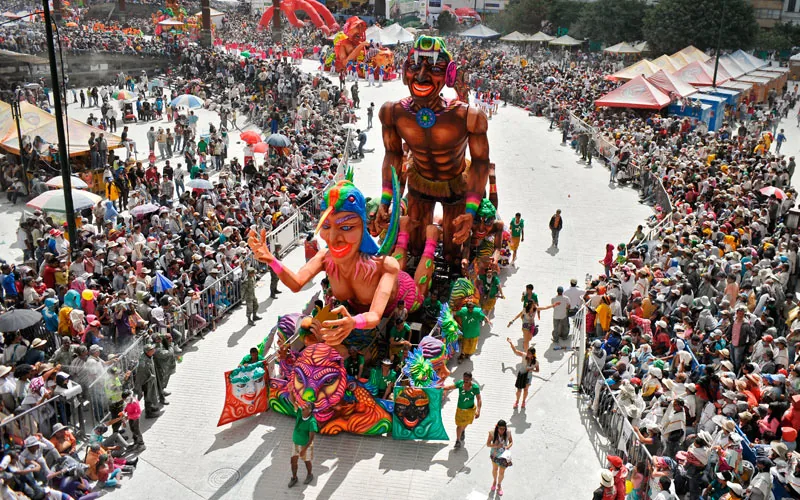
At this carnival, everyone joyfully smears each other black one day and white the next, in a celebration of mixed cultures.
About Carnaval de Negros y Blancos
The Carnival of Blacks and Whites grew from a blend of indigenous Andean, African and Spanish traditions in the Pasto region, with the black-and-white painting custom carrying historic meanings of equality and the mixing of peoples. Celebrated for centuries, it was inscribed by UNESCO as Intangible Cultural Heritage. Its giant floats reflect a sophisticated local tradition of carnival craftsmanship.
The Carnival of Blacks and Whites, held each
January in the southern Colombian city of Pasto, is one of the largest and most distinctive festivals in the country, recognised by UNESCO as Intangible Cultural Heritage of Humanity. Famous for its enormous, intricately crafted floats and for revellers playfully painting and dusting each other black and then white, it is a riotous celebration of cultural unity.
Painted Black and White
The carnival's signature ritual opens up over two days: on one day, people daub one another with black paint or grease, and on the next with white talcum powder and foam, in a joyful, messy celebration of the mixing of cultures and races, with roots in colonial and indigenous traditions of inversion and equality. The climax is the Grand Parade on January 6th, featuring monumental papier-mache floats that artisans labour on for an entire year.
The Experience
You join the crowds in the streets of Pasto as people of all backgrounds cheerfully paint and powder one another black and white, then watch the spectacular Grand Parade on January 6th, when towering, brilliantly detailed papier-mache floats, each a year in the making, roll through the city. The music, costumes, foam and sheer exuberance make it an immersive and joyful cultural experience.
Why It Matters
The Carnival of Blacks and Whites is one of Colombia's most important cultural celebrations and a UNESCO-recognised expression of the country's mixed heritage and spirit of unity. Its artistry, history and inclusive symbolism make it a profound and exuberant showcase of Andean and Colombian identity.
Why Visit
Visit in early January for one of Colombia's greatest festivals, the UNESCO-listed Carnival of Blacks and Whites in Pasto, with giant floats and joyful black-and-white painting.
✦ Photo Gallery
Best Season
🌤 The carnival runs in early January, peaking with the Grand Parade on the 6th. Book travel and accommodation in Pasto well ahead, as the festival draws large crowds.
Quick Facts
Best time to visit
The carnival runs in early January, peaking with the Grand Parade on the 6th. Book travel and accommodation in Pasto well ahead, as the festival draws large crowds.
Getting there
In Pasto, Colombia; reach Pasto first, then continue to the site.
Location
Pasto, Colombia
Type
attraction
Insider Tips
- 1
Time a visit for early January, with the parade on the 6th.
- 2
Expect to be painted black and powdered white; wear old clothes.
- 3
The Grand Parade's giant floats take a year to build.
- 4
Book accommodation in Pasto well in advance.