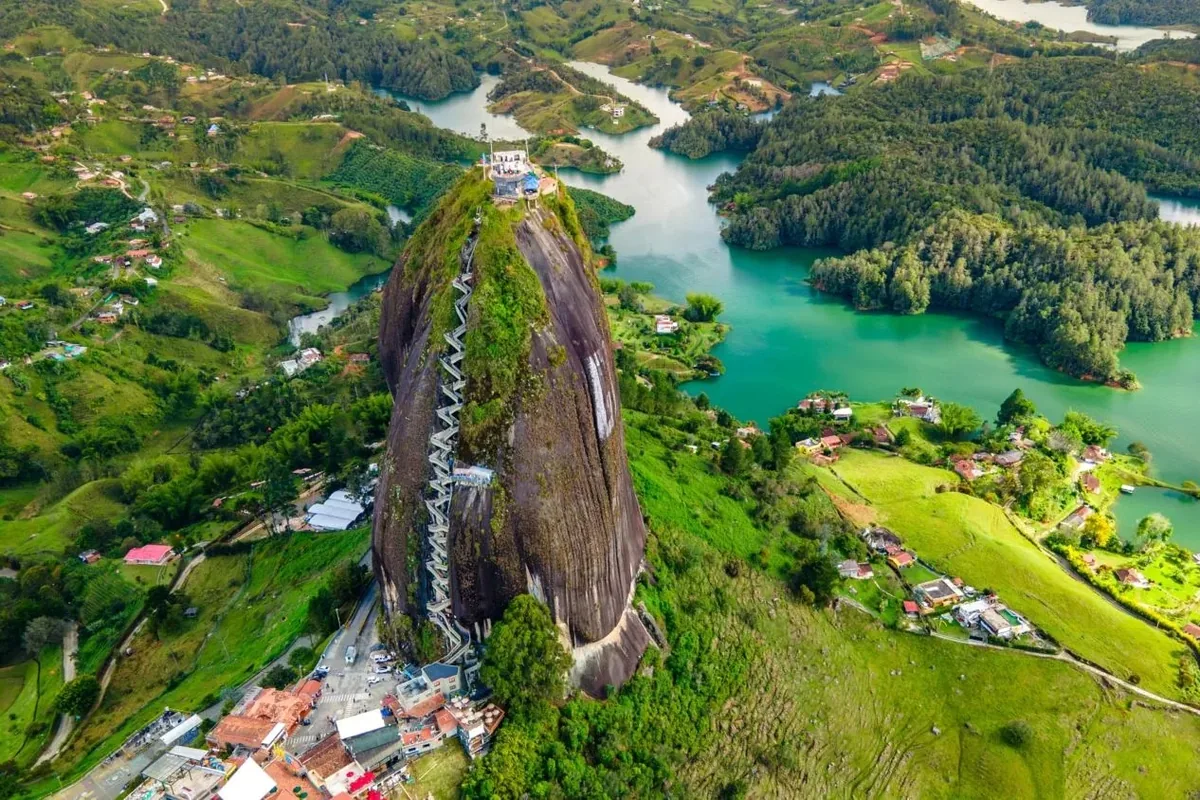
A staircase of more than 700 steps climbs a natural crack in this giant rock to a summit view over a maze of water and islands.
About El Peñón de Guatapé
El Penon is an ancient granite monolith long held sacred by indigenous peoples. In the 20th century a staircase was built into a fissure in the rock to enable the climb to its summit. The dramatic lake landscape below was formed when a river was dammed for hydroelectricity in the 1970s, flooding the valleys into the labyrinth of water seen today and making the rock a premier viewpoint.
El Penon de Guatape
El Penon de Guatape is a colossal granite monolith rising abruptly some 220 metres from the lake-strewn landscape near the colourful town of Guatape, in Colombia's Antioquia region. A staircase of over 700 steps zigzags up a great fissure in the rock to a summit viewpoint, where one of the most spectacular panoramas in the country opens up over a labyrinth of blue water and green islands.
700 Steps Up a Giant Rock
The rock is a single enormous granite inselberg, smooth and dark, that for centuries was revered by the indigenous people. A masonry staircase of more than 700 steps was ingeniously built into a natural crack splitting the rock, allowing visitors to climb to the top. From the summit, the view reveals the sprawling, many-fingered reservoir created by a hydroelectric dam, an intricate maze of water and islands stretching to the horizon.
The Experience
The path goes up the winding staircase up the crack in the rock, more than 700 steps, pausing to catch your breath, until you reach the summit and its viewing platform, where the astonishing panorama of the branching reservoir and its countless green islands opens out below. Boats ply the water far beneath. The nearby town of Guatape, famous for its vividly painted houses, completes a memorable day out from Medellin.
Why It Matters
El Penon de Guatape is one of Colombia's most iconic natural landmarks and a hugely popular destination, offering a spectacular reward for the climb. Together with the colourful town of Guatape, it showcases the beauty of the Antioquia region and is a highlight of any visit to the country.
Why Visit
A giant granite monolith near Medellin, climbed by 700 steps to a summit with a spectacular panorama over a maze of lakes and islands, beside colourful Guatape.
✦ Photo Gallery
6 photos of El Peñón de Guatapé · click to enlarge
Best Season
🌤 The Antioquia region is pleasant year-round; drier spells make the climb easier. Mornings are best for clear views and to beat the crowds and midday heat.
Quick Facts
Best time to visit
The Antioquia region is pleasant year-round; drier spells make the climb easier. Mornings are best for clear views and to beat the crowds and midday heat.
Getting there
In Guatapé, Colombia; reach Guatapé first, then continue to the site.
Location
Guatapé, Colombia
Type
attraction
Coordinates
6.2195°, -75.1792°
Insider Tips
- 1
Climb the 700-plus steps up the natural crack in the rock.
- 2
The summit view over the lake maze is the reward.
- 3
Combine it with the colourful town of Guatape.
- 4
Go early for clear views and fewer crowds.