A South Bohemian village whose German farmers applied Baroque decorative gables to ordinary farm buildings for two centuries. The farmers were expelled in 1945. The collective farming that followed preserved the buildings by removing the incentive to modernize them. UNESCO found the result exceptional.
About Holašovice Historic Village
Founded by German settlers in the 13th century; Folk Baroque farmhouse facades developed through the 18th and 19th centuries. Post-1945 expulsion of German population and subsequent collective farming preserved the building stock. UNESCO World Heritage designation 1998.
Holašovice is a small agricultural village in South Bohemia whose central green is enclosed by farmhouses in South Bohemian Folk Baroque style, a regional vernacular tradition that applied Baroque decorative motifs to the gable facades of ordinary farm buildings in a way that has no equivalent elsewhere in Central Europe. The UNESCO listing came Holašovice a World Heritage Site in 1998 as an exceptionally complete example of a Central European village whose building stock survived intact from the eighteenth and nineteenth centuries.
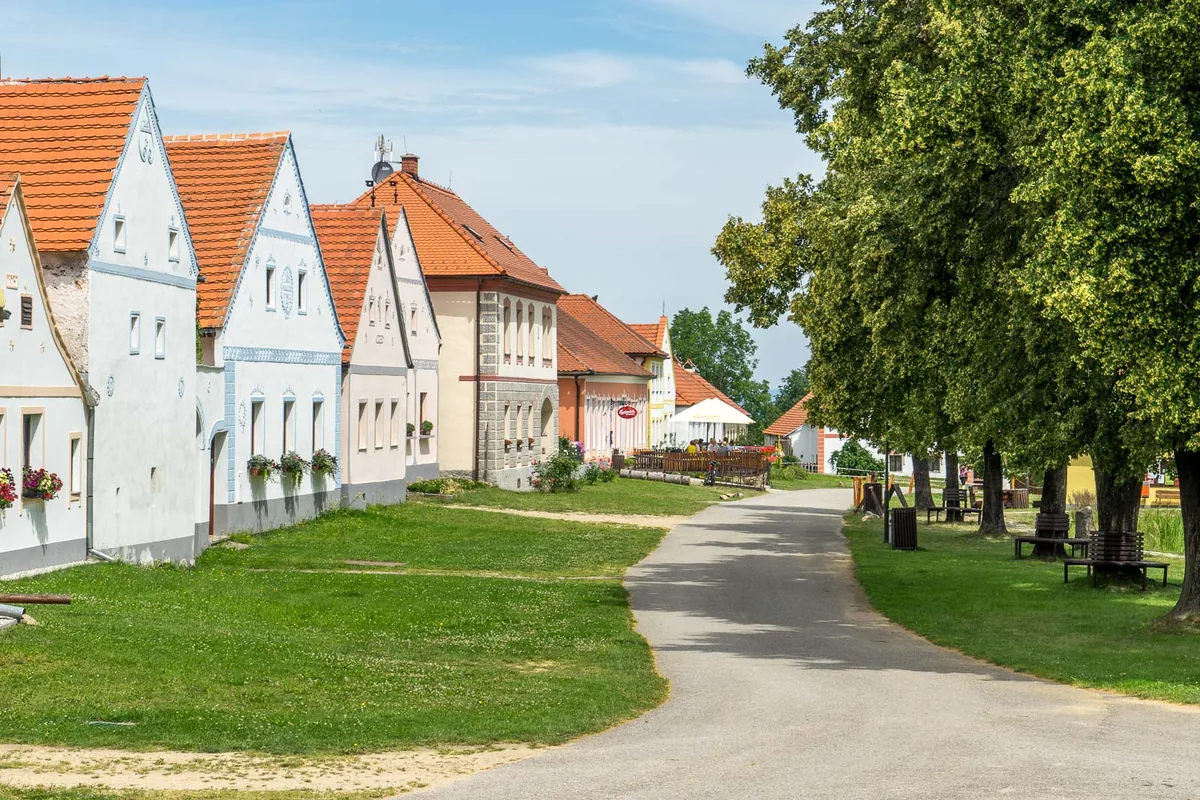
Holašovice Historic Village, Czechia
Sudeten German population, 1945
The village was originally settled by German-speaking farmers in the thirteenth century and was repopulated by Czech settlers after the expulsion of the Sudeten German population in 1945–1946. The German settlers who left had maintained the buildings in excellent condition; the Czech settlers who arrived found a complete village with working farms and intact architecture. Paradoxically, the postwar disruption of landownership, when collective farming replaced individual farm management, reduced the pressure to modernize the buildings, and the facade decorations that German farmers had maintained through the eighteenth and nineteenth centuries survived the twentieth century intact. UNESCO designation came when surveys identified Holašovice as the best-preserved example of a type of village that had once been common across South Bohemia.
The village green is small enough to walk entirely in fifteen minutes. The farmhouse facades around the green present a continuous display of Folk Baroque gable decoration, whitewashed plaster with molded ornament, each house slightly different in its specific decorative program. The church at one end of the green and the pond at the other give the space its enclosure. Several farmhouses have been converted to guesthouses and restaurants. Holašovice is 10 kilometers from České Budějovice, accessible by local bus or taxi. České Budějovice is 150 kilometers south of Prague by bus or train (2.5 hours).
The Experience
A village green enclosed by whitewashed Folk Baroque farmhouses, each with individual Baroque gable decoration, walkable in fifteen minutes and demonstrating a vernacular architectural tradition found nowhere else in Central Europe.
Why It Matters
Holašovice is the only surviving complete example of a South Bohemian Folk Baroque village, a building tradition that combined rural function with decorative ambition and was once common across the region.
Why Visit
The village is small, quiet, and genuinely beautiful, the Folk Baroque facades reward close looking, and the absence of tourist infrastructure means you have the green mostly to yourself. The UNESCO designation reflects real architectural distinction.
Insider Tips
- 1
Combine with a visit to České Budějovice and the Třeboň fishpond landscape on the same South Bohemia day.
- 2
Walk around the green slowly and look at individual gable details, the decorative programs differ house by house.
- 3
The village is best experienced on a weekday; weekend visitors are few but the quiet is more complete mid-week.