“Soviet tanks fired on this building in 1968, mistaking it for the Czechoslovak parliament. The bullet marks were preserved in the 2018 renovation. The building has been asserting Czech national identity at the top of Wenceslas Square since 1891.”
About National Museum
Founded 1818 by Bohemian aristocrats as a Czech national cultural institution. The current Neo-Renaissance building by Josef Schulz opened 1891 as the Czech national revival's architectural statement. Soviet tanks fired on the facade in August 1968; restored 2011–2018 with bullet marks preserved.
About National Museum
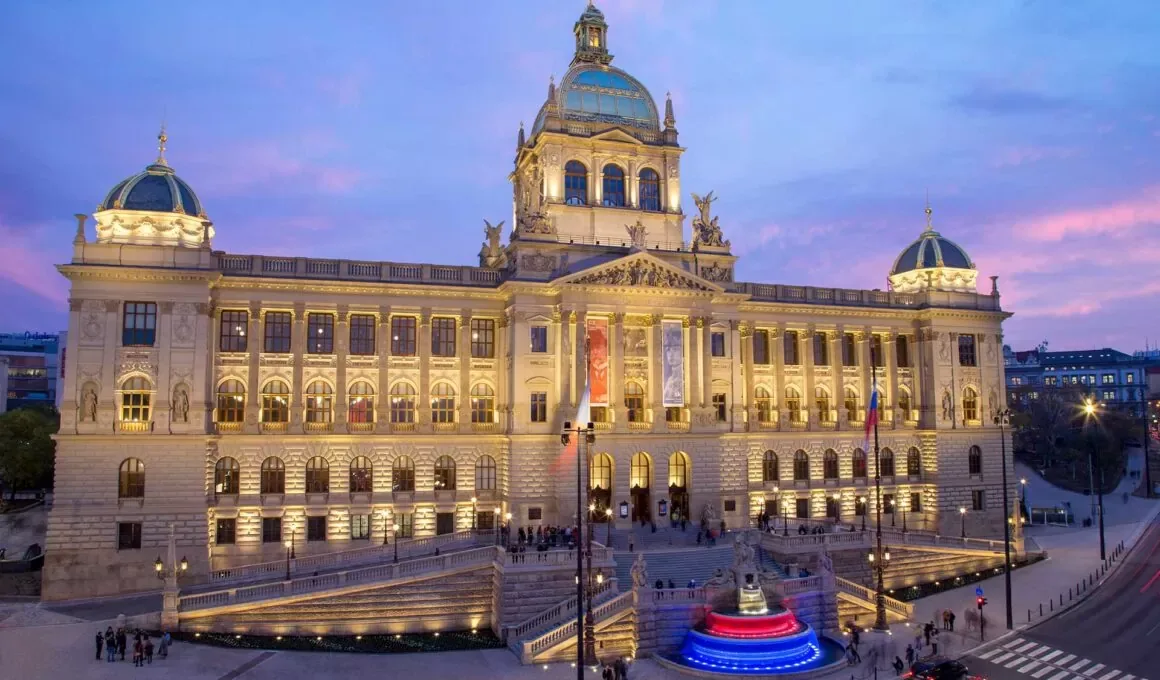
The National Museum, Národní muzeum, occupies the dominant Neo-Renaissance building at the top of Wenceslas Square in Prague, where it has closed the perspective of the city's principal boulevard since its completion in 1891. The building itself is as much the point as the collection, a statement of Czech national identity in stone at the moment when the Czech national revival was asserting cultural independence within the Austro-Hungarian Empire. A €700 million renovation completed in 2018 restored the building to its 1891 appearance and opened the staircase hall to public view for the first time.
A €700 million renovation completed in 2018 restored the building to its 1891 appearance and opened the staircase hall to public view for the first time.
What it represents
The museum was founded in 1818 by Bohemian aristocrats who wanted to document Czech natural history, language, and culture, an institution explicitly framed as a national project at a time when Czech cultural identity was being suppressed in favor of German. The 1891 building, designed by Josef Schulz, was the culmination of the Czech national revival movement's institutional program: a monumental Neo-Renaissance palace at the head of the most important street in Prague, asserting cultural parity with Vienna. On August 21, 1968, Soviet tanks entering Prague fired on the National Museum facade mistaking it for the Czechoslovak parliament; the bullet marks were preserved during the 2018 renovation as a historical record.
The renovated building opens with the ceremonial staircase hall, a vast atrium of marble, gilded columns, and painted ceilings housing the national pantheon of busts and statues. The natural history and paleontology collections on the upper floors are extensive; the mineralogy hall is particularly strong. The 1968 bullet marks on the exterior facade are documented with interpretive panels. The view down Wenceslas Square from the museum steps is Prague's most photographed urban perspective.
The National Museum is at the top of Wenceslas Square, directly above Muzeum metro station (Lines A and C).
The Experience
A restored ceremonial staircase hall of marble and gilded columns housing the national pantheon, natural history and paleontology collections, 1968 bullet marks documented on the exterior facade, and the view down Wenceslas Square from the steps.
Why It Matters
The National Museum building is the architectural culmination of the Czech national revival, a deliberate assertion of cultural identity at the top of Prague's principal boulevard, as politically meaningful as its collections.
Why Visit
The 2018 renovation returned the staircase hall to public access for the first time and revealed the building's interior ambition, which the collections alone did not convey. The preserved 1968 bullet marks add a layer of twentieth-century history to the nineteenth-century fabric.
✦ Insider Tips
- 1
Spend time in the staircase hall before going to the collections, it is the architectural centerpiece of the restoration.
- 2
Find the 1968 bullet marks on the exterior facade before entering, the interpretive panels provide the context.
- 3
The mineralogy collection on the upper floors is undervisited and genuinely excellent.