Twenty-seven Bohemian Protestants were executed in this square in 1621 in a single morning. The Astronomical Clock installed in 1410 still tracks four simultaneous time systems. Tycho Brahe is buried in the Gothic church behind it.
About Old Town Square
A market and civic center since the 11th century. The 1621 executions of Protestant leaders followed the Battle of White Mountain and ended Bohemian independence for three centuries. The Astronomical Clock dates to 1410; the Týn Church to 1365. The square's current Baroque and Gothic ensemble reflects four centuries of successive rebuilding.
What Old Town Square is
Prague's Old Town Square, Staroměstské náměstí, has been the city's public center since the eleventh century: a market place, an execution ground, a political arena, and the architectural showcase of every Bohemian dynasty that wanted to demonstrate civic ambition. The square is enclosed by the Gothic Church of Our Lady before Týn, the Baroque St. Nicholas Church, the Renaissance and Baroque town house facades, and the Old Town Hall with its Astronomical Clock. Few medieval European squares have this concentration of architectural quality.
“The square is enclosed by the Gothic Church of Our Lady before Týn, the Baroque St.”
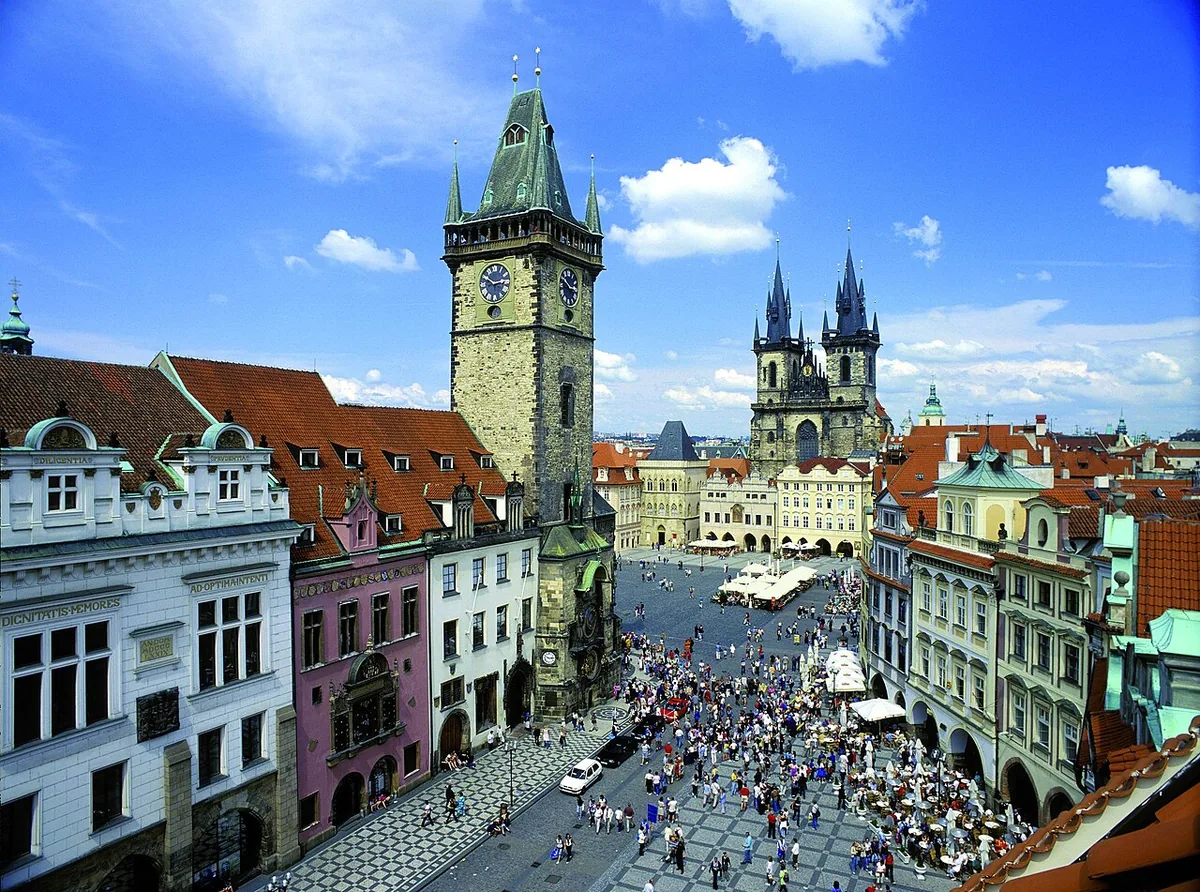
Old Town Square, Czechia
The square's most violent moment came on June 21, 1621, when twenty-seven Bohemian Protestant leaders were publicly executed following the Battle of White Mountain, the event that extinguished Bohemian political independence for three centuries and ushered in the Habsburgs' Counter-Reformation program that rebuilt the square in Baroque. The Astronomical Clock, Orloj, was installed on the town hall in 1410 and is the third-oldest in the world still in operation; each hour a mechanical procession of the twelve apostles moves past the windows above the clock face. The Church of Our Lady before Týn, begun in 1365, was the main Hussite church and has the tomb of Danish astronomer Tycho Brahe, who came to Prague in 1599 at the invitation of Rudolf II.
The hourly Astronomical Clock show draws crowds on the hour; the mechanism itself, with its four dial systems tracking solar time, lunar phase, position of the sun in the zodiac, and Bohemian time simultaneously, rewards study beyond the apostle procession. The Týn Church interior is accessible and less visited than the exterior suggests it should be; Brahe's tomb is behind the main altar. The square's Christmas and Easter markets are among the most atmospheric in Central Europe.
Old Town Square is at the center of Prague's pedestrian historic core. Metro Line A to Staroměstská station, then a 5-minute walk. All trams and tourist circuits in the Old Town pass through or near the square.
“Old Town Square is at the center of Prague's pedestrian historic core.”
The Experience
The Astronomical Clock's hourly apostle procession, the Týn Church's Gothic interior and Brahe's tomb, and Prague's best-framed medieval square, with Christmas and Easter markets that transform the space seasonally.
Why It Matters
Old Town Square is where Bohemian history was made publicly, executions, coronation processions, political rallies, and the 1989 Velvet Revolution demonstrations. The architectural ensemble reflects every major change in Bohemian power since the Middle Ages.
Why Visit
The square is not merely historic, it is spatially beautiful, the buildings that enclose it are individually significant, and the Astronomical Clock's mechanical complexity rewards time that most visitors don't give it.
Insider Tips
- 1
Read the Astronomical Clock face before the hourly show, understanding the four dial systems makes the mechanism interesting rather than just busy.
- 2
Enter the Týn Church, the interior is quieter than the exterior crowds outside and Brahe's tomb is genuinely worth finding.
- 3
The tower of the Old Town Hall is climbable for the best overhead view of the square geometry.