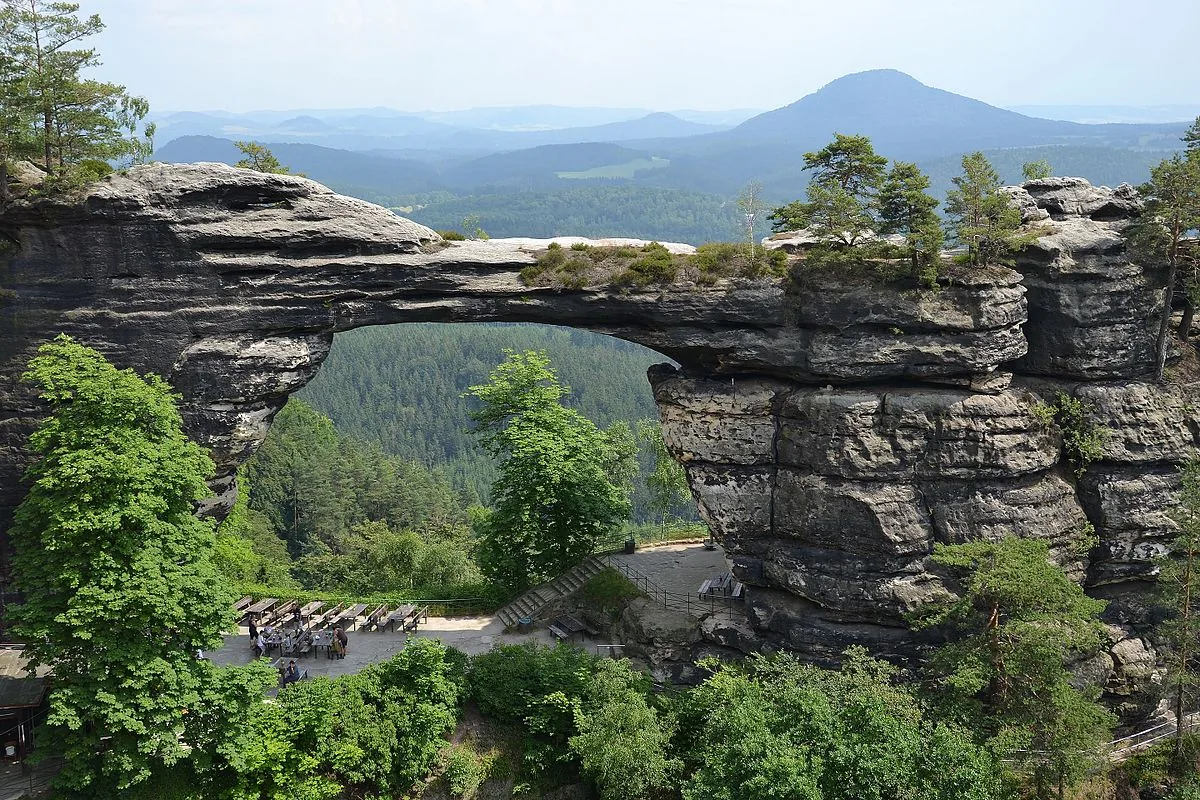
Europe's largest natural sandstone arch has had a restaurant beneath it since 1826. Climbing on the arch was banned in 1982 when the sandstone started cracking. The arch has survived 25 million years of erosion; the visitors required managing.
About Pravčická brána
Formed over 25 million years in the Elbe sandstone landscape of Bohemian Switzerland. The Falcon's Nest guesthouse was built against the rock face in 1826. Climbing prohibited since 1982 due to sandstone fracturing. The national park protecting the area was established in 2000.
What Pravčická brána is
Pravčická brána is the largest natural sandstone arch in Europe, a span of 26.5 meters with a maximum height of 16 meters, formed over millions of years in the Bohemian Switzerland National Park near the German border. The arch sits above a forested gorge in the sandstone landscape of the Elbe valley, and a nineteenth-century romantic guesthouse, the Falcon's Nest, clings to the rock face immediately below it. The arch is protected from human climbing since 1982, when cracking was detected in the sandstone under the weight of visitor traffic.
Bohemian Switzerland, České Švýcarsko, takes its name from the Swiss painters Adrian Zingg and Anton Graff, who came to study the Elbe sandstone landscape in the eighteenth century and compared the rock formations to Switzerland's alpine scenery. The comparison was geographically imprecise but culturally accurate, the landscape attracted Romantic painters, writers, and eventually hikers who established the trail network that still defines the park. The Falcon's Nest guesthouse was built against the arch rock face in 1826 and operated as a destination restaurant and overnight accommodation for visitors who had hiked up to see the arch. Caspar David Friedrich is thought to have used the arch and the surrounding Elbe sandstone formations as compositional references in his paintings, though the attribution is contested.
Visiting Pravčická brána
The standard approach is a 4-kilometer round trip from Hřensko village on the Elbe, climbing through sandstone gorges to the arch viewpoint. The arch is best seen from below, the full span requires a position to the east for the classic view. The Falcon's Nest, still operating as a restaurant, provides the opportunity to eat a meal directly beneath a natural arch that has survived 25 million years of erosion. The trail continues beyond the arch to the Mezní Louka area for those wanting a longer route.
Hřensko is 100 kilometers north of Prague, on the Czech-German border at the Elbe. Buses from Prague's Florenc station or from Dresden reach Hřensko in approximately 2 hours. The trail to the arch begins from the village.
The Experience
A 4-kilometer round-trip hike from Hřensko through sandstone gorges to Europe's largest natural arch, best viewed from the east, with the Falcon's Nest restaurant built directly beneath the span.
Why It Matters
Pravčická brána is the largest natural arch in Europe and the centerpiece of the Bohemian Switzerland landscape that inspired the Romantic era's perception of the region as a sublime natural destination.
Why Visit
Standing beneath a 26-meter natural sandstone arch with a nineteenth-century restaurant built against the same rock is a specific combination of geological scale and human eccentricity that rewards the 4-kilometer approach.
✦ Photo Gallery
Best Season
🌤 May through October; the approach trail is hikeable year-round but the gorges retain ice in winter.
Quick Facts
Best time to visit
May through October; the approach trail is hikeable year-round but the gorges retain ice in winter.
Getting there
In Hřensko, Czechia; reach Hřensko first, then continue to the site.
What's nearby
Terezín Small Fortress, Bohemian Paradise and Prague Castle are also in the area.
Location
Hřensko, Czechia
Type
attraction
Coordinates
50.8838°, 14.2815°
Insider Tips
- 1
Take a boat through the Edmundova soutěska gorge before or after the arch hike, the boat section is among the most beautiful in Bohemian Switzerland.
- 2
The classic arch view is from the east, not from directly beneath, walk a few hundred meters past the arch for the full span.
- 3
The Falcon's Nest serves food and drinks; the terrace view of the arch is worth the price of a meal.