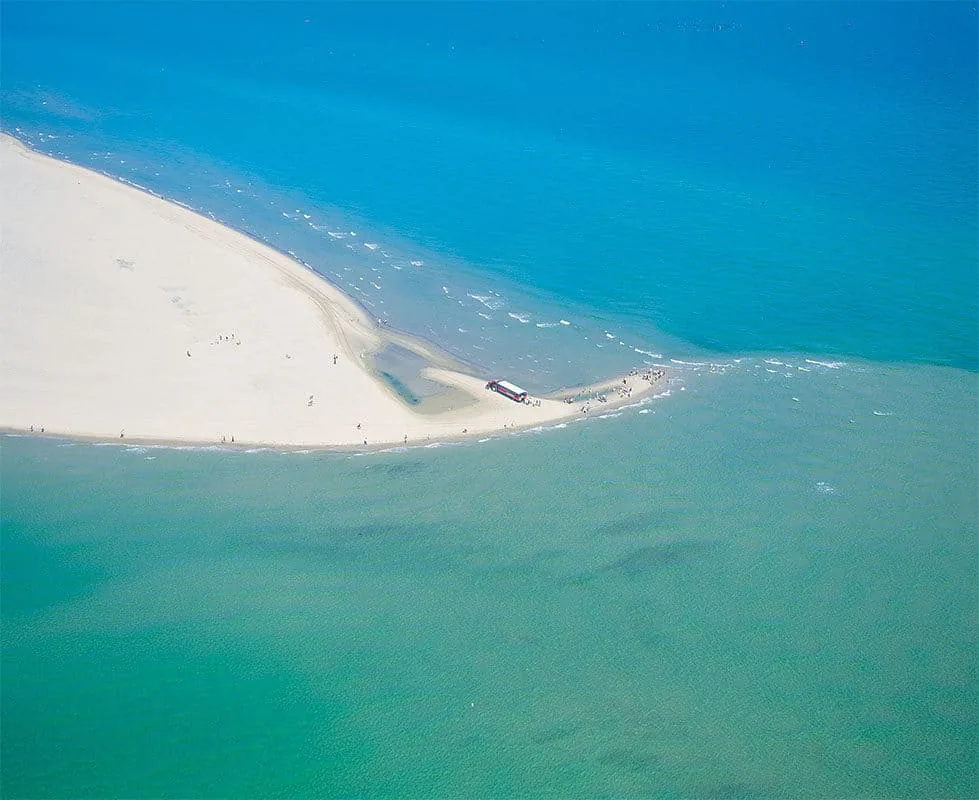
Denmark ends here as a curved sandbar where the North Sea and the Kattegat arrive from opposite directions and collide. Swimming is prohibited at the meeting point. The sand position shifts with every tide.
About Grenen
Grenen is the active tip of Jutland, a constantly shifting sandbar at the northernmost point of Denmark. The Skagen Painters arrived in the 1870s drawn by the peninsula's unique double-sea light; P.S. Krøyer and the Anchers documented the landscape in works that established Skagen in Scandinavian cultural consciousness.
What Grenen actually is
Grenen is the northernmost point of Denmark, a curved sandbar at the tip of Jutland where the North Sea and the Kattegat meet in visible collision, the two bodies of water approaching from opposite directions and producing a turbulence of crossing waves where they join. Swimming is prohibited at the meeting point, which generates its own current and undertow. At the tip with one foot in each sea is a geographic ritual that draws visitors from across Scandinavia.
Skagen, the town 3 kilometers south of Grenen , became famous in the 1870s and 1880s as the gathering point for Scandinavian artists drawn by the extraordinary quality of the northern light, the low-angle sun, the double reflection from sea on both sides of the narrow peninsula, and the clarity of the coastal air produced painting conditions available almost nowhere else in Europe. The Skagen Painters, P.S. Krøyer, Michael and Anna Ancher, Laurits Tuxen, documented the fishing community and the landscape in a realist style whose influence on Scandinavian art was substantial. Grenen itself, the bare sandbar at the tip, appears in several of the most celebrated Skagen paintings. The sand shifts constantly; the exact position of the meeting point changes with tidal and wind conditions.
A tractor-drawn sand wagon, the Sandormen, carries visitors from the Grenen parking area across the 2-kilometer sand flat to the tip, or the walk takes approximately 30 minutes on foot. At the point, the two seas are visibly distinct, the Kattegat is generally calmer and lighter, the North Sea darker and more energized, and their collision at the sand tip is one of those geographic phenomena where the description is immediately confirmed by observation. The view to the north is open ocean; no land lies between Grenen and the North Pole in that direction. Skagen is 100 kilometers north of Aalborg by road. Trains run from Aalborg to Frederikshavn (40 minutes), then a regional train to Skagen (35 minutes). The Grenen parking area is 3 kilometers north of Skagen center.
The Experience
A tractor-wagon or 30-minute walk across a sand flat to the point where two seas collide in visible turbulence, one foot in each sea, no land between you and the North Pole, and the Kattegat and North Sea visibly distinct in color and texture.
Why It Matters
Grenen is the geographic terminus of mainland Scandinavia's western peninsula and the site where Scandinavian Impressionism's most influential landscape school gathered, a place whose physical distinctiveness produced its cultural distinctiveness.
Why Visit
The two-sea collision is one of those rare natural phenomena that genuinely matches its description, you can see the distinct water bodies meeting, and the geography of standing at the absolute northern tip of a country is more affecting than most endpoint visits.
✦ Photo Gallery
Best Season
🌤 May through September. Summer is the most visited but the light at Grenen in spring and autumn is what drew the Skagen Painters, low-angle and extraordinary.
Quick Facts
Best time to visit
May through September. Summer is the most visited but the light at Grenen in spring and autumn is what drew the Skagen Painters, low-angle and extraordinary.
Getting there
In Skagen, Denmark; reach Skagen first, then continue to the site.
Location
Skagen, Denmark
Type
attraction
Coordinates
57.7439°, 10.6475°
Insider Tips
- 1
Walk rather than taking the Sandormen, the 30-minute approach across the open sand flat is part of the experience.
- 2
Visit the Skagen Museum in town before walking to Grenen, the Skagen Painters' work gives the landscape its context.
- 3
The Kattegat-side beach of the peninsula is calmer and less visited; the North Sea side is rougher. Both are visible from the tip.