The Danish royal family has been buried in this cathedral since the fifteenth century. There are 40 monarchs in the chapels. The most recent sarcophagi are modern designs continuing a conversation that started when Bishop Absalon built the first Gothic brick cathedral in Scandinavia around 1170.
About Roskilde Cathedral
Begun around 1170 by Bishop Absalon as Scandinavia's first Gothic cathedral, using local brick rather than imported stone. Royal burials began in the 15th century and continue to the present dynasty. UNESCO World Heritage Site 1995.
Commissioned by Bishop Absalon
Roskilde Cathedral is the burial church of the Danish royal family and has been since the fifteenth century, 40 Danish monarchs are buried here, spanning nine centuries of Danish royal history. The cathedral is a UNESCO World Heritage Site, designated in 1995 as the first Gothic cathedral in Scandinavia, its brick construction, begun around 1170 under Bishop Absalon, introduced the French Gothic architectural tradition to the Nordic region and influenced church construction across Scandinavia for the following century.
“Roskilde Cathedral is the burial church of the Danish royal family and has been since the fifteenth century, 40 Danish monarchs are buried here, spanning nine centuries of Danish royal history.”
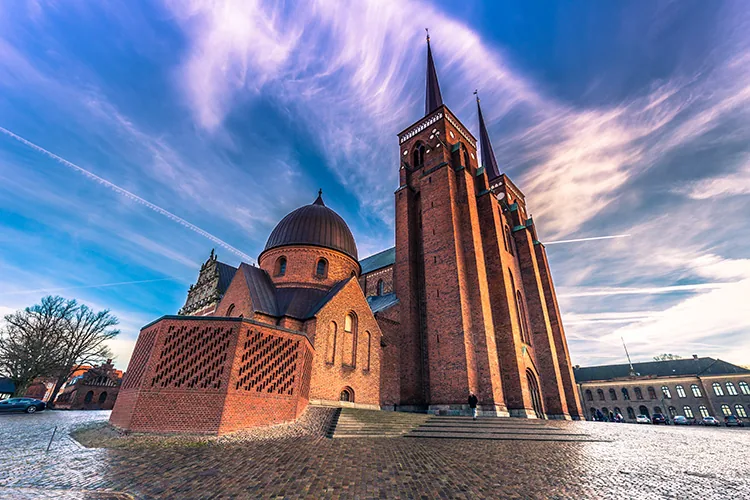
Roskilde Cathedral, Denmark
commissioned the cathedral, 1170
Bishop Absalon, who also founded Copenhagen in the same decade, commissioned the cathedral around 1170 to replace an earlier Romanesque church. The choice of brick, manufactured locally rather than quarried from distant sources, established a specifically Scandinavian Gothic tradition that differed from the French and German models it drew from. The royal burials began in the fifteenth century and continued without interruption through the present dynasty, with new sarcophagi added to the chapels that line the nave. The most recent royal burials have brought new contemporary design into the medieval building, the porphyry sarcophagus of Frederick IX, designed by Thorbjørn Lasson in 1972, and the sarcophagus of Ingrid of Sweden, completed in 2000, continue the architectural conversation that the building has been conducting since 1170.
The cathedral interior is a chronological sequence of Danish royal burial chapels from the fifteenth century to the twentieth. The varying quality and style of the sarcophagi, from late Gothic stone carvings to Neo-Renaissance marble to mid-century porphyry, make the interior an unexpected survey of funerary art across four centuries. The cathedral tower offers views over Roskilde Fjord. The Viking Ship Museum on the fjord, housing five recovered eleventh-century ships, is a 10-minute walk away.
Roskilde is 30 minutes from Copenhagen by regional train (line E or F). The cathedral is a 10-minute walk from Roskilde station.
The Experience
A sequence of royal burial chapels spanning five centuries, with funerary art ranging from late Gothic stone carvings to mid-century porphyry, plus cathedral tower views over Roskilde Fjord and the nearby Viking Ship Museum.
Why It Matters
Roskilde Cathedral introduced Gothic architecture to Scandinavia and established the brick Gothic tradition that spread across the Nordic region. As the continuous royal burial site for nine centuries, it is the most concentrated physical record of Danish dynastic history.
Why Visit
The cathedral's interior is more interesting than most Scandinavian medieval churches because the royal burial program created a layered funerary art collection across five centuries in a single building.
Insider Tips
- 1
Walk the nave slowly and read the sarcophagi dates, the jump from late Gothic to contemporary design is the most interesting sequence.
- 2
Combine with the Viking Ship Museum on the same day trip from Copenhagen.
- 3
The cathedral tower is climbable and gives the best fjord view from the town.