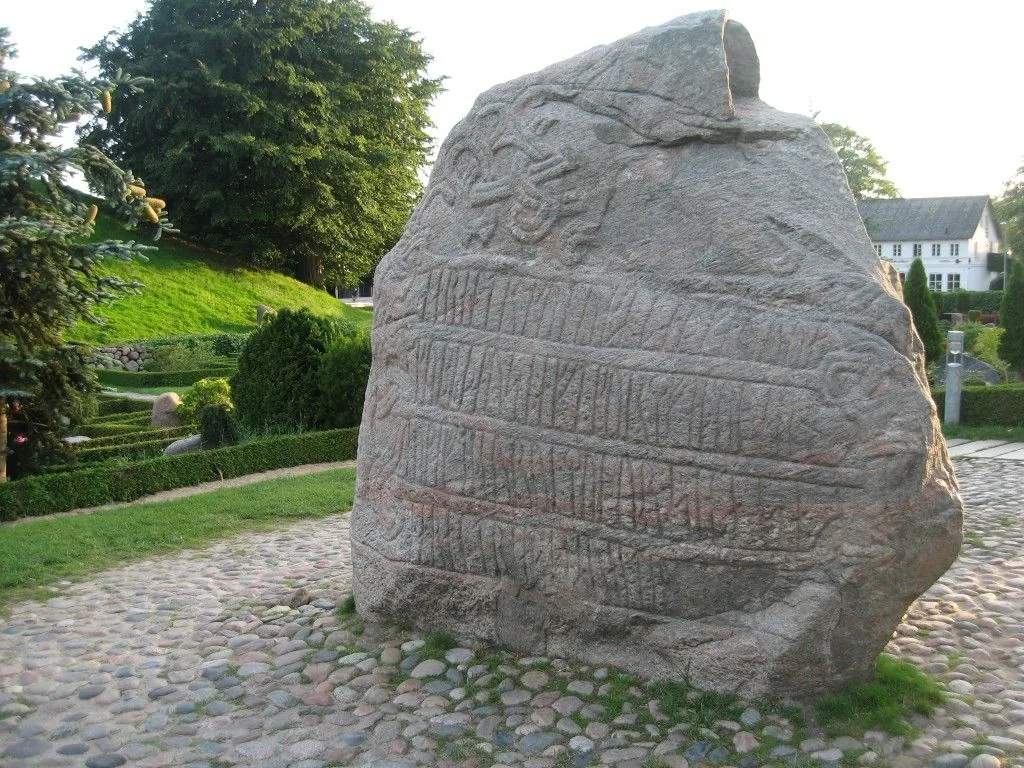
“Harald Bluetooth erected a runestone in 965 CE claiming he had won all of Denmark and Norway and made the Danes Christian. The stone has the oldest image of Jesus in Scandinavia carved on it. The Bluetooth wireless standard is named after him.”
About Jelling Mounds
Gorm the Old erected the smaller runestone around 958 CE. Harald Bluetooth raised the larger one around 965 CE, converted Denmark to Christianity, and reburied his parents inside the new church, emptying the pagan mounds his father had built. UNESCO World Heritage Site 1994.
The Jelling Mounds and Runestones in the small
Jutland town of Jelling are the most important Viking-age monuments in Denmark and among the founding documents of Danish national identity. Two massive burial mounds, a runic stele known as Denmark's birth certificate, and the oldest surviving Christian church on Danish soil together mark the historical transition from the Viking age's pagan culture to the Christian kingdom that became modern Denmark. The UNESCO listing came the site a World Heritage Site in 1994.
Jutland town of Jelling are the most important Viking-age monuments in Denmark and among the founding documents of Danish national identity.
runestones at Jelling, 958
King Gorm the Old, the first historically attested Danish king, erected the smaller of the two runestones at Jelling around 958 CE in memory of his wife Thyra. His son, Harald Bluetooth, erected the larger runestone around 965 CE in memory of his parents and to celebrate his own achievements: unifying the Danish kingdom and, crucially, making the Danes Christian. Harald Bluetooth's runic inscription reads: Harald who won for himself all of Denmark and Norway and made the Danes Christian. The larger stone bears the oldest known image of Jesus Christ in Scandinavia, a figure with arms extended in cruciform. Harald then built a wooden church on the site and buried his parents' remains inside it, emptying the burial mounds his father had built. The archaeological record inside both mounds confirms the reburials and tells the story of Denmark's conversion in physical evidence.
The two runestones stand between the mounds in a churchyard adjacent to the current Jelling church. The large Harald Bluetooth stone, three-sided, with runic inscriptions and the Christ figure, is protected by a glass enclosure. The mounds are freely walkable. The Jelling Museum adjacent to the site provides the full archaeological context, including the results of recent excavations that revealed a large Viking-age royal complex around the church. The museum displays a replica of the stone at full size for close examination.
Jelling is in central Jutland,
10 kilometers from Vejle. Trains run from Vejle to Jelling in 15 minutes. The site is a 5-minute walk from the Jelling station.
The Experience
Two Viking-age burial mounds, two runestones (the larger in a protective glass enclosure), the oldest Christian church site in Denmark, and an adjacent museum with full archaeological context and a full-scale stone replica.
Why It Matters
The Jelling monuments are the physical record of Denmark's transition from Viking-age paganism to Christianity, the documents of the Danish nation's founding, as directly evidenced as any historical monument in Scandinavia.
Why Visit
The Harald Bluetooth stone is one of the most historically consequential objects in Scandinavia, the claim carved into it established Danish sovereignty and Christian identity simultaneously. The Jelling complex is small, accessible, and carries an extraordinary historical weight.
✦ Insider Tips
- 1
Visit the museum before the mounds, the archaeological context transforms the open-air site.
- 2
The glass enclosure around the large stone makes close examination of the Christ figure and runic inscription possible without touching.
- 3
Harald Bluetooth's name became the Bluetooth wireless standard's branding, the logo combines his runic initials H and B.