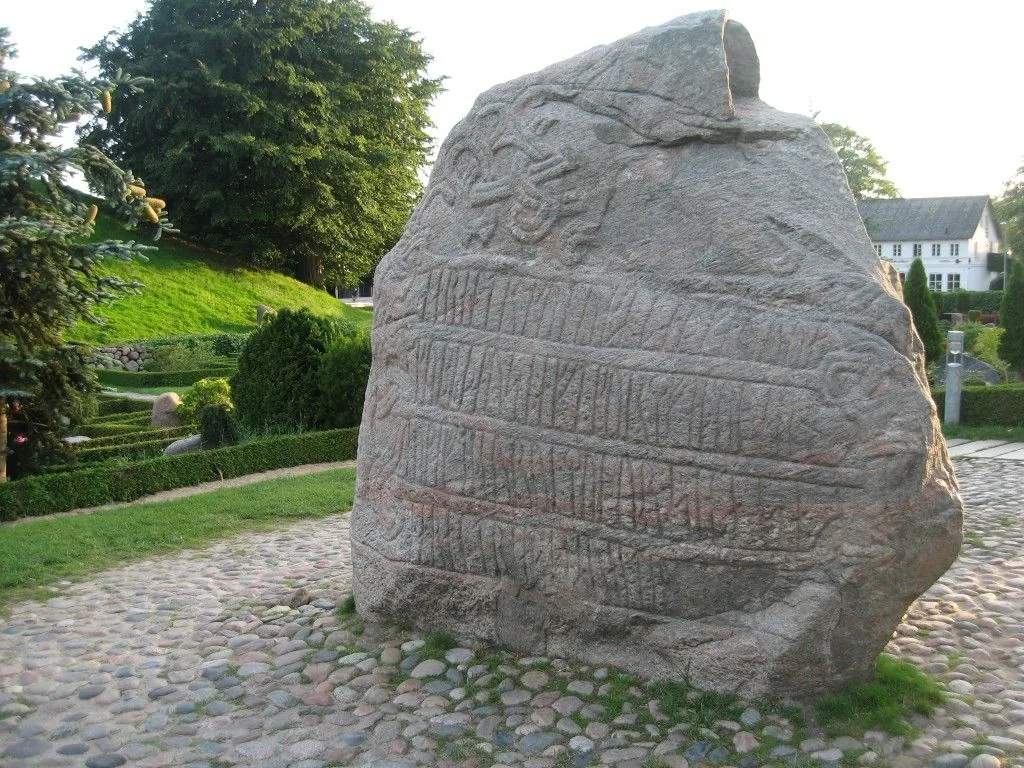
This 10th-century stone is called Denmark's 'birth certificate', and the king who raised it lent his nickname, Bluetooth, to your phone.
About Jelling Mounds and Runestones
The Jelling monuments were created by the first Danish kings, Gorm the Old and his son Harald Bluetooth, in the 10th century. Harald's runestone of around 965 records the unification of Denmark and the conversion to Christianity. The two great mounds and the stones mark the transition from the pagan Viking age to a Christian kingdom. The site is a UNESCO World Heritage Site.
In brief
The Jelling Mounds, runestones and church in Denmark are among the most important monuments of the Viking Age and a UNESCO World Heritage Site. At their heart stand two carved runestones, often called 'Denmark's birth certificate', raised by 10th-century Viking kings, flanked by two huge burial mounds and a small white church.
Denmark's Birth Certificate
The larger of the two runestones was raised by King Harald Bluetooth around 965, proclaiming that he had united Denmark and Norway and converted the Danes to Christianity. Because it carries the earliest record of the name 'Denmark' on home soil and marks the kingdom's conversion, it is celebrated as the nation's 'birth certificate'. The stone bears one of the oldest depictions of Christ in Scandinavia, and the king's Bluetooth nickname later inspired the name of the wireless technology.
The Experience
You visit the runestones, now protected in glass cases, and read about Harald Bluetooth's proclamation, then climb the burial mounds for views over the site and explore the small church said to stand where an earlier wooden one held royal remains. An excellent visitor centre brings the Viking history to life. The sense of standing at the founding moment of the Danish nation is powerful.
Why It Matters
The Jelling monuments are among the most significant Viking-Age sites in the world and a foundational symbol of Danish national identity, a UNESCO World Heritage Site. They record the birth of Christian Denmark and connect, through King Harald Bluetooth, even to the modern world of technology.
Why Visit
The Viking-Age Jelling runestones, Denmark's 'birth certificate', with royal burial mounds and a church, a UNESCO World Heritage Site.
✦ Photo Gallery
Best Season
🌤 Denmark is most pleasant from late spring to early autumn.
Quick Facts
Best time to visit
Denmark is most pleasant from late spring to early autumn.
Getting there
In Jelling, Denmark; reach Jelling first, then continue to the site.
Location
Jelling, Denmark
Type
attraction
Insider Tips
- 1
Read the runestones, Denmark's 'birth certificate'.
- 2
Climb the Viking burial mounds for the views.
- 3
Visit the modern centre to grasp the Viking story.
- 4
Note the link to Harald Bluetooth and the tech name.