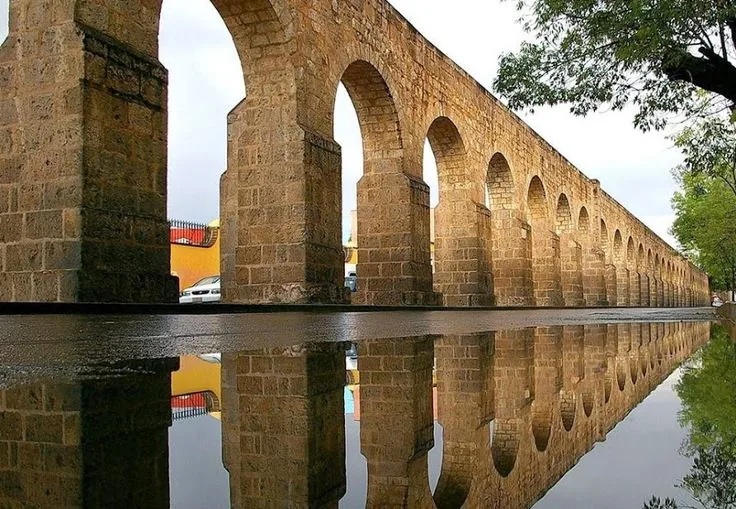
Two hundred and fifty-three pink stone arches march through the city, built not just to carry water, but to save a starving population through labor.
About Acueducto de Morelia
The current aqueduct was completed in 1789 under the direction of Bishop Antonio de San Miguel. It replaced several cruder versions that had serviced the city since 1541. This version was a massive relief effort during a famine, employing thousands of local workers. For over a century, it was the city's lifeblood, finally decommissioned in the early 20th century as modern piping took over. Despite being 'retired,' the structure was meticulously preserved during Morelia's mid-century modernization, ensuring its place as a centerpiece of the historic district.
What Acueducto de Morelia actually is
Morelia’s skyline is anchored by 253 massive stone arches that march across the city with a rhythmic grace. Built from the region's signature pink volcanic stone, the aqueduct stretches for over a mile, connecting the lush forest of Cuauhtémoc to the colonial heart of the city. During the day, the stone takes on a dusty rose hue, but at sunset, it seems to glow with an inner warmth. The structure no longer carries water, yet it remains the primary artery of Morelia’s identity. Locals congregate in the shadows of the arches, and the surrounding green spaces provide a buffer against the modern city’s pace. It is a monument that feels functional and aesthetic at once, evidence of a time when civic engineering was treated as a form of high art.
Commissioned by Bishop Antonio
Bishop Antonio de San Miguel ordered the construction of the current aqueduct in 1785, primarily as a response to a devastating drought that had paralyzed the city. More than just a water project, it was a massive public works program designed to provide jobs for the indigenous population during a period of famine. Workers hauled millions of pounds of 'cantera rosa' (pink stone) to raise the arches, some of which reach nearly ten meters in height. It functioned reliably until 1910, delivering water from the springs of El Carrizal directly to the fountains of the city center. While older versions of the aqueduct existed since the 16th century, this late-colonial masterpiece is what survived the centuries, becoming a symbol of Morelia’s resilience and its status as a UNESCO World Heritage site.
Visiting Acueducto de Morelia
Walking along the Calzada de Fray Antonio de San Miguel, The rhythmic repetition of the arches creates a hypnotic visual corridor. The air near the aqueduct is often cooler, thanks to the mature ash trees that line the adjacent pedestrian paths. What registers is the sound of birds nesting in the cracks of the weathered stone, a constant twittering that replaces the noise of nearby traffic. Something of rough, cool texture of the pink volcanic rock, which has been pitted by two hundred years of rain and wind. People often miss the small plaques that mark where the water once flowed into secondary distribution channels. What hits is how the night lighting transforms the structure into a dramatic silhouette of light and shadow. The bit that stays with you is standing at the 'Las Tarascas' fountain, where the aqueduct terminates in a theatrical display of local history and bronze sculpture.
The aqueduct begins near the Bosque
The aqueduct begins near the Bosque Cuauhtémoc and runs toward the historic center along Avenida Acueducto. Reaching it is best done on foot if you are already in the downtown area; it is a pleasant fifteen-minute walk from the Cathedral. Local 'combis' or micro-buses frequently pass along the avenue, and any taxi driver in Morelia knows the arches as the city's most recognizable meeting point. The area around the 'Las Tarascas' fountain is often congested, so arriving by foot through the park allows for a more contemplative approach to the monument.
The Experience
What catches your eye is is the way the 'cantera rosa' stone changes from a pale peach in the morning to a deep magenta at dusk. The hum of the city feels distant when you are tucked into the leafy Calzada that runs parallel to the arches. Something of immense scale of the colonial ambition as you look down the mile-long stretch of masonry. Most visitors miss the small carved details on the keystone of each arch. What sticks with you is seeing the aqueduct illuminated at night, looking like a glowing spine through the city.
Why It Matters
Morelia's aqueduct is one of the most important and best-preserved colonial water systems in the world. It is the defining feature of the city's pink-stone architecture, which is unique to this region of Mexico. It functions as a rare example of 18th-century humanitarian engineering, where aesthetics and social welfare were combined.
Why Visit
Visit this aqueduct to see how a piece of utility can become a city's soul. While other colonial cities have ruins, Morelia has a monument that still integrates perfectly into daily life. It is the best place in Mexico to take a long, meditative walk through history without leaving the comfort of a vibrant urban center.
✦ Photo Gallery
Best Season
🌤 September is particularly beautiful, as the rains have turned the surrounding parks emerald green, providing a sharp contrast to the pink stone.
Quick Facts
Best time to visit
September is particularly beautiful, as the rains have turned the surrounding parks emerald green, providing a sharp contrast to the pink stone.
Getting there
In Morelia, Mexico; reach Morelia first, then continue to the site.
Location
Morelia, Mexico
Type
attraction
Insider Tips
- 1
Start your walk at the Las Tarascas fountain and head away from the center to find the quietest, most photogenic arches.
- 2
The Calzada de San Miguel, which runs alongside, is one of the most romantic walkways in Mexico, visit it at twilight.
- 3
Bring a wide-angle lens if you want to capture the full perspective of the archway's curve.
- 4
Stop at one of the small 'gazpacho' stands nearby; the Morelian version of this fruit salad is a local staple.
- 5
Look for the small niche at the end of the aqueduct that still holds a colonial-era statue of the Virgin.