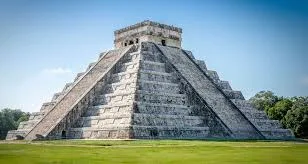
Twice a year, the sun plays the role of a god, using shadow and stone to make a giant serpent slither down the stairs of a thousand-year-old clock.
About Kukulkan Pyramid
The pyramid was the spiritual heart of a cosmopolitan Maya-Toltec city that thrived between the 9th and 12th centuries. Its design is a physical manifestation of the Mayan concept of time, with eighteen terraces representing the months of the year. In 1931, archaeologists discovered a hidden chamber inside the structure containing a red jaguar throne studded with eighty pieces of jade. This discovery proved the pyramid was not just a monument, but a container for an older, more sacred past. During the 1920s and 30s, the Carnegie Institution of Washington led a massive restoration project that cleared away the jungle and stabilized the crumbling stairs we see today.
Kukulkan Pyramid in Mexico
Geometry becomes sorcery at the foot of El Castillo, where four steep staircases rise toward the Yucatan sky in a perfect stone echo of the Mayan calendar. This limestone behemoth anchors the scorched plaza of Chichén Itzá, acting as a massive solar clock that tracks the seasons with mathematical cruelty. The environment around the structure hums with the heat of the tropical sun and the rhythmic, high-pitched chirping of birds that locals swear the pyramid can mimic. The walk across the white-hot limestone pavement. Notice how the ninety-one steps on each side, plus the top platform, add up to exactly three hundred and sixty-five days. Audible here is a mix of the wind whistling through the temple’s comb and the strange, sharp echoes of clapping hands that bounce off the stone, creating a sound identical to the quetzal bird's call.
this current iteration, 800
Mayan architects began the primary construction of this current iteration around 800 AD, though like most great pre-Hispanic structures, it was built atop an even older pyramid that still sits in the dark center of the stone. They dedicated the temple to Kukulkan, the Feathered Serpent deity whose descent from the heavens was central to their agricultural survival. When the Spanish arrived in the 16th century, they found a city that had been largely abandoned for two hundred years, yet the pyramid remained a silent sentinel of a collapsed empire. It survived the subsequent centuries of jungle encroachment and early, destructive archaeological digs to become a global symbol of indigenous engineering. The true genius of the site was only fully understood in the modern era, when observers realized the entire building was tilted to catch the sun during the equinox.
Standing at the base of the northern staircase during the late afternoon, The weight of a thousand years of ritual and astronomical precision. You register the way the light begins to play along the balustrades, creating seven triangles of shadow that slowly crawl down the stone. This optical illusion forms the body of a serpent that eventually joins with the massive stone head at the bottom, a moment that feels more like magic than physics. The sound of a collective gasp from the gathered crowds ripples through the hot air as the shadow snake completes its descent. A mark of the rough, weathered texture of the limestone under your palms, a stone that has absorbed the heat of a million Yucatecan afternoons. Beginning with the sharp, geometric shadows cast by the temple above, cutting through the hazy light like a knife. The most enduring memory is the realization that the Maya turned the very movement of the earth into a theatrical performance. Chichén Itzá sits in the middle of the Yucatan Peninsula, roughly two hours from both Mérida and the coastal resorts of Cancun or Playa del Carmen. Many visitors arrive via organized tour buses that pull in mid-morning, though the savvy traveler catches a pre-dawn ADO bus to arrive at the gates when they open at 8:00 AM. Walking from the parking lot involves a short trek through a gauntlet of persistent vendors before the trees break to reveal the massive clearing of the Great North Plaza. The heat can be punishing by noon, so starting at the pyramid and moving toward the cooler, shaded cenotes and the observatory later in the day is the only way to maintain your energy.
The Experience
The sense of the pyramid is a strange blend of reverent silence and touristic buzz. The first thing you register is the smell of the jungle, a damp, green heat, mingling with the scent of sunblock and dust from the dry earth. A mark of the intensity of the sun reflected off the white stone, making the structure appear almost luminous against the blue sky. The light is so bright it seems to flatten the world into two dimensions until the shadows begin to lengthen in the late afternoon. First, the small, intricate carvings of warriors and eagles that decorate the upper friezes, details often lost in the sheer scale of the building. The most striking thing is the acoustic trickery; a clap at the base returns a sound that is undeniably avian, a direct communication from the ancient architects.
Why It Matters
Kukulkan Pyramid is a masterpiece of archaeoastronomy and one of the New Seven Wonders of the World. It represents the height of Mayan scientific achievement, integrating advanced mathematics, seasonal tracking, and symbolic theology into a single architectural form. Culturally, it remains the most iconic image of Mexico's pre-Hispanic heritage and indigenous resilience.
Why Visit
The pull is that you need to see stone behave like liquid. While other ruins offer beautiful vistas, El Castillo offers a functional, interactive experience with the cosmos. You come here to witness a shadow move across a staircase and realize that people a thousand years ago knew the rhythm of the stars better than most of us do today. It is the only place on earth where a building acts as a theater for the sun.
✦ Photo Gallery
Best Season
🌤 March and September are the essential months, specifically during the Spring or Autumn Equinox when the shadow-serpent descent occurs in its full, intended glory.
Quick Facts
Entry
Around 600 MXN in total (state and federal fees combined) for foreign visitors to Chichen Itza.
Opening hours
Open daily, roughly 8am to 5pm; last entry before closing.
Time needed
About 2 to 3 hours.
Best time to visit
March and September are the essential months, specifically during the Spring or Autumn Equinox when the shadow-serpent descent occurs in its full, intended glory.
Getting there
At Chichen Itza in Yucatan, Mexico; about 2 to 2.5 hours by car from Cancun or 1.5 hours from Merida.
Location
Chichen Itza, Mexico
Type
attraction
Insider Tips
- 1
Bring an umbrella for shade rather than just a hat; the plaza surrounding the pyramid offers zero protection from the vertical noon sun.
- 2
Arrive at the gate thirty minutes before opening to see the pyramid in the soft morning light before the thousands of tour bus visitors arrive.
- 3
Walk to the nearby Sacred Cenote after seeing the pyramid; the walk through the jungle path provides a much-needed drop in temperature.
- 4
Check the lunar calendar; during a full moon, the site occasionally hosts night visits where the pyramid is lit in a ghostly, monochromatic silver.