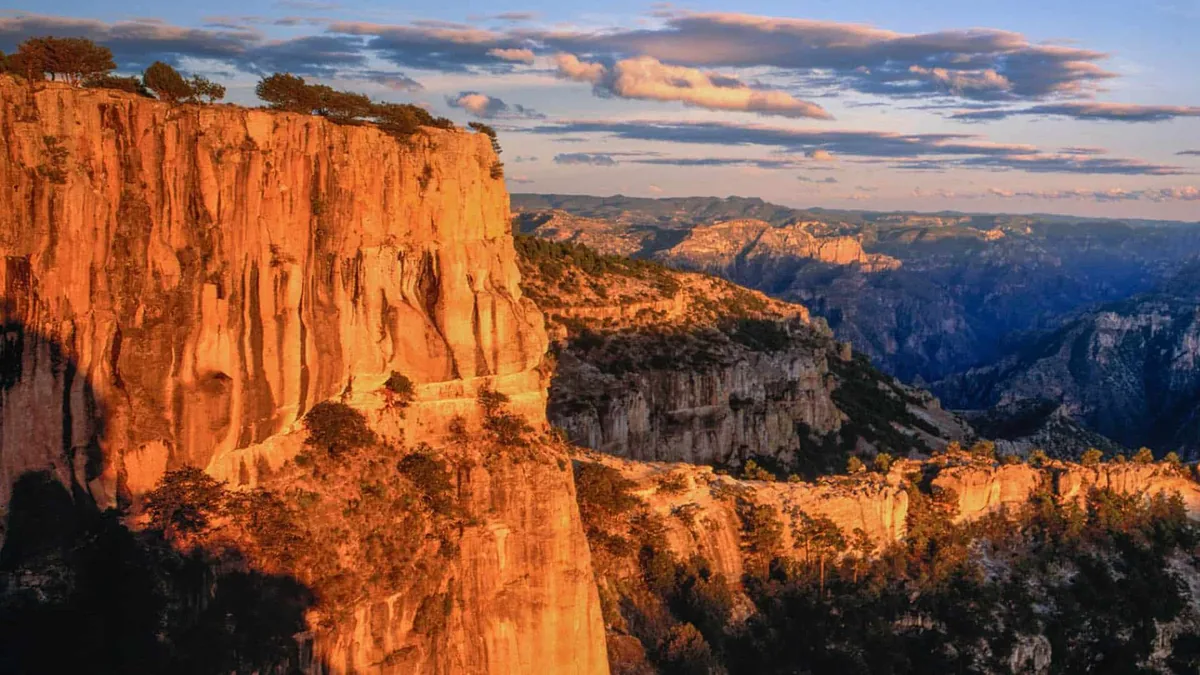
Four times larger than the Grand Canyon, this copper-hued labyrinth is a place where trains defy gravity and the world's greatest endurance runners live in the cliffs.
About Barrancas del Cobre
The geologic formation of the Sierra Tarahumara dates back 20 to 40 million years, but its modern history was rewritten by the 1961 completion of the railway. For nearly a century, the 'Chepe' was a dream of connecting the Pacific to the central plains. The Rarámuri people, who migrated here to escape the silver-mining labor of the Spanish, developed a unique culture of 'rara' (foot) 'muri' (run) to communicate between distant canyon settlements. Today, the region balances its mining and logging history with a growing emphasis on adventure tourism and indigenous autonomy.
What Barrancas del Cobre actually is
Deep at the core of the Sierra Tarahumara, a massive system of six distinct canyons carves a path through the copper-toned volcanic rock. Barrancas del Cobre, or Copper Canyon, is roughly four times the size of its famous northern cousin in Arizona, offering a vertical landscape that shifts from alpine pine forests at the rim to tropical mango groves on the canyon floor. The scale here is difficult to grasp from a single vantage point. Instead, the landscape reveals itself in layers, accessible via one of the world's most impressive engineering feats: the Chepe Express train. This region is the ancestral home of the Rarámuri people, famous long-distance runners who have lived in these canyons for centuries, carving a life out of the cliffs and valleys.
The canyons were formed over millions
The canyons were formed over millions of years by the erosive power of several rivers that eventually flow into the Gulf of California. However, the human history of the region is defined by the struggle to connect this rugged interior to the rest of Mexico. The construction of the Chihuahua-al-Pacífico railway, known as El Chepe, began in the late 19th century but took nearly 90 years to complete due to the impossible terrain. Engineers had to design 37 bridges and 86 tunnels to bridge the chasms. Throughout this modernization, the Rarámuri (Tarahumara) remained the guardians of the canyon. They retreated into the deeper recesses during the Spanish conquest, preserving a culture centered on community, endurance, and a deep spiritual connection to the land.
Inside
Standing on the glass-bottomed observation deck at Divisadero, your breath hitch as the ground seemingly disappears beneath your boots. It smells of woodsmoke and pine needles, a sharp, cool scent that defines the high-altitude rims. The vibrant colors of the Rarámuri women's dresses, bright pinks and greens that stand out against the earthy reds of the rock. An impression of rhythmic sway and click-clack of the Chepe train as it hugs the cliffside, offering glimpses into vertical drops that seem bottomless. Often overlooked is the smaller hiking trails that lead to hidden waterfalls like Basaseachi, focusing only on the train views. First, the deep silence of the canyon at dawn, broken only by the distant chime of a goat's bell. What stays with you is watching a Rarámuri runner move effortlessly across a scree slope that would take an outsider hours to navigate.
The most iconic way to experience
The most iconic way to experience the canyon is via the Chepe Express, which runs between Los Mochis on the coast and Creel in the mountains. Chihuahua City also is a major gateway for those starting from the east. While the train provides the transit, staying overnight in towns like Creel, Divisadero, or the quiet discovery of Bahuichivo is necessary to actually experience the depth of the canyons. Driving is possible but involves navigating grueling switchbacks and unpaved roads, making the train or a local shuttle the preferred choice for most travelers.
The Experience
You notice the dramatic temperature swing of twenty degrees as the train descends from the chilly heights of Creel to the humid valleys near El Fuerte. Nearby, the wind howling through the 'Balcón del Diablo' creates an eerie, whistling music. There is a feeling of sheer scale of the landscape as the train crosses the Chinipas Bridge, suspended hundreds of feet above the river. Most visitors miss the Jesuit missions tucked into the valleys, like the one in Satevó. The moment that stays with you is seeing the sunrise light up the canyon walls, turning the 'Copper' name into a glowing reality.
Why It Matters
Barrancas del Cobre is a global landmark for both geology and human anthropology. It contains some of the deepest canyons in North America and serves as the vital territory for the Rarámuri, whose culture is proof of human resilience. The Chepe railway itself is recognized as a masterpiece of 20th-century engineering.
Why Visit
Visit Copper Canyon to experience a wilderness that feels truly immense and unconquered. Unlike more tourist-heavy canyons, the Sierra Tarahumara offers a living culture that is inextricably linked to the geography. It is the ultimate slow-travel journey, where the transit is just as spectacular as the destination.
✦ Photo Gallery
Best Season
🌤 Oct-Nov offers the best combination of green, post-rainy-season landscapes and clear, crisp air for long-distance viewing.
Quick Facts
Best time to visit
Oct-Nov offers the best combination of green, post-rainy-season landscapes and clear, crisp air for long-distance viewing.
Getting there
In Copper Canyon, Mexico; reach Copper Canyon first, then continue to the site.
Location
Copper Canyon, Mexico
Type
attraction
Insider Tips
- 1
Book a seat on the 'Executive' or 'First' class of the Chepe Express to gain access to the open-air viewing vestibules between cars.
- 2
Spend at least two nights in Creel to acclimatize to the altitude before attempting any significant canyon hikes.
- 3
Purchase hand-woven pine needle baskets directly from Rarámuri artisans; they are durable, beautiful, and support the local economy.
- 4
The zip-line at Copper Canyon Adventure Park is one of the longest in the world and offers a view you can't get any other way.
- 5
Pack layers, including a heavy fleece; even in summer, the canyon rim can be freezing once the sun goes down.