“A one-handed muralist painted a man on fire inside a former orphanage, creating a ceiling so powerful it makes the very stone seem to scream.”
About Hospicio Cabañas
Bishop Cabañas started this project in 1805 to shelter Guadalajara’s outcasts, but the building spent much of its early life as a military stronghold during the revolution. It served its original purpose for nearly a century and a half, housing orphans until the 1980s. The site's transformation into a UNESCO World Heritage landmark was secured by the 1937 arrival of José Clemente Orozco. His frescoes, painted over the course of two years, replaced traditional religious imagery with a haunting, secular examination of the human condition.
What Hospicio Cabañas actually is
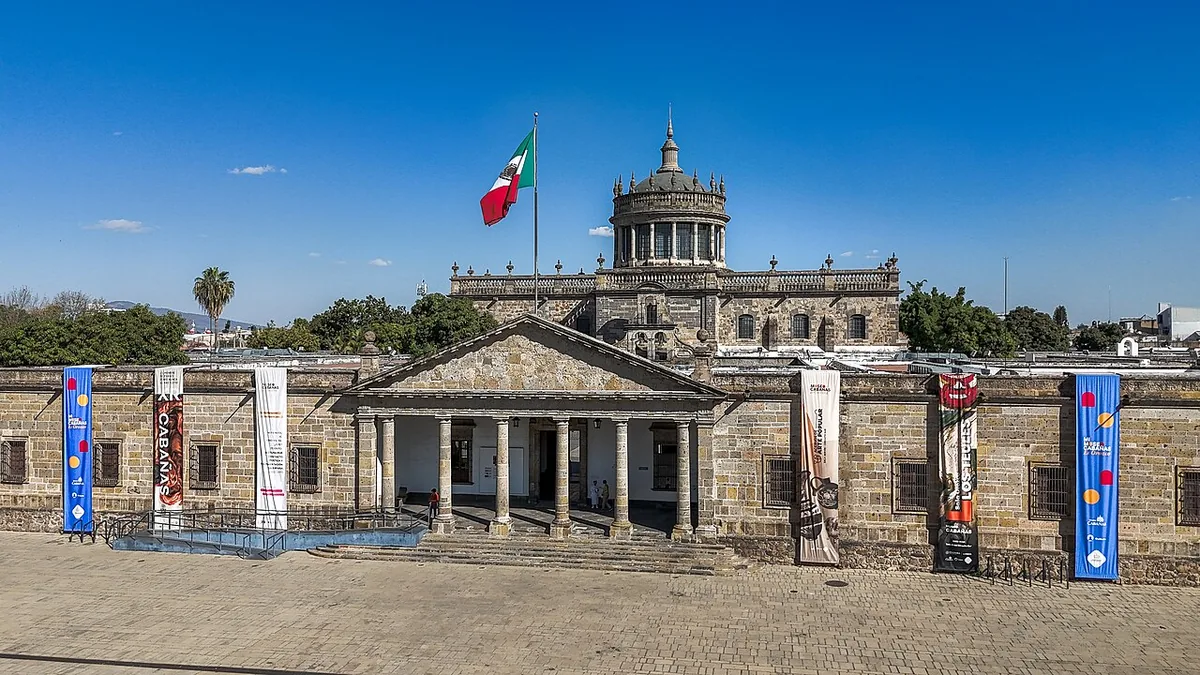
Fifty-seven domes and dozens of serene courtyards define this neoclassical complex, yet most people come for the fire in the ceiling. Situated in the centre of Guadalajara, the Hospicio Cabañas began its life as a house of mercy for the orphaned and the elderly. Architect Manuel Tolsá designed the structure with a rigid, harmonious symmetry that was supposed to bring order to the lives of the marginalized. Sunlight pours through hundreds of windows, illuminating the volcanic stone floors and the long, silent corridors that once echoed with the footsteps of the city's most vulnerable residents. Today, the complex has transitioned from a shelter to a museum, housing the most visceral works of the muralist José Clemente Orozco. The contrast between the cool, disciplined architecture and the violent, expressive murals creates a tension that is unique in the world of Latin American art.
Fifty-seven domes and dozens of serene courtyards define this neoclassical complex, yet most people come for the fire in the ceiling.
Bishop Juan Cruz
Bishop Juan Cruz Ruiz de Cabañas y Crespo envisioned a massive social project at the dawn of the 19th century, commissioning a space that would provide education and care rather than mere incarceration. Construction began in 1805, though the Mexican War of Independence soon turned the site into a barracks. After the smoke cleared, the hospice finally opened its doors to the poor, functioning for over 150 years as a self-contained city within a city. The most significant turning point arrived in the late 1930s when the government invited José Clemente Orozco to decorate the chapel. Orozco, a man who had lost his left hand in a childhood accident, painted with a fury that transformed the quiet chapel into a monumental critique of conquest and technology. His masterpiece, 'The Man of Fire,' remains the ultimate symbol of Mexican identity, rising toward the apex of the central dome.
Standing in the center of the chapel, you
Standing in the center of the chapel, a strange physical sensation as your eyes track the murals upward. The perspective shifts so radically that the figures seem to move walking, a technique Orozco perfected to engage the viewer’s body. The air remains cool even when the Jalisco sun is at its zenith, carrying a faint scent of old stone and floor wax. The absolute silence of the outer courtyards, where orange trees cast long, geometric shadows against the pale walls. A weight of history in the dining halls and sleeping quarters, which are now repurposed as galleries for contemporary art. Frequently skipped is the intricate drainage systems and kitchens that speak to the building's practical past. What remains with you is the first sight of the 'Man of Fire,' where the ceiling seems to dissolve into a vortex of orange and red.
Guadalajara’s historic center
Guadalajara’s historic center is a maze of plazas, and the Hospicio sits at the far end of the Plaza Tapatía. The easiest way to reach it is by walking east from the Cathedral, a ten-minute stroll past fountains and bronze sculptures. While the city's light rail system is efficient, taking a ride-share directly to the Cabañas entrance is often more practical for those unfamiliar with the downtown layout. Inside the complex requires passing through a large stone gateway that immediately muffles the noise of the surrounding street markets, transporting you into a collection of neoclassical order.
Guadalajara’s historic center is a maze of plazas, and the Hospicio sits at the far end of the Plaza Tapatía.
The Experience
The way the figures in the murals appear to follow your movement through the chapel, a masterclass in anamorphic perspective. You hear the city disappears the moment you cross the threshold into the first courtyard. A sense of solemnity in the repetitive arches and the uniform grey of the volcanic rock. Most visitors miss the small gallery dedicated to the original architectural plans of Manuel Tolsá. The quality of light in the late afternoon turns the stone walls into a soft, glowing gold.
Why It Matters
Hospicio Cabañas is frequently called the 'Sistine Chapel of the Americas' because it houses the pinnacle of the Mexican Muralist movement. It represents the transition of Mexico from a colonial religious society to a modern, revolutionary one. Architecturally, it is one of the finest examples of neoclassical design in the Western Hemisphere.
Why Visit
Visit this place to stand under the most important painting in North America. While other museums feel like quiet archives, the Cabañas feels like a living, breathing confrontation with the soul of Mexico. It is the only place where the architecture of the Enlightenment and the fire of the Revolution coexist in perfect, terrifying harmony.
✦ Insider Tips
- 1
Lie down on the benches provided in the chapel; it is the only way to see the 'Man of Fire' without straining your neck.
- 2
Visit on a Tuesday when admission is often free, but arrive early to beat the local school groups.
- 3
The museum cafe is a quiet spot for a coffee, offering a view of the rear domes that most tourists never see.
- 4
Photography of the murals is strictly prohibited, so focus on absorbing the details with your own eyes instead of a lens.
- 5
Look for the smaller Orozco sketches in the side rooms to see the raw, frantic energy behind his massive finished works.