“Luis Barragán looked at a desolate wasteland of frozen black lava and saw a luxury sanctuary where architecture and volcanic rock would become one.”
About Jardines del Pedregal
The Pedregal development was launched in 1945 as a protest against the 'international style' that was making cities look identical. Barragán wanted an architecture that was uniquely Mexican, rooted in the violent geography of the valley. He and his team spent years mapping the lava flows to ensure that every house occupied a natural 'pocket' in the rock. Throughout the 1950s, it became the most fashionable address in Mexico, attracting intellectuals and artists. Although urban sprawl and property subdivision have threatened the original vision, the area remains the most significant collection of mid-century modern homes in Latin America.
What Jardines del Pedregal actually is
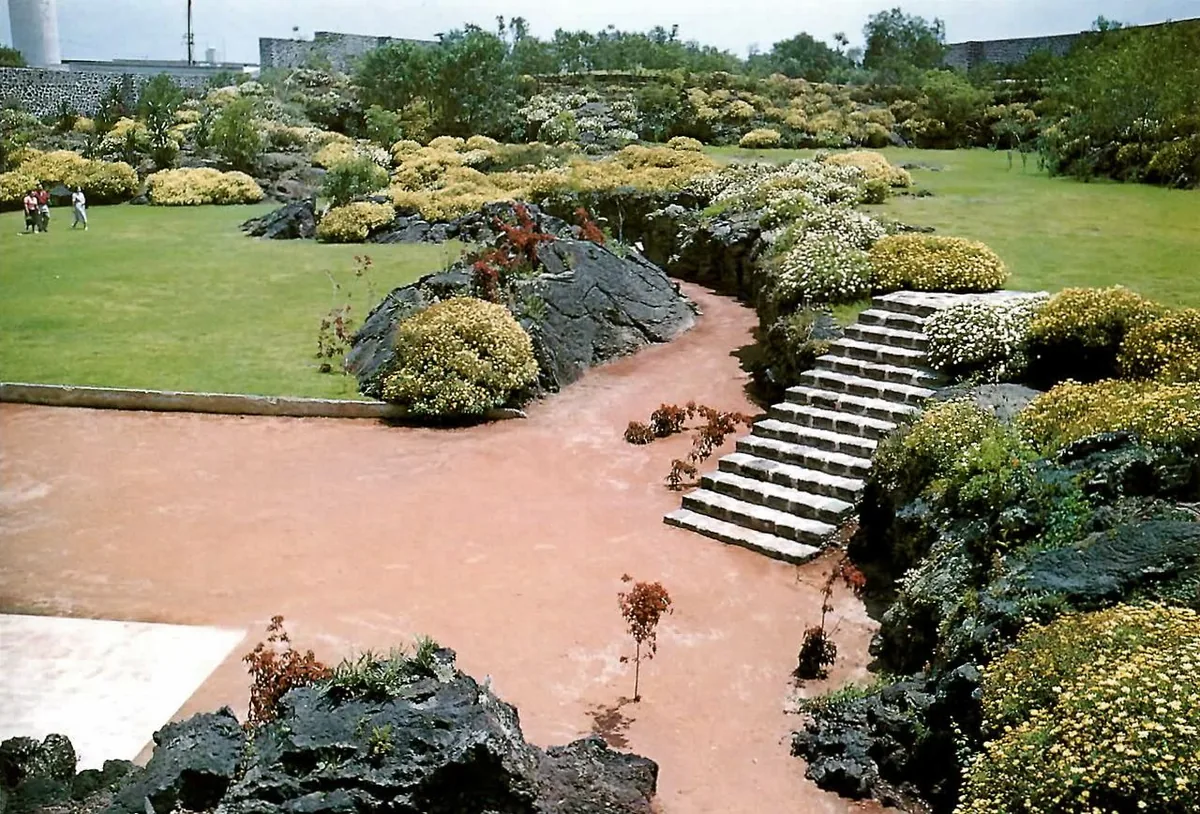
In the southern reaches of Mexico City, a vast sea of frozen black lava is the foundation for one of the world's most ambitious experiments in modernist architecture. Jardines del Pedregal was the brainchild of Luis Barragán, who saw the jagged, inhospitable volcanic landscape left by the eruption of the Xitle volcano as a poetic canvas. Instead of leveling the rock, Barragán and his contemporaries built homes that seem to emerge from the stone itself, using high walls of volcanic rock, vibrant primary colors, and lush, hidden gardens. This is a neighborhood of 'architectural silence,' where the packed chaos of the capital is locked out by massive iron gates and soaring stone facades. It represents a moment in the 1940s and 50s when Mexico led the world in defining a regional, organic modernism.
In the southern reaches of Mexico City, a vast sea of frozen black lava is the foundation for one of the world's most ambitious experiments in modernist architecture.
The Xitle volcano erupted roughly 1,700
The Xitle volcano erupted roughly 1,700 years ago, covering the southern valley in a thick layer of basalt. For centuries, this 'Pedregal' (stony place) was a wasteland, home only to snakes and unique volcanic flora. In the late 1940s, Barragán purchased a large tract of this land, envisioning an elite residential development that would harmonize with the 'genius loci' of the lava. He collaborated with other legends like Max Cetto and Mathias Goeritz to create a manifesto for the site. The project was revolutionary because it rejected the traditional European garden in favor of the wild, jagged beauty of the local terrain. While many of the original houses have been altered, the neighborhood still contains the purest examples of Barragán’s use of light, water, and shadow.
Visiting Jardines del Pedregal
Walking along the wide, quiet streets, The overwhelming presence of the black volcanic rock, which makes up the walls, the curbs, and the foundations. The air here feels slightly cooler and thinner, scented by the heavy jasmine and bougainvillea that spills over the high garden walls. The element that registers is the way the sunlight hits a shock of pink or ochre plaster, a signature Barragán move that turns a simple wall into a piece of art. The transition from the public street to the private, monastic peace that the architecture was designed to foster. Simple to walk past is the small public plazas and fountains Barragán designed, focusing only on the famous private residences. The strange, sculptural shapes of the endemic plants that grow directly out of the cracks in the lava. The piece that stays with you is the glimpse of a hidden courtyard through a half-open gate, where a still pool of water reflects a single, ancient tree.
Location and access
Jardines del Pedregal is located in the Álvaro Obregón borough, south of the city center. It is most easily accessed by car or ride-share, as the neighborhood is sprawling and designed for a vehicular lifestyle. The nearby Ciudad Universitaria (UNAM), itself a UNESCO World Heritage site, is a logical starting point for a day of architectural exploration. While the famous private homes are generally not open to the public without a prior appointment, visiting the Casa del Pedregal (Prieto López House) or the nearby Anahuacalli Museum provides a profound understanding of the aesthetic that defines this volcanic district.
Jardines del Pedregal is located in the Álvaro Obregón borough, south of the city center.
The Experience
You notice the extreme contrast between the rough, porous texture of the basalt and the smooth, polished surfaces of the modernist glass and steel. The sound of the city's traffic is replaced by the rustle of wind through the scrub oaks that managed to survive the lava. There is a sense of mystery, as most of the neighborhood’s beauty is hidden behind imposing walls. Most visitors miss the 'Espacio Escultórico' at the nearby UNAM, which uses the same volcanic landscape to create a massive, circular land-art installation. The detail that stays with you is seeing a house where a living room wall is simply the raw, uncarved face of the lava flow.
Why It Matters
Jardines del Pedregal is a landmark of 'Organic Modernism.' it proved that modern architecture could be deeply rooted in local ecology and history. It set the stage for Luis Barragán to become the only Mexican to win the Pritzker Architecture Prize. Culturally, it remains the ultimate symbol of the sophisticated, design-forward Mexican upper class of the mid-20th century.
Why Visit
Visit this neighborhood to see a world where the 'suburb' was treated as a high-art installation. It is the best place to understand the genius of Luis Barragán without the crowds of his more famous house-museum. It offers a masterclass in how to build with nature rather than against it.
✦ Insider Tips
- 1
Book a tour of Casa Prieto López (Casa del Pedregal) weeks in advance to see a Barragán interior in its original volcanic context.
- 2
The Anahuacalli Museum nearby is built of the same volcanic stone and was designed by Diego Rivera; it's a perfect thematic companion.
- 3
Focus your walking on the area around Plaza del Cigarro, where several of the most iconic original walls and fountains are located.
- 4
Look for the 'Cetto House,' which is one of the few that still perfectly preserves the integration of house and lava according to the original manifesto.
- 5
The neighborhood is very large and not particularly walkable; use a ride-share to move between specific architectural points.