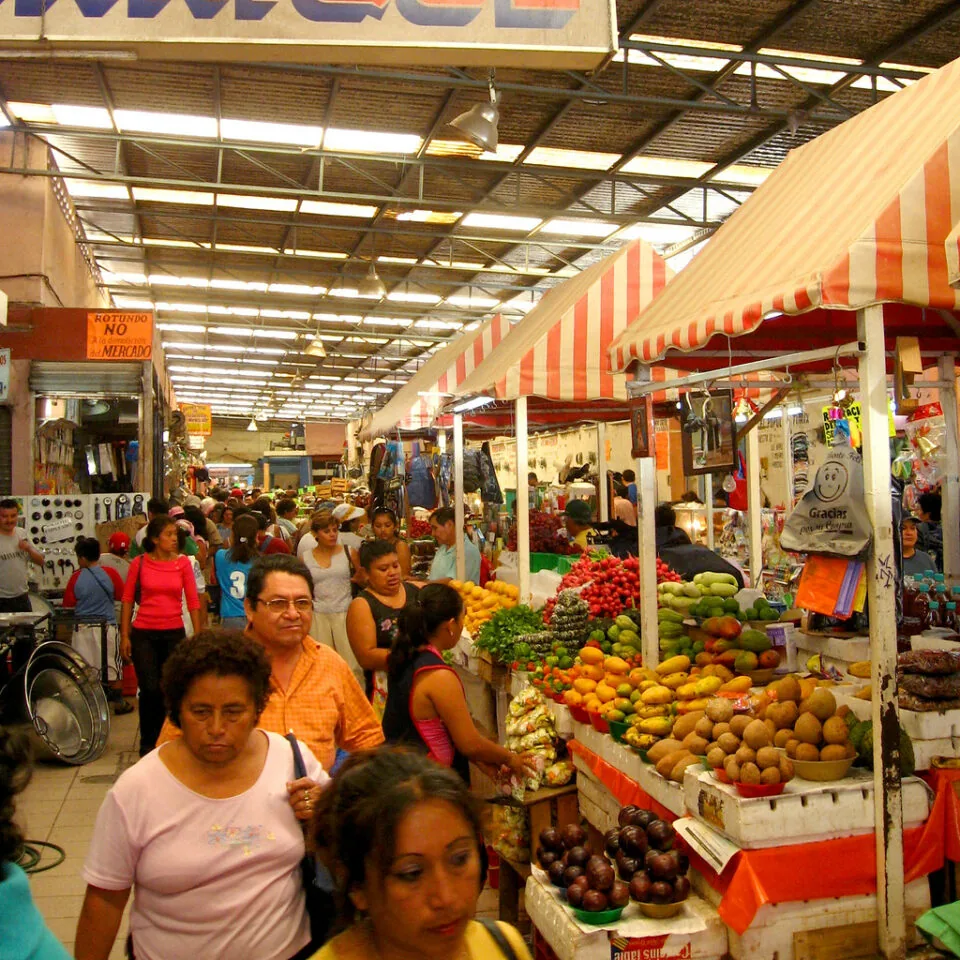
Maya women in embroidered white dresses trade piles of orange habaneros and black chili paste in a labyrinth that smells of sour orange and ancient history.
About Lucas de Galvez Market
The market site has been a center of trade since Mérida was a colonial outpost, but it officially took the name of Lucas de Gálvez in the late 1800s. It was the primary distribution point for the region’s wealth during the henequen 'green gold' era. Unlike many colonial markets that have become boutique gentrified spaces, Lucas de Gálvez remains a blue-collar stronghold. It has expanded and contracted through fires and renovations, but its role as the linguistic and culinary heart of the Maya world has never wavered.
What Lucas de Galvez Market is
Within the humid, white-stone streets of Mérida, the Lucas de Gálvez Market is the sensory engine of the entire Yucatán Peninsula. This is a place of organized chaos where the scents of habanero peppers, fresh lime, and slow-roasted pork collide. The market is a sprawling labyrinth that spills out of its mid-century concrete shell and into the surrounding avenues. Here, the Maya language is heard as frequently as Spanish, and the traditional 'huipiles', white cotton dresses with intricate floral embroidery, are the standard uniform for the vendors. It is not a place built for tourists; it is a raw, functional hub where the ingredients for the world’s most distinct regional cuisine are traded daily. To understand the Yucatán, you must first survive the heat and the noise of these crowded aisles.
Named after a late-18th-century Spanish governor
Named after a late-18th-century Spanish governor who promoted public works, the market has existed in various forms for over a hundred years. The current structure, which has seen numerous renovations, reflects the rapid growth of Mérida as a commercial powerhouse. Historically, this site was where the produce from the inland Maya villages met the imported luxuries from Europe and the Caribbean. This trade created the unique fusion of Yucatecan food: Lebanese spices, Caribbean fruits, and indigenous corn and beans. The market survived the decline of the henequen boom and the arrival of modern supermarkets, remaining the most important economic center for thousands of local families who bring their goods from the 'milpas' (fields) every morning at dawn.
Entering the market, an immediate surge
Entering the market, an immediate surge in temperature and a wall of sound, the rhythmic thwack of butcher knives, the shouting of price specials, and the hum of industrial fans. The air smells intensely of sour orange and achiote paste, the base for the legendary cochinita pibil. The texture of the habanero peppers, piled high in baskets like small, orange coals. The press of the crowd, a gentle but persistent flow that carries you past towers of tropical fruit and stalls selling handmade hammocks. Frequently skipped is the second floor, where skilled cobblers still repair traditional leather sandals. The vibrant displays of Recado Negro, a charred chili paste that looks like dark earth. The element that stays with you is tasting a hand-pressed tortilla topped with pit-roasted turkey, served on a piece of greasy brown paper in the middle of the bustle.
The market is located on Calle 56, just
The market is located on Calle 56, just a few blocks south of Mérida’s main plaza. It is the terminal point for dozens of local bus lines, making it the most congested part of the city. Walking from the Plaza Grande is the most straightforward approach, though you should be prepared for uneven sidewalks and heavy pedestrian traffic. Taxis will often drop you a block away to avoid the gridlock. Arriving early in the morning, around 7:00 AM, allows you to see the market at its most energetic before the midday heat becomes oppressive.
The Experience
You notice the sound of the Maya language, soft and tonal, rising above the Spanish clamor. The scent of fresh cilantro and raw honey from the jungle is suddenly replaced by the sharp, metallic smell of the fish section. There is a feeling of grit and the humidity of a place that never stops moving. Most visitors miss the spice section where you can buy whole vanilla beans for a fraction of the price elsewhere. The moment that stays with you is the sight of a vendor skillfully peeling a mamey fruit to reveal its shocking, salmon-colored flesh.
Why It Matters
Lucas de Gálvez is the cultural and economic lung of the Yucatán. It preserves the traditional Maya trade system and serves as the essential laboratory for Yucatecan cuisine, which is recognized globally for its uniqueness. It is the most authentic link between the modern city and the traditional agricultural life of the peninsula's interior.
Why Visit
Visit this market to escape the sanitized version of Mexico found in resorts. It is a masterclass in sensory immersion and the only place where you can see the true, unvarnished diversity of the Yucatán. If you want to know what a culture values, look at what it eats; this market is the best answer to that question.
✦ Photo Gallery
Best Season
🌤 January and February offer the most 'breathable' air in the market, as the humidity is at its lowest and the citrus harvest is in full swing.
Quick Facts
Best time to visit
January and February offer the most 'breathable' air in the market, as the humidity is at its lowest and the citrus harvest is in full swing.
Getting there
In Mérida, Mexico; reach Mérida first, then continue to the site.
Location
Mérida, Mexico
Type
attraction
Insider Tips
- 1
Keep your phone and wallet in your front pockets; it's crowded and easy to lose track of belongings in the crush.
- 2
Head to the 'Comida' section for a breakfast of salbutes or panuchos, look for the stand with the longest line of locals.
- 3
Buy a small bag of achiote or recado paste to take home; it is the most authentic souvenir you can find.
- 4
Don't be afraid to ask for a sample of fruit you don't recognize; vendors are usually proud to show off local species like pitaya or zapote.
- 5
Wear closed-toe shoes, as the floors in the meat and produce sections can be damp and slippery.