Half of this building belongs to a decadent European past, while the other half houses the revolutionary murals that tore that past down.
About Palacio de Bellas Artes
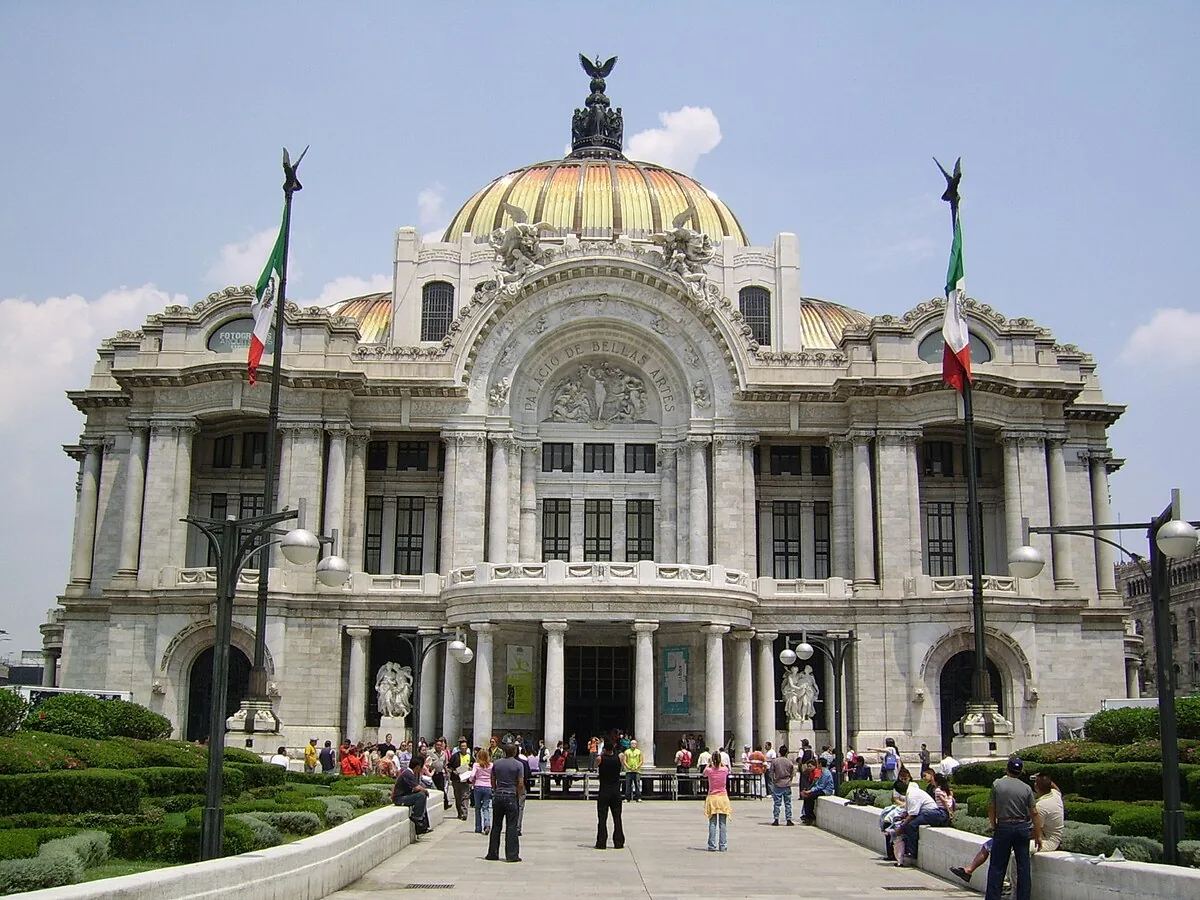
The Palacio de Bellas Artes is a building defined by a revolution. Adamo Boari's original 1904 design was a tribute to the Porfiriato's love for all things French. However, the revolution of 1910 forced Boari to flee, leaving the marble skeleton behind. It sat unfinished for twenty years, slowly sinking into the mud of the former Lake Texcoco. When Federico Mariscal took over in 1932, he used the interior to showcase the new, modern Mexico. The 1934 opening featured the recreation of Diego Rivera's 'Man at the Crossroads,' which had been destroyed in New York for its pro-communist imagery, finding a permanent and defiant home here.
Palacio de Bellas Artes in short
A wedding cake of Carrara marble on the outside and a geometric temple of Art Deco on the inside, the Palacio de Bellas Artes is the crown jewel of Mexico City’s historic center. It sits at the edge of the Alameda Central park, its orange and yellow tiled dome gleaming against the frequently hazy sky. This is the nation's premier performing arts venue, but it functions equally as a museum of monumental muralism. The building is famously sinking into the soft lakebed soil of the city, a slow-motion descent that has left the ground floor several feet below its original street level. Inside, the transition from the white, classical exterior to the dark, polished marble and bronze of the interior is one of the most dramatic architectural shifts in the world. It is the place where high European opera met the revolutionary fire of Mexican art.
President Porfirio Díaz, 1904
Commissioned by President Porfirio Díaz in 1904, the palace was intended to celebrate the centennial of Mexican Independence. The Italian architect Adamo Boari envisioned a grand Neo-Classical and Art Nouveau theater, but the project was halted by the 1910 Mexican Revolution. For two decades, the building stood as an empty shell of steel and marble. When construction resumed in the 1930s under Federico Mariscal, the aesthetic had shifted to the bold, sleek lines of Art Deco. This delay created the building’s unique dual identity. Upon its completion in 1934, it became a canvas for the 'Big Three' muralists, Diego Rivera, David Alfaro Siqueiros, and José Clemente Orozco, who painted massive works on the upper floors that challenged the very bourgeoisie the building was originally meant to serve.
Entering the main lobby, The sound
Entering the main lobby, The sound of your own voice is swallowed by the vast, echoing space of polished marble. The air smells faintly of floor wax and old velvet. What draws the eye is the texture of the bronze stylized masks and geometric patterns that adorn the elevators and railings. The transition from the chaotic noise of the Eje Central avenue to the heavy, hushed atmosphere of the galleries. Often missed is the Tiffany glass curtain in the main theater, which is composed of nearly a million pieces of stained glass depicting the volcanoes Popocatépetl and Iztaccíhuatl. It becomes clear how the light filters through the central dome, illuminating the mural 'Man at the Crossroads' by Diego Rivera. What remains with you is seeing the sheer scale of Siqueiros's murals, their distorted perspectives making the figures seem to leap off the walls.
The palace is the focal point of downtown
The palace is the focal point of downtown Mexico City and is exceptionally easy to reach. The 'Bellas Artes' metro station (lines 2 and 8) has an exit that pops up directly beside the building. It is also a short walk from the Zócalo or the Torre Latinoamericana. Passing through the Alameda Central park provides the most photogenic approach, allowing you to see the marble facade framed by jacaranda trees. Since the area is a high-traffic pedestrian zone, using public transport is far superior to trying to park a car in the congested historic center.
The Experience
Notice the way the light catches the metallic sheen of the Art Deco bronze work, giving the interior a futuristic, cinematic feel. The clatter of a distant piano or a soprano’s rehearsal often drifts through the upper corridors. A sense of gravity as you stand before Orozco's 'Katharsis,' its violent imagery a stark contrast to the elegant marble hallways. Most visitors miss the detailed scale models of the building in the architecture museum on the top floor. The piece that stays with you is standing on the balcony of the Sears building across the street to see the palace’s domes glowing at night.
Why It Matters
The Palacio de Bellas Artes is the most important cultural center in Mexico. It serves as the home of the National Symphony Orchestra and the Ballet Folklórico de México. Architecturally, it is one of the world's finest examples of the transition from Art Nouveau to Art Deco. Politically and artistically, it is the 'shrine' of Mexican Muralism, housing works that define the country's post-revolutionary identity.
Why Visit
Visit Bellas Artes for the murals; it is the only place where you can compare the works of Rivera, Siqueiros, and Orozco side-by-side in a single space. It offers a luxurious, sensory-rich experience that perfectly captures the contrast between Mexico’s colonial aspirations and its revolutionary reality. It is the heart of the city's intellectual life.
✦ Photo Gallery
Best Season
🌤 March is spectacular, as the surrounding Alameda park is filled with blooming purple jacaranda trees that contrast beautifully with the white marble.
Quick Facts
Best time to visit
March is spectacular, as the surrounding Alameda park is filled with blooming purple jacaranda trees that contrast beautifully with the white marble.
Getting there
In Mexico City, Mexico; reach Mexico City first, then continue to the site.
What's nearby
Jardines del Pedregal, Biblioteca Palafoxiana and Monarch Butterfly Biosphere Reserve are also in the area.
Location
Mexico City, Mexico
Type
attraction
Coordinates
19.4353°, -99.1414°
Insider Tips
- 1
Buy a ticket for the Ballet Folklórico to see the famous Tiffany glass curtain illuminated; it is rarely shown otherwise.
- 2
The architecture museum on the fourth floor is included in your ticket and offers a quiet escape from the crowds.
- 3
Head to the coffee shop on the 8th floor of the Sears building across the street for the best overhead view of the palace.
- 4
Notice the 'sinking' of the building by comparing the height of the marble stairs to the original sidewalk levels on the south side.
- 5
Photography of the murals is allowed, but strictly without flash, the guards are very vigilant about this.