“In 1952, a secret staircase found hidden beneath a temple floor revealed the jade-covered remains of a king who had been forgotten by the jungle for twelve centuries.”
About Zona Arqueológica de Palenque
Palenque was a medium-sized city that punched well above its weight in art and politics. Under King Pakal, who took the throne at age twelve and ruled for 68 years, the city became a center of Maya refinement. They pioneered the use of the corbelled arch to create wider interior spaces, seen in the stunning Palace tower. After its collapse around 800 CE, the site was lost to the Lacandon jungle until the late 1700s. Early explorers found it so grand they initially refused to believe it was built by indigenous Americans, a bias that wasn't fully dismantled until the mid-20th century excavations.
The short version
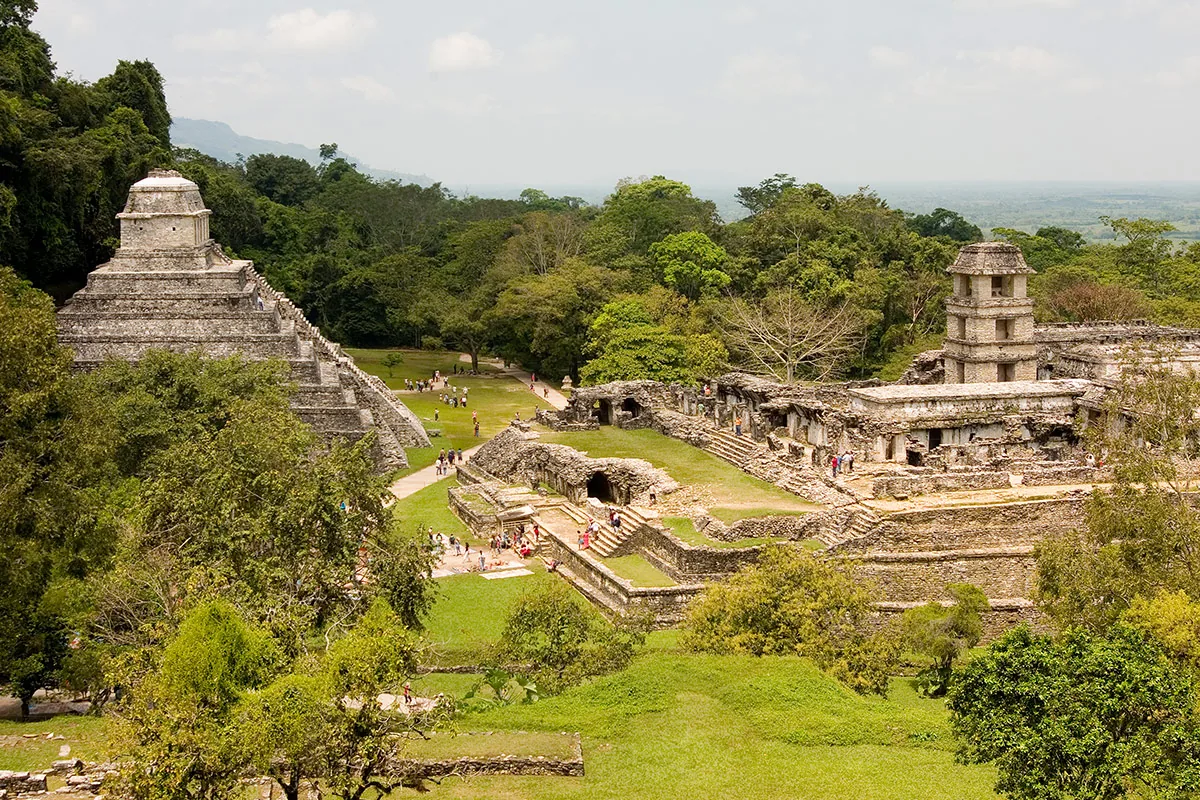
Deep in the emerald embrace of the Chiapas highlands, the grey stone of Palenque emerges from the steam of the jungle like a fever dream. This Maya city is not the largest, but it is undoubtedly the most elegant, characterized by delicate roof combs and intricate bas-reliefs that survived centuries of tropical humidity. The site is famous for its association with K’inich Janaab’ Pakal, the Great Sun, whose reign transformed Palenque into a masterpiece of architectural innovation. Here, the buildings seem to grow out of the hillsides, following the contours of the land and the flow of the Otulum River. The atmosphere is heavy with the sounds of the rainforest, where the roar of howler monkeys is a primitive soundtrack to the silent ruins. The barrier between the human world and the wild jungle feels dangerously thin.
Deep in the emerald embrace of the Chiapas highlands, the grey stone of Palenque emerges from the steam of the jungle like a fever dream.
The past
Palenque’s history is a saga of royal ambition and mathematical genius. While the city dates back to 226 BCE, its golden age occurred in the 7th century under Pakal the Great. He and his sons constructed the Temple of the Inscriptions, a funerary monument that held one of the most significant archaeological finds of the 20th century: Pakal’s hidden tomb. In 1952, Alberto Ruz Lhuillier discovered a secret stairway under the temple floor that led to the king’s massive stone sarcophagus, adorned with a lid depicting his descent into the underworld. This find changed our understanding of Maya burial rites forever. By the late 8th century, however, the city began to decline, and by the time the Spanish arrived, the jungle had almost entirely reclaimed the white-painted palaces.
Walking through the Palace complex,
Walking through the Palace complex, The dampness of the stone and the moss that clings to the intricate carvings. Around you it is thick and sweet smelling of wet earth and tropical blossoms. What registers is the sound of water rushing through the ancient aqueducts, a feat of Maya hydraulic engineering that still functions today. The vibration of the jungle, the insects, the birds, and the hidden animals, which creates a constant, low-level energy. Simple to walk past is the Group of the Cross, a set of temples built into the steep hills that offer the best views of the central towers. how the light filters through the giant mahogany trees, creating a mottled pattern on the grey limestone. What lingers with you is standing at the base of the Temple of the Inscriptions and realizing that a king’s bones lay hidden beneath your feet for over a millennium.
Location and access
Palenque is located in northern Chiapas, about five miles from the modern town of the same name. Long-distance buses run frequently from San Cristóbal de las Casas and Villahermosa, the latter being the closest airport. Small 'colectivos' or vans run constantly between the town and the ruins, dropping you off right at the entrance. The journey into the park is a steep ascent through dense forest, often shrouded in morning mist. Most travelers stay in the 'La Cañada' district of the town or in jungle lodges along the road to the ruins to ensure an early start before the heat and humidity become overwhelming.
Palenque is located in northern Chiapas, about five miles from the modern town of the same name.
The Experience
The way the humidity turns the stone slick and dark under the canopy. The hum of howler monkeys can be terrifying at first, a guttural roar that echoes through the temples like the voice of a forest god. The heat radiating from the open plazas, forcing you to seek the shade of the vaulted galleries. Most visitors miss the small, carved 'aqueduct' figures near the stream at the bottom of the site. The detail that stays with you is the view from the Temple of the Sun, where the forest canopy stretches out like a green ocean toward the horizon.
Why It Matters
Palenque is a UNESCO World Heritage site and the most important center of Maya epigraphy. The vast amount of hieroglyphic text found here has allowed historians to reconstruct a detailed history of its dynasty, more so than almost any other Maya city. It is considered the 'Athens of the Maya' for the sophistication and naturalism of its stone and stucco artwork.
Why Visit
Visit Palenque for the intimacy and the setting; unlike the flat plains of Chichén Itzá, Palenque is a vertical world of mystery. It is the best place to experience the 'Indiana Jones' thrill of ruins half-devoured by the jungle. Nowhere else can you see such a perfect marriage of high art and wild, untamed nature.
✦ Insider Tips
- 1
The onsite museum is excellent and contains the famous jade mask of Pakal, don't skip it thinking it's just more ruins.
- 2
Hire a local guide to take you through the 'jungle trail' behind the main temples to see unexcavated mounds and hidden waterfalls.
- 3
Wear insect repellent with DEET; the mosquitoes in the Chiapas jungle are legendary and persistent.
- 4
Check the humidity forecast; on very wet days, the stone stairs can become extremely slippery and dangerous to climb.
- 5
Look for the 'Group of the Cross' at sunset; the light hits the roof combs in a way that highlights the delicate stone lace.