A single hectare of this ancient forest holds more diverse tree species than the entire continental United States and Canada combined.
About Bukit Timah Nature Reserve
The British colonial government established this as one of the first forest reserves in the Straits Settlements in 1883, acting on concerns about the loss of timber. In the 1930s, the reserve faced existential threats from granite quarrying, but botanist Isaac Henry Burkill fought to preserve the primary forest for scientific study. Following the 1942 conflict, the area was slowly rehabilitated, eventually being gazetted as a National Park and an ASEAN Heritage Park to protect its unique equatorial ecology.
What Bukit Timah Nature Reserve in Singapore
Deep within the geographic center of the island, a 163-hectare patch of primary rainforest works as a stubborn remnant of the wild jungle that once covered Singapore entirely. The reserve contains more tree species in a single hectare than the whole of North America combined, making it a cathedral of biodiversity. At its heart lies the highest natural point in the nation, though its elevation of 163 meters is modest compared to the giants of the region. Despite the proximity of residential blocks, the forest air here is thick, humid, and heavy with the sound of cicadas and the rustle of long-tailed macaques in the canopy.
Naturalist Alfred Russel Wallace spent significant
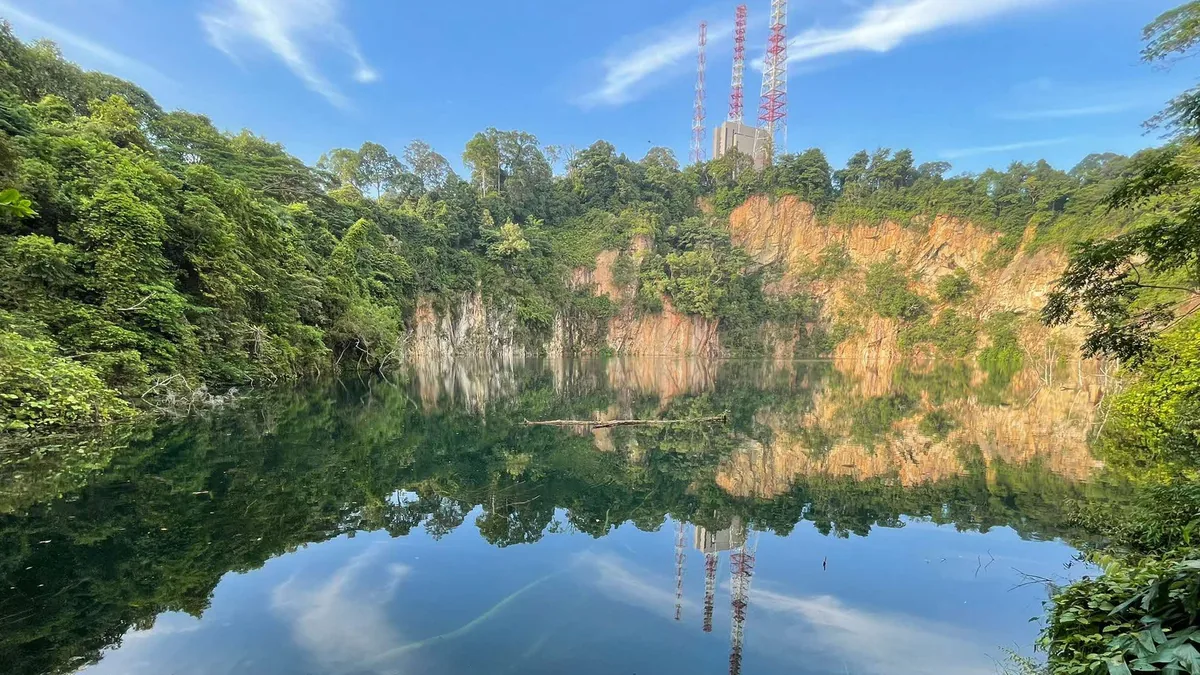
Naturalist Alfred Russel Wallace spent significant time here in the 1850s, collecting thousands of beetle species and documenting a landscape that was rapidly being cleared for pepper and gambier plantations. While most of the island's timber was harvested by the late 19th century, Bukit Timah was saved from the axe because it was declared a forest reserve in 1883. It narrowly escaped being turned into a granite quarry, and even today, the scars of industrial mining are visible in the deep, water-filled pits that have become scenic lakes. During the battle for Singapore in 1942, these slopes were the site of some of the fiercest fighting between Allied and Japanese forces, as the hill offered the only tactical high ground on the island.
The ascent begins on a steep, paved path
The ascent begins on a steep, paved path that quickly tests your calves, but the true magic happens when you veer off onto the unpaved forest trails. You get a temperature drop as the giant dipterocarp trees block out the equatorial sun, creating a permanent twilight on the forest floor. The soil is dark and loamy, often tangled with thick lianas that hang like heavy ropes from the heights. The sudden movement of a Malayan colugo clinging to a trunk or the bright flash of a forest wagtail. At the summit, a modest rock marks the peak, but the real reward is the sensory immersion in a world that feels thousands of years old.
Beauty World MRT station on the Downtown Line
Beauty World MRT station on the Downtown Line is the most convenient rail link. From the station, a ten-minute walk through a residential area leads to the Visitor Centre at the base of the hill. For those driving, the small parking lot fills up by 7:30 AM on weekends, so early arrival or public transport is essential to avoid frustration at the gate.
The Experience
Sweat stings your eyes as you tackle the initial incline, but the sound of the city fades into a rhythmic roar of insects the further you climb. First, the intricate patterns of ferns and mosses that carpet the granite boulders along the path. The place is remarkably still, punctuated only by the occasional heavy thud of a falling fruit or the screech of a macaque defending its territory. Near the Hindhede Quarry, the view of the vertical granite cliffs reflected in the emerald water provides a quiet, almost cinematic stillness.
Why It Matters
This reserve represents the ecological soul of Singapore. It is a rare surviving fragment of the primary tropical rainforest that once defined the Malay Peninsula, serving as a critical refuge for rare fauna and a living laboratory for botanists studying the effects of urban isolation on forest ecosystems.
Why Visit
Visit to escape the glass and steel of the city and realize that Singapore was a jungle long before it was a shipping hub. It is the only place in the country where you can stand among trees that were already old when Raffles first stepped onto the island.
✦ Photo Gallery
Best Season
🌤 January and February are the driest months, making the trails less slippery and the humidity slightly more bearable for the steep climb.
Quick Facts
Best time to visit
January and February are the driest months, making the trails less slippery and the humidity slightly more bearable for the steep climb.
Getting there
In Bukit Timah, Singapore; reach Bukit Timah first, then continue to the site.
What's nearby
Night Safari, Singapore Zoo and Singapore Botanic Gardens are also in the area.
Location
Bukit Timah, Singapore
Type
attraction
Coordinates
1.3528°, 103.7783°
Insider Tips
- 1
Keep all food and plastic bags hidden inside your backpack to avoid aggressive encounters with the local macaque population.
- 2
The Dairy Farm Loop offers a more rugged and less crowded alternative to the main paved summit path.
- 3
Check the weather radar before you start; tropical downpours turn the unpaved trails into muddy streams in a matter of minutes.
- 4
The Visitor Centre has an excellent small museum with a taxidermied tiger that reminds you of the forest's more dangerous past.
- 5
Fill your water bottles at the base, as there are no refreshment points once you leave the Visitor Centre area.