“Inside the very room where Japanese generals once signed their surrender, contemporary artists now hang provocative canvases that challenge the colonial history of the walls themselves.”
About National Gallery Singapore
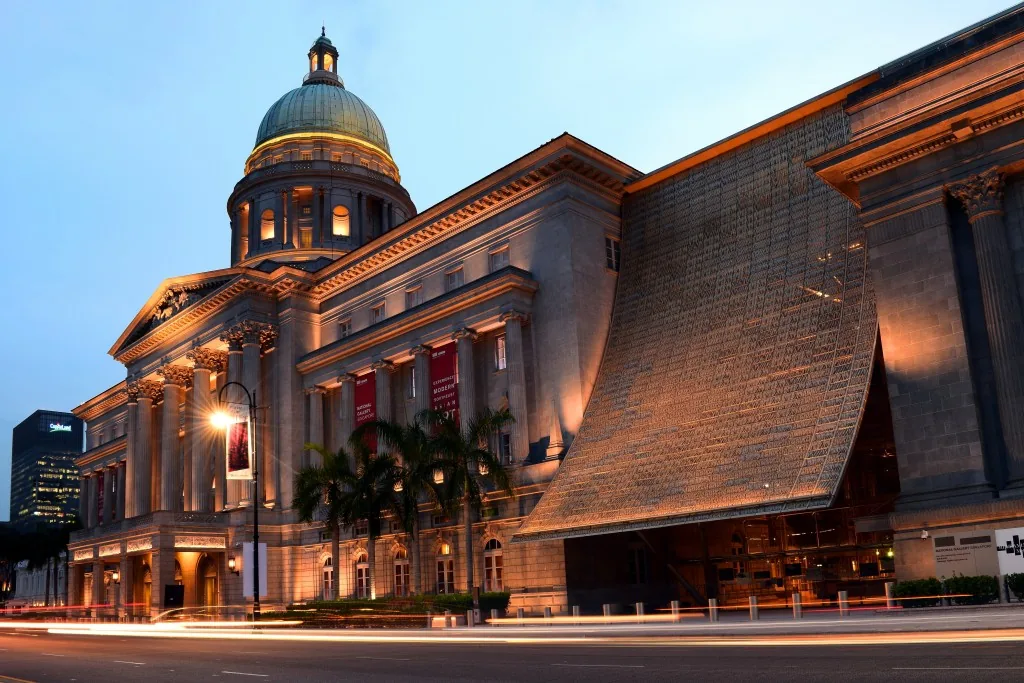
The Supreme Court building was the last major structure of the British era, built on the site of the former Grand Hotel de l'Europe. During the conversion process, architects discovered hidden tunnels and original mosaic floors that had been covered for decades. The unification of the two buildings required a sophisticated roof structure that mimics the weave of a traditional rattan mat, bridging the architectural styles of the 20th and 21st centuries.
National Gallery Singapore in Singapore
Two of the city’s most austere colonial monuments, the former City Hall and Supreme Court, have been fused together by a canopy of golden filigree to house the world’s largest public collection of Southeast Asian modern art. This 64,000-square-meter space is a triumph of adaptive reuse, where wood-paneled courtrooms and jail cells now serve as galleries for avant-garde paintings. The architecture itself is a dialogue between the heavy stone of the British Empire and the light, airy glass of contemporary Singapore. It sits overlooking the Padang, the grassy field where the nation's independence was once proclaimed, standing as a guardian of the region’s complex visual history.
This 64,000-square-meter space is a triumph of adaptive reuse, where wood-paneled courtrooms and jail cells now serve as galleries for avant-garde paintings.
Hall was completed, 1929
City Hall was completed in 1929 and the Supreme Court in 1939, marking the final flourish of British neoclassical architecture in the city. These buildings witnessed the surrender of the Japanese in 1945 and the swearing-in of Lee Kuan Yew as the first Prime Minister in 1959. In the mid-2000s, the government decided to convert these administrative hubs into a world-class art museum. Studio Milou Architecture won the design contract, proposing a 'veil' made of glass and aluminum that would link the two buildings while preserving their historical integrity. The gallery opened in 2015, timed perfectly for the nation’s 50th anniversary.
You enter through a massive basement
You enter through a massive basement concourse that leads up into the soaring atriums where the original stone facades are still visible. The setting is quiet and smells faintly of beeswax and floor polish, a stark contrast to the humid bustle of the city outside. Passing through the link bridges, you can look down at the massive Corinthian columns that once intimidated legal defendants. The galleries themselves are a path through the evolution of regional identity, from pastoral landscapes to gritty, political installations. On the rooftop, the view opens up to the Padang and the skyline, offering a moment of reflection before you dive back into the exhibits.
City Hall MRT station
City Hall MRT station is the primary gateway, connected via a short walk through an air-conditioned underground passage. Several buses stop directly in front of the building along St. Andrew’s Road. For those coming from the riverfront, the gallery is a five-minute walk from the Asian Civilisations Museum, making it easy to combine multiple cultural stops in a single afternoon.
City Hall MRT station is the primary gateway, connected via a short walk through an air-conditioned underground passage.
The Experience
Your footsteps echoes against the marble of the Supreme Court Wing, where the original judge's benches still stand in some galleries. A sense of solemnity in the Rotunda Library, with its domed ceiling and stacks of legal texts, before transitioning into the vibrant, light-filled spaces of the City Hall Wing. The rooftop garden provides a sudden burst of green and a perspective on the city that feels both intimate and grand.
Why It Matters
This isn't just an art museum; it is a repository of the Southeast Asian psyche. By housing works from Indonesia, Vietnam, and Thailand alongside Singaporean art, it positions the city as the intellectual and cultural crossroads of the region, moving beyond its reputation as merely a financial hub.
Why Visit
Visit to see the friction between the past and the present. You can literally stand in a prisoner's dock one minute and witness a radical feminist installation the next, all within a building that is arguably the most beautiful example of heritage preservation in Asia.
✦ Insider Tips
- 1
Join the free 'Building Highlights' tour at 11:00 AM to see the holding cells and the private chambers of the former Chief Justice.
- 2
The Ng Teng Fong Roof Garden Gallery often features a single, massive installation that changes annually and is free to the public.
- 3
Visit the Keppel Centre for Art Education if you have children; it offers some of the most sophisticated interactive art spaces in the city.
- 4
The Rotunda Library & Archive is a quiet, hidden spot perfect for reading and escaping the main gallery crowds.
- 5
Check the basement level for a small, well-curated shop that sells local design objects you won't find in the airport.