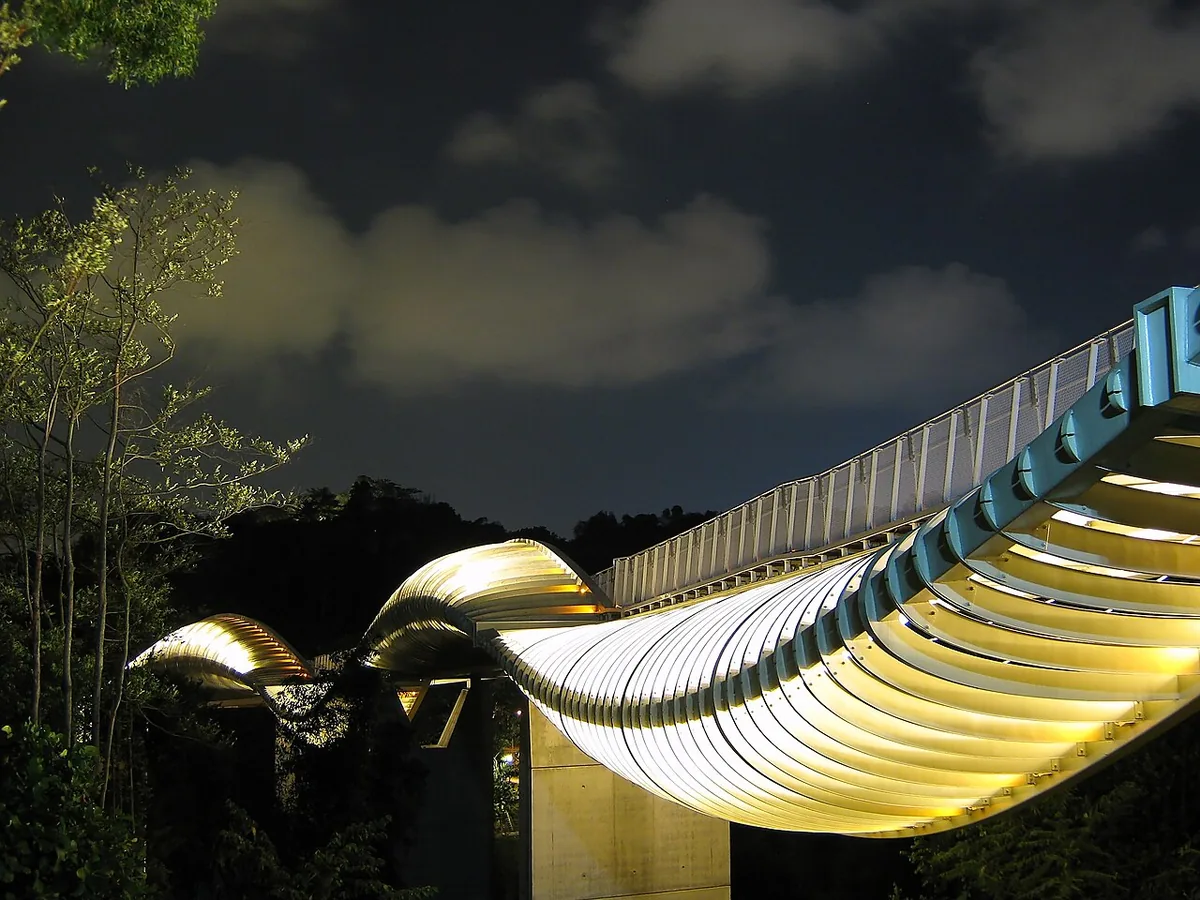
Thirty-six meters above the asphalt, seven giant steel waves wrapped in tropical timber allow you to walk among the treetops without ever touching a leaf.
About Henderson Waves
The bridge was a key component of the 'Parks & Waterbodies Plan' introduced in 2002 to make the city's natural assets more accessible. Engineers had to carefully hoist the massive steel ribs into place without damaging the fragile forest ecosystem of the surrounding ridges. Since its opening, it has become a case study for architects worldwide on how to create functional infrastructure that also serves as a public art installation and a sanctuary for urban wildlife.
What Henderson Waves is
Suspending pedestrians thirty-six meters above the forest floor, this sculptural bridge is the highest pedestrian walkway in the nation. It undulates in a series of seven curved steel 'ribs' that mimic the rhythmic pulse of a wave, spanning 274 meters between Mount Faber Park and Telok Blangah Hill Park. The structure is clad in Balau wood, a heavy-duty timber that adds a warm, organic texture to the futuristic design. It is a critical link in the Southern Ridges trail, a nine-kilometer green corridor that allows you to walk through the jungle canopy while remaining safely above the traffic of Henderson Road.
“Suspending pedestrians thirty-six meters above the forest floor, this sculptural bridge is the highest pedestrian walkway in the nation.”
Henderson Waves, Singapore
Singapore’s Urban Redevelopment Authority commissioned
Singapore’s Urban Redevelopment Authority commissioned the bridge as part of a larger initiative to connect the city's fragmented green spaces into a continuous 'Ridge-to-Ridge' experience. Designed by IJP Corporation and RSP Architects, the bridge was completed in 2008 and immediately won acclaim for its innovative engineering. The designers wanted to create more than just a crossing; they intended the 'waves' to function as sheltered seating areas where people could rest and observe the forest. The use of sustainable timber and the careful integration into the existing tree line demonstrated a new approach to urban infrastructure that prioritized both aesthetics and the environment.
The air feels noticeably fresher at this height
The air feels noticeably fresher at this height, catching the breeze that rolls off the nearby southern coast. From somewhere comes the muffled roar of cars far below, but the sound is largely masked by the rustle of leaves and the occasional song of a bulbul. The wooden slats underfoot provide a soft, natural sound walking, a contrast to the hard concrete of the city. Within the 'folds' of the waves, joggers stretching and couples sitting on the built-in benches, watching the sunset. As night falls, the bridge is illuminated by thousands of LED lights that highlight its sinuous form, making it appear like a glowing ribbon draped across the dark jungle.
HarbourFront MRT station is the most
HarbourFront MRT station is the most common starting point; from there, you can take a bus to the base of Mount Faber or ride the cable car to the summit and walk down. For a direct approach, several bus services stop along Henderson Road right beneath the bridge, where a steep set of stairs leads you directly up to the walkway. If you prefer a longer hike, start at the Kent Ridge Park and follow the Southern Ridges trail toward the bridge.
“HarbourFront MRT station is the most common starting point; from there, you can take a bus to the base of Mount Faber or ride the cable car to the summit and walk down.”
The Experience
You feel a slight, rhythmic vibration in the timber when a group of joggers passes, a trace of the bridge's flexible engineering. The light at 7:00 PM is particularly beautiful, as the sun dips below the horizon and the yellow LED lights begin to glow within the wooden alcoves. The way the bridge frames the silhouette of the Keppel shipyards and the distant islands, offering a panoramic view that shifts from industrial to natural as you turn your head. It is a place where the city's geometry feels strangely at peace with the chaos of the jungle.
Why It Matters
This landmark is a symbol of Singapore's commitment to being a 'City in a Garden.' It proves that urban connectivity doesn't have to be utilitarian; it can be an aesthetic experience that encourages people to engage with the natural world even in a densely populated metropolis.
Why Visit
The view and the architecture, but stay for the quiet. It is one of the few places in the city where you can be surrounded by modern design while feeling completely detached from the urban grind, floating somewhere between the canopy and the clouds.
Insider Tips
- 1
Bring a mosquito repellent if you plan to sit in the wooden alcoves after dusk, as the surrounding forest is active at night.
- 2
The bridge is illuminated from 7:00 PM to 7:00 AM every night, making it an excellent spot for late-night strolls when it is less crowded.
- 3
Start your walk from the Mount Faber side to enjoy a mostly downhill path toward the bridge.
- 4
Look for the interpretive signs along the trail that identify the various species of birds and plants visible from the walkway.
- 5
There are no restrooms on the bridge itself, so use the facilities at Mount Faber or Telok Blangah Hill Park before you start the crossing.