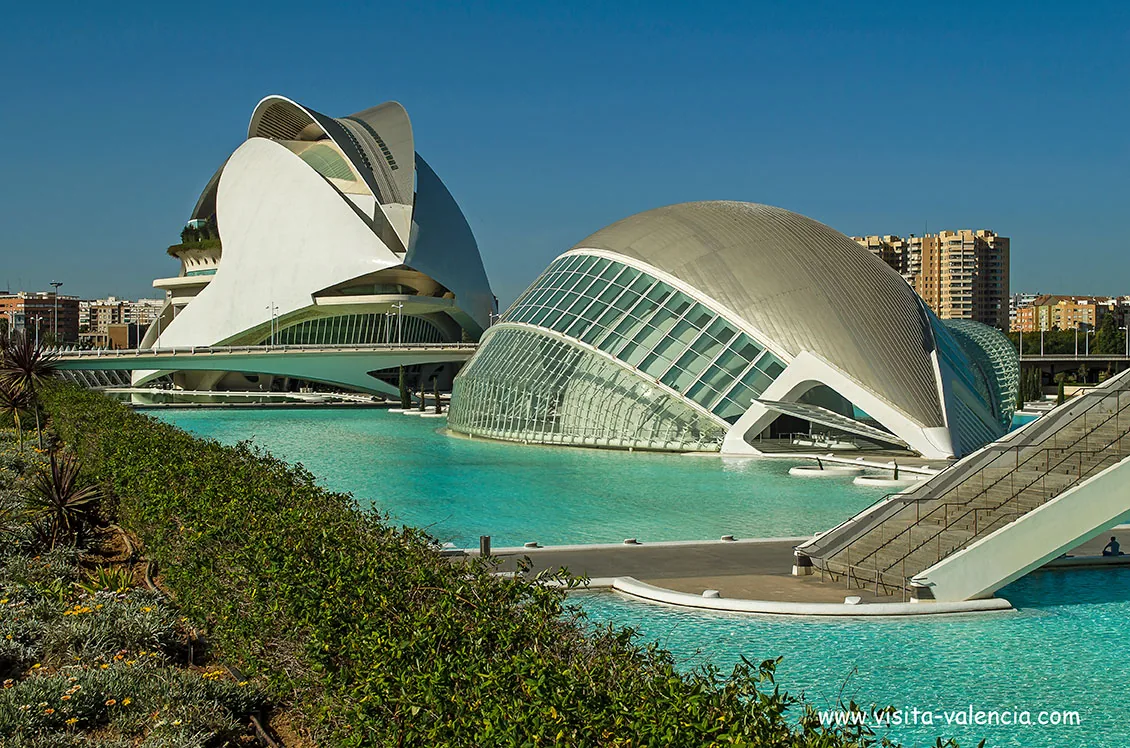
This sci-fi cultural complex was built in the dry bed of a river that was diverted after a deadly flood.
About Ciudad de las Artes y las Ciencias
After a devastating flood in 1957, Valencia diverted the Turia River and turned its old bed into a park. From 1998, the City of Arts and Sciences rose along this corridor, a series of avant-garde buildings designed chiefly by the Valencian architect Santiago Calatrava. It became the city's signature project, housing a science museum, planetarium, opera house, aquarium and gardens in dramatic modern form.
Overview
The City of Arts and Sciences in Valencia is a vast, futuristic complex of museums and cultural buildings, a gleaming ensemble of white concrete and glass set in the drained bed of the old Turia River. Designed largely by the architect Santiago Calatrava, its sculptural, organic forms have made it the modern icon of Valencia and one of Spain's most striking pieces of contemporary architecture.
A Future City in a Dry Riverbed
The complex was built from the late 1990s in the bed of the Turia, a river diverted after a catastrophic flood, leaving a long green park through the city. Calatrava and Felix Candela designed its dramatic structures, including a science museum resembling a whale skeleton, an opera house like a cresting wave, and the Hemisferic, a planetarium and cinema shaped like a giant human eye that appears to blink over a reflecting pool. Together they form a surreal, sci-fi cityscape.
The Experience
You wander among soaring white structures reflected in shallow blue pools, exploring the interactive science museum, the eye-shaped Hemisferic planetarium, the Oceanografic aquarium, Europe's largest, and the wave-like opera house, the whole complex feeling like a city of the future. The sculptural architecture, especially striking at sunset and when lit at night, makes it a draw for photographers and a fun, family-friendly cultural destination.
Why It Matters
The City of Arts and Sciences is the emblem of modern Valencia and one of the most ambitious contemporary architectural complexes in Europe. Combining science, art and spectacular design in a reclaimed riverbed, it showcases Spanish creativity and has become a major cultural and tourist landmark.
Why Visit
Valencia's futuristic City of Arts and Sciences, a stunning complex of avant-garde white buildings, a science museum, planetarium and Europe's largest aquarium.
✦ Photo Gallery
Best Season
🌤 Valencia is pleasant much of the year, with hot summers. The complex is striking by day and beautifully lit at night; sunset offers the best light for photos.
Quick Facts
Best time to visit
Valencia is pleasant much of the year, with hot summers. The complex is striking by day and beautifully lit at night; sunset offers the best light for photos.
Getting there
In Valencia, Spain; reach Valencia first, then continue to the site.
Location
Valencia, Spain
Type
attraction
Insider Tips
- 1
See the eye-shaped Hemisferic planetarium over its pool.
- 2
The white architecture is stunning at sunset and lit at night.
- 3
It sits in the green park of the old Turia riverbed.