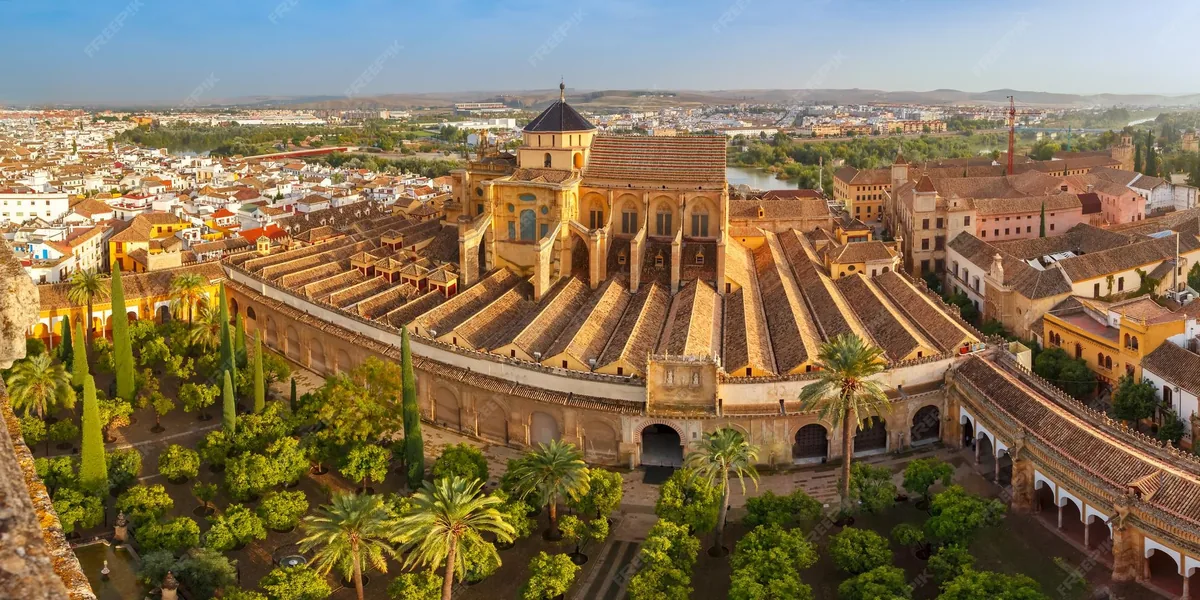
After conquering the city, Christians built an entire cathedral directly inside this great mosque's forest of arches.
About Mezquita-Catedral de Córdoba
The great mosque was begun in 785 under the Umayyad rulers of Al-Andalus and expanded over the following centuries into one of the largest and most splendid mosques in the world, the heart of Cordoba's golden age. After Cordoba fell to Christian forces in 1236, it was consecrated as a cathedral, and a Renaissance choir and nave were controversially built into its centre in the 1500s. It is now a UNESCO World Heritage Site.
The Mosque-Cathedral of Cordoba is one of the most extraordinary buildings in the world, a vast former great mosque famous for its striking forest of red-and-white striped arches, with a Christian cathedral built into its very centre. A UNESCO World Heritage Site, it embodies the layered religious history of Spain across more than a thousand years.
A Cathedral Inside a Mosque
Built from the 8th century as the great mosque of Cordoba, then capital of Muslim Spain, the building is famous for its hall of over 800 columns of jasper, marble and granite, supporting double-tiered horseshoe arches striped in red brick and white stone. After the Christian reconquest of the city in 1236, the mosque was converted into a cathedral, and in the 16th century a full Renaissance cathedral nave was inserted into the middle of the arch-filled hall, creating a unique fusion of Islamic and Christian architecture.
The Experience
Entering, the dim, vast hypostyle hall and lose yourself among the endless rows of red-and-white striped arches stretching in every direction, then come upon the soaring Christian cathedral rising incongruously from the centre. The richly decorated mihrab prayer niche glitters with gold mosaic. The juxtaposition of the Islamic arch-forest and the Christian nave makes the building a singular and moving record of Spain's intertwined faiths.
Why It Matters
The Mosque-Cathedral of Cordoba is one of the greatest monuments of Islamic architecture and a unique symbol of the religious and cultural history of Spain, where Muslim and Christian worlds met. A UNESCO World Heritage Site, it is among the most beautiful and historically significant buildings in Europe.
Why Visit
One of the world's most remarkable buildings, a vast former mosque of striped arches with a cathedral built into its centre, in Cordoba.
✦ Photo Gallery
Best Season
🌤 Cordoba is intensely hot in summer; spring and autumn are ideal. Early morning offers cooler temperatures and softer light through the arch-filled hall.
Quick Facts
Best time to visit
Cordoba is intensely hot in summer; spring and autumn are ideal. Early morning offers cooler temperatures and softer light through the arch-filled hall.
Getting there
In Córdoba, Spain; reach Córdoba first, then continue to the site.
Location
Córdoba, Spain
Type
attraction
Insider Tips
- 1
Wander the forest of red-and-white striped arches.
- 2
Find the gold-mosaic mihrab prayer niche.
- 3
See the Renaissance cathedral built into the centre.
- 4
Visit early to beat the heat and the crowds.